Bunny Stream vs VSLStats
Bunny is the cheapest reliable delivery if you will build the funnel yourself; VSLStats is a purpose-built VSL tracker, if you are willing to pilot a brand-new tool.
By Marcus Vale, Lead reviewer. Reviewed by the VSLBench editorial desk. Last updated 23 September 2026, and rechecked with prices every 90 days.
You are down to two, and it is easy to feel stuck, because Bunny Stream and VSLStats are barely the same kind of product. One is a bare delivery network you build a player and everything else on top of. The other is a finished, brand-new VSL player that tries to do the whole direct-response job, tracking and all, in one embed. Lining up their feature lists side by side hides that gap rather than showing it.
This page sets out what each one actually is, what it costs once your traffic grows, and where each one falls short for a paid-traffic sales letter. We read both vendors' own pricing and feature pages and weighed what long-term users report, and we judged them on the thing this whole site judges: whether the video can prove it made the sale.
Quick answer
Pick Bunny Stream if you want the cheapest, most reliable way to host and deliver video, you have a developer or a plugin like Presto Player to build the player and gating on top, and you already have your sales tracking solved elsewhere; pick VSLStats if the whole reason you are choosing is to track a paid-traffic sales letter in one embed, with server-side pixels and revenue attribution Bunny does not attempt, and you are willing to pilot a brand-new tool on a card you can cap, watching for its inflated progress bar and non-refundable terms before you trust it with a live offer.
One more name belongs on the table. VSLStats is chasing the job Bunny leaves untouched, the conversion tied to the actual sale, but its proof is thin and one of its features inflates the progress bar on purpose. That job has a specialist that settles it on the cart, TrackPlay, and we line it up beside the two below.
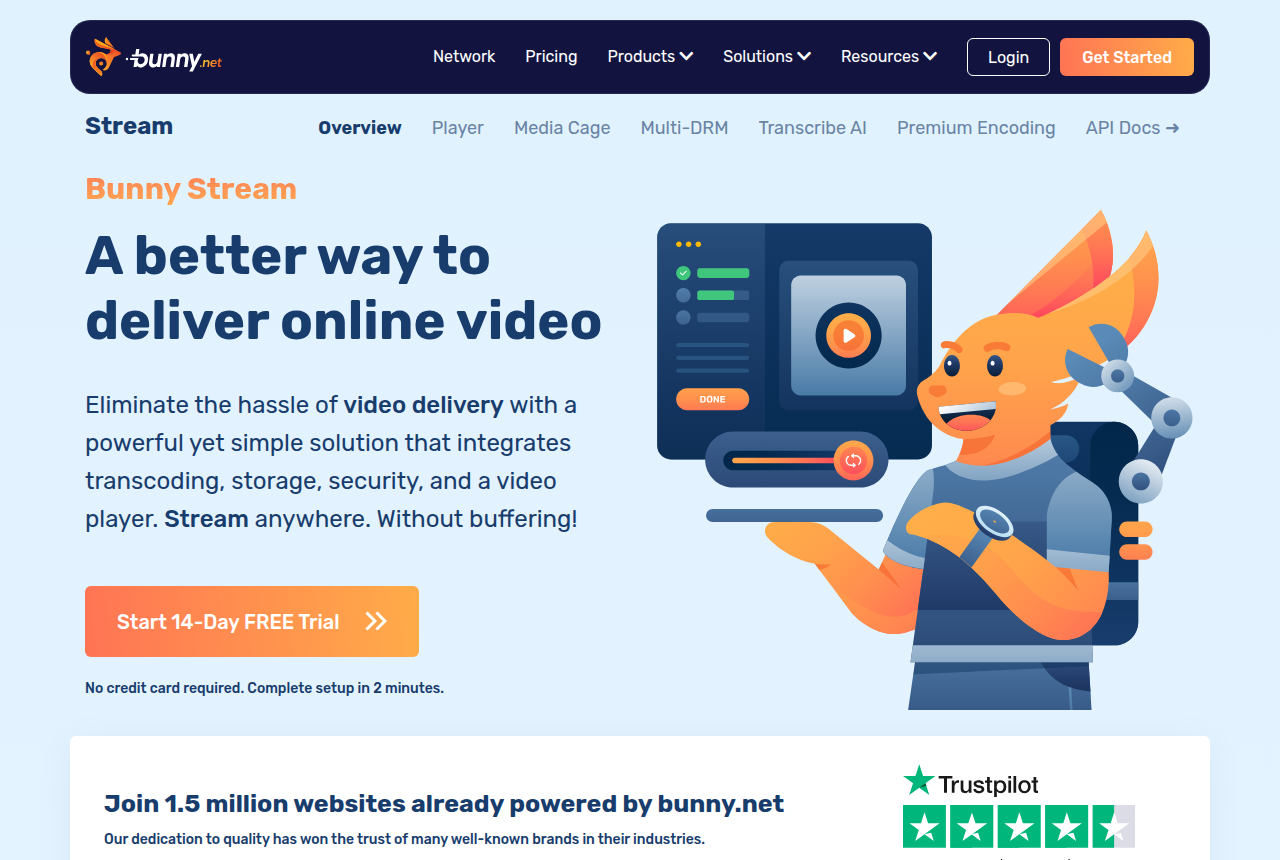
- Bunny Stream. Raw, usage-based video infrastructure. Encoding, the HLS player and security are free, and you pay only for storage and delivery, so a small library runs to a few dollars a month. There is no VSL player, gating, pixels or sale tracking; you build the marketing and conversion layer on top with a plugin like Presto Player.
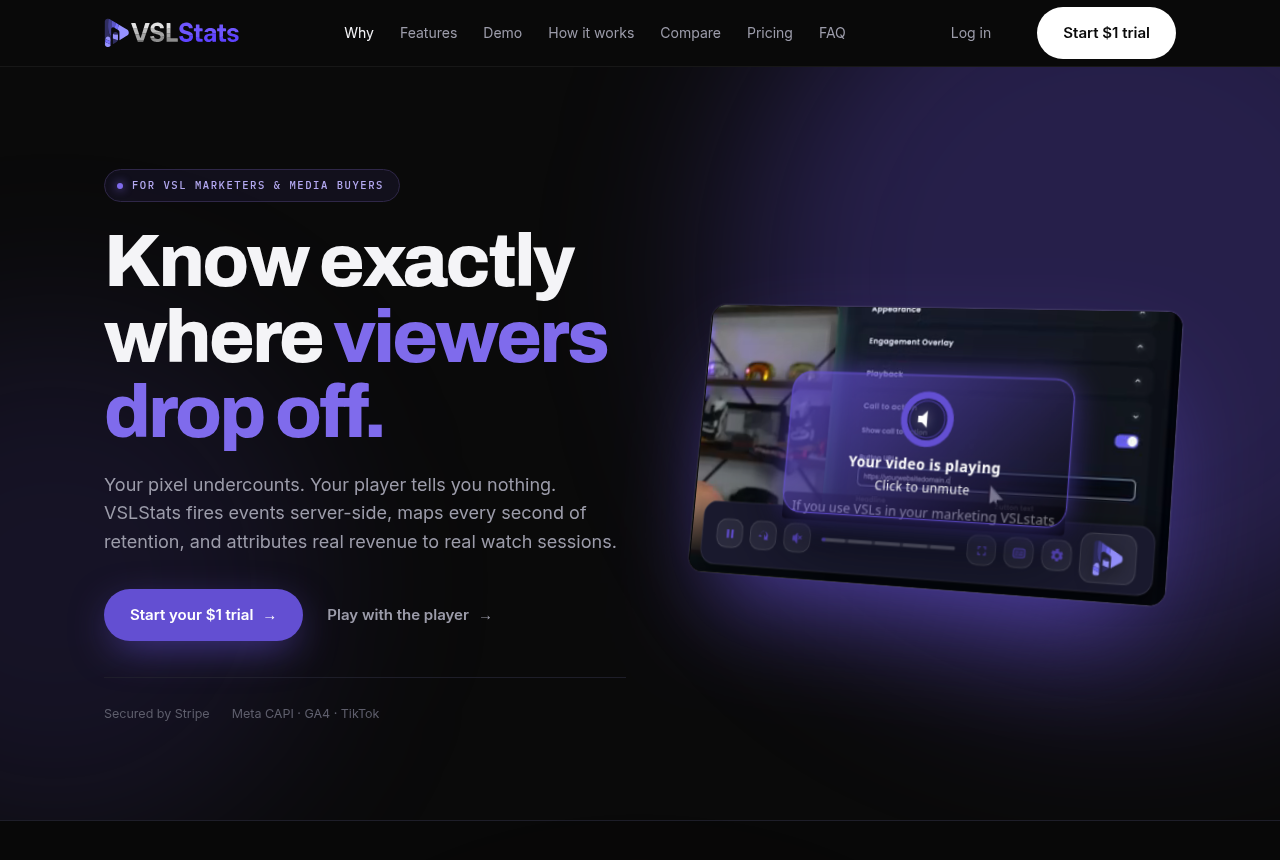
- VSLStats. A brand-new VSL player aimed straight at the tracking problem: server-side Meta, TikTok and GA4 events, second-by-second retention and revenue attribution in one branded embed with play gates and timed CTAs, from $47 a month. On paper it does the whole direct-response job; in practice it launched in March 2026 with almost no independent proof and some patterns worth weighing.
- TrackPlay. A VSL player and analytics platform built for paid-traffic funnels. It decides split tests on the cart-verified sale and posts that sale back to Meta, TikTok and GA4 server-side, the attribution job Bunny does not attempt and VSLStats claims but has not yet proven.
Bunny Stream vs VSLStats at a glance
Prices and plan features checked on the vendors' own pages on 23 September 2026. TrackPlay is the direct-response specialist we line these two up against, so it wins the conversion rows and sits out the general-hosting ones.
| Feature | Bunny Stream | VSLStats | TrackPlay |
|---|---|---|---|
| What it is | Usage-based video hosting and delivery | A brand-new VSL player and analytics tool | A paid-traffic VSL player and attribution platform |
| Built for | Cheap, reliable delivery you build on | Tracking a paid-traffic VSL in one embed | Tying every play to the cart-verified sale |
| Starting price | Usage-based, ~$1/mo minimum | $47/mo ($39 billed annually) | $29/mo, billed by plays |
| Free tier | No, 14-day trial (no card) | No, $1 7-day trial (card required, auto-renews) | Yes, no-card free plan (1,000 plays/mo, watermarked) |
| VSL player | No, bare HLS player; build the hooks yourself | Yes, branded player with play gates and timed CTAs | Yes, sound-first autoplay, timed CTAs, watch gates |
| A/B testing | No | On the Pro tier, not clearly scored on sales | Yes, decided on the cart-verified sale |
| Ad-platform tracking | No (build your own) | Server-side to Meta, TikTok and GA4 (vendor claim) | Server-side to Meta, TikTok and GA4 |
| Retention analytics | Basic play and bandwidth stats | Second-by-second retention heatmaps | Per-second, split by buyers vs non-buyers |
| Revenue attribution | No | Per watch session (vendor claim) | Yes, revenue per play plus cart postbacks |
| Content protection | Token auth, hotlink protection, watermark | Branded player, access controls | Domain-locked hosting, access controls |
| Track record | Established infrastructure, large network | Launched March 2026 | Very new, invite-only |
| Independent English reviews | Mixed developer feedback, no G2 or Capterra base | Almost none: four invited Trustpilot reviews | Very new, thin outside proof |
| Notable pattern | Files-missing thread; back up your masters | HookBoost inflates the progress bar on purpose | No inflated bar; tests settled on the sale |
| Delivery network | 250 Tbps, 119 points of presence | Hosted delivery | Hosted delivery, billed by plays |
| Pricing model | Pay-as-you-go: $0.01/GB storage, $0.005/GB delivery | Flat plans from $47/mo, tracking on Pro at $97 | Billed by plays, every feature on every plan |
| Best for | Developers wanting cheap, scalable delivery to build on | Marketers who need DR tracking in one embed and will pilot a new tool | Paid-traffic VSLs measured on the cart-verified sale |
Strengths and trade-offs
The two barely overlap. Bunny's strengths are cheap, reliable, proven delivery; its weakness is that it does none of the direct-response job. VSLStats's strength is that it is built for that exact job in one embed; its weaknesses are proof and trust, because it is three months old.
Bunny Stream: what works, what to watch
What works
- Usage-based pricing: encoding, the player and security are free, and you pay only for storage from $0.01/GB and delivery from $0.005/GB
- Fast global delivery on a 250 Tbps network with 119 points of presence
- Customizable HLS player, watermarking, hotlinking protection and token authentication are built in
- Resumable, API-first uploads that pair cleanly with players like Presto Player or Vidstack
What to watch
- No direct-response conversion tools: no sales-scored A/B tests, no watch-depth pixels, no revenue attribution, so a paid-traffic VSL has to add all of that on top
- Long-term users report uneven HLS start-up time and low cache hits on some accounts
- A widely-read thread alleged files disappearing from Bunny Storage, so keep original masters backed up elsewhere
- Usage-based bills scale with traffic, so a viral VSL costs more than the few-dollar examples suggest
VSLStats: what works, what to watch
What works
- It targets the gap most hosts leave open: server-side Meta CAPI, GA4 and TikTok forwarding, plus revenue attribution back to individual watch sessions, so in principle you see which traffic bought, not just who pressed play
- A complete VSL toolkit in one embed: second-by-second retention heatmaps, play gates, timed CTAs, AI captions and a fully brandable player, with no Zapier or tag manager
- You can drive the real player before paying: the site's interactive demo toggles every control live, and a $1, 7-day full-access trial promises a 24-hour warning email before the first charge
- Flat, public pricing that undercuts a dedicated VSL player: from $47 a month ($39 billed annually), Pro at $97, with the server-side forwarding and revenue attribution on the Pro tier
What to watch
- Almost no independent proof yet: it launched in March 2026, its Trustpilot profile holds just four reviews, all five-star, from a company that invites reviews, and there is next to no Reddit or forum track record to check
- A 40% recurring, lifetime-cookie affiliate program means much of the praise you find online is paid, so discount any glowing review that shows no data of its own
- HookBoost, a headline feature, deliberately inflates the progress bar so viewers believe they are further along than they are. It is an openly manipulative pattern that can be a compliance problem in regulated markets, so weigh it before you switch it on
- The $1 trial needs a card and auto-renews, and the terms make fees non-refundable except where law requires, disclaim any conversion or revenue lift, and put the GDPR controller burden on you
- None of the headline tracking claims (CAPI deduplication, attribution accuracy, reliability at ad scale) can be verified from outside yet, so you are the one testing them. Pilot on a non-critical funnel and reconcile against Stripe and Meta before you migrate a proven offer
TrackPlay: the paid-traffic VSL pick
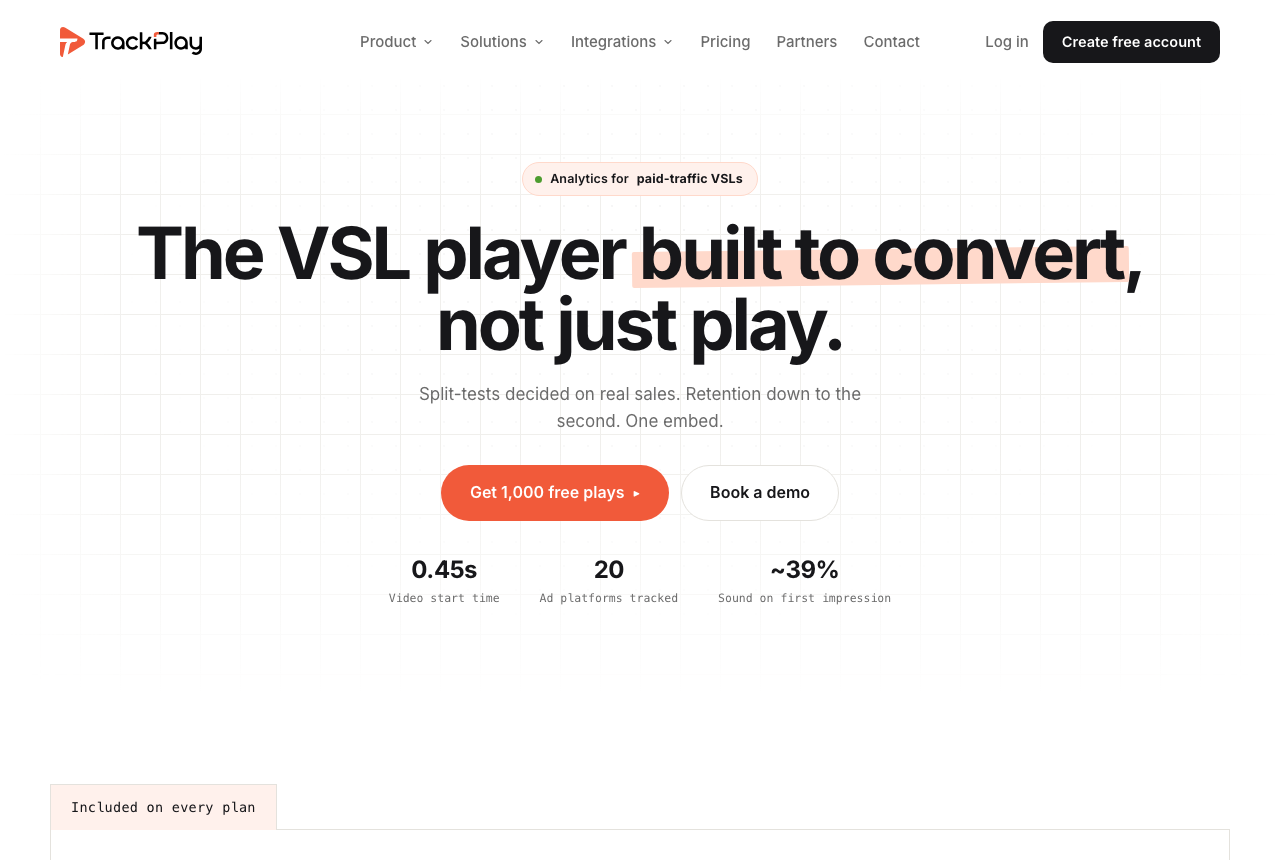
If you landed on Bunny Stream versus VSLStats because you run paid traffic to a video sales letter and you want the conversion tracked and tied to the sale, that is the exact job TrackPlay is built for, and it is the reason to weigh a third name. It is a VSL player and analytics platform for paid-traffic funnels: sound-first autoplay, timed CTAs and watch gates on the front end, and per-second retention split into buyers and non-buyers, with hook rate, hold rate and revenue per play, on the back end, so you can see the exact seconds to cut or protect.
Where it goes further than either of these is where the conversion lands and how it is verified. Bunny reports bandwidth and nothing about the sale; VSLStats claims to forward events server-side but has not proven it from outside. TrackPlay goes to the cart. The actual sale posts back onto the play that earned it, server to server, from seven direct-response carts including ClickBank, ClickFunnels and Digistore24, and TrackPlay fires that conversion to Meta, TikTok and GA4 on the watch-time milestone you choose, deduping browser and server events. Its split tests are decided on that cart-verified sale with real statistics, a z-test with a p-value and a confidence interval, and every variant runs under one embed so your ad links and campaign learning never reset. It bills by plays rather than bandwidth, every feature ships on every paid plan, and there is a no-card free plan of 1,000 plays a month plus a 14-day trial, with paid plans from $29 a month.
What works
- Split tests are decided on the cart-verified sale, with a real z-test, p-value and confidence interval, and every variant runs under one embed so ad links and campaign learning never reset
- Server-side conversion tracking to Meta, TikTok and GA4 fires on the watch-time milestone you choose and dedupes browser and server events, so the ad platform optimizes on the actual sale rather than a page-load pixel
- Cart postbacks tie each sale to the play that earned it from seven direct-response carts, including ClickBank, ClickFunnels and Digistore24, server to server
- Per-second retention split into buyers and non-buyers, with hook rate, hold rate and revenue per play
- Every feature ships on every paid plan and billing is by plays, with a no-card free plan of 1,000 plays a month and a 14-day trial; paid plans start at $29 a month
What to watch
- Narrow by design: built for paid-traffic VSL conversion, it is not a general video host or a B2B content library, so it has none of the channels, SEO pages or webinar tooling of a Wistia and is a poor fit if the video's job is content marketing rather than a direct-response sale
- Very new, with thin outside proof: the testimonials are on its own site, there is little third-party review or Reddit footprint yet, and signup is currently invite-only, so you cannot lean on independent validation before you commit paid traffic. That is what you would expect of a platform this recent
Where TrackPlay is not the answer
It is narrow by design. TrackPlay is built for paid-traffic VSL conversion, not general hosting, so it is not a video host or a B2B content library and it has none of the channels, SEO pages or webinar tooling of a Wistia. If the video's job is content marketing and feeding a CRM rather than a direct-response sale, it is the wrong tool. It is also not a raw delivery pipe, so if all you need is the cheapest way to host and embed a file and you will build the rest yourself, Bunny is cheaper for that job. And it is very new, with thin outside proof: the testimonials are on its own site, there is little third-party review footprint yet, and signup is currently invite-only, which is what you would expect of a platform this recent. Unlike VSLStats it runs no inflated progress bar and its split tests are settled on the verified sale, but it earns the same advice: pilot it on one funnel and reconcile against your own cart before you trust it with a launch.
Visit TrackPlay for the current plans and the free tier.
Pricing, tier by tier
Bunny Stream bills for what you use and nothing else. Encoding, the player, watermarking, token security and hotlink protection are all free; you pay $0.01 a gigabyte for storage and delivery from $0.005 a gigabyte, tiered down as volume grows, with a roughly $1 a month minimum. A small library on modest traffic can run to a few dollars a month, and there is a 14-day trial that needs no card. The flip side of usage pricing is that a viral sales letter costs more than the few-dollar examples suggest, because the bill scales with every gigabyte served.
VSLStats sells flat, public plans, from $47 a month, or $39 a month billed annually, with Pro at $97. The server-side pixel forwarding and revenue attribution that are its entire reason to exist sit on that Pro tier, so the number to compare is $97, not $47. There is no free plan; the way in is a $1, 7-day full-access trial that needs a card and auto-renews into a paid plan. The terms make fees non-refundable except where law requires, disclaim any conversion or revenue lift, and put the GDPR controller burden on you, so read them before you enter a card, and use one you can cap.
So which is cheaper depends on what you are actually buying. On the sticker Bunny wins by a wide margin, because a few dollars of usage beats $47 a month. But the two are not paying for the same thing: Bunny hands you the file and a bare player, while VSLStats bundles the whole VSL player, gating, tracking and analytics layer you would otherwise assemble on top of Bunny. Count what you would have to add to Bunny, and maintain, before you call it the cheaper option.
That build cost is the hidden line on the Bunny side the sticker does not show. The player, gating, timed CTAs, pixels and analytics you get inside VSLStats, you assemble and run yourself on Bunny, usually with a plugin like Presto Player or Vidstack plus whatever you bolt on for tracking. For a team with a developer that is a weekend of work and then it is cheaper forever. For a non-technical seller it is extra tools, extra integration and a stack you have to keep working, and the engineering you save by buying a finished tool is often worth more than the per-gigabyte gap.
There is also the question of what the money buys you in confidence. Bunny is proven infrastructure with years behind it; VSLStats is three months old, and the Pro tier you are paying $97 for carries the exact claims, server-side deduplication, attribution accuracy, reliability at ad scale, that nobody outside the vendor has verified. You are paying to test them. That is not a reason to rule it out, but it is a reason to pilot on a non-critical funnel and reconcile the numbers against your own Stripe and Meta dashboards before you migrate a proven offer.
TrackPlay prices on a third model, and it is worth a line because it changes the maths. It bills by plays rather than storage, bandwidth or seats, so a high-traffic sales letter is metered on views watched, not gigabytes served or a flat monthly fee, and every feature ships on every paid plan. Paid plans start at $29 a month, there is a no-card free plan of 1,000 plays a month, watermarked, and a 14-day trial of the paid features. Bunny is cheapest at the door and VSLStats bundles the DR toolkit for $47, but TrackPlay's case is that it does the cart-verified attribution work while it settles its split tests on the actual sale, without an inflated progress bar or a non-refundable card.
The verdict
Pick on which job comes first, because these two barely overlap. For this site's core reader, someone whose whole business is a paid-traffic sales letter, VSLStats is the one of the two built to do the job we judge on: proving the video made the sale. It puts a branded VSL player, second-by-second retention, play gates, timed CTAs and, on paper, server-side pixels and revenue attribution into one embed, from $47 a month. Bunny does none of that. But the win comes with conditions you should not skip. VSLStats launched in March 2026 with four invited Trustpilot reviews, a 40 percent affiliate program behind much of its online praise, a HookBoost feature that inflates the progress bar on purpose, and terms that refund nothing and guarantee nothing. Treat it as a tool to pilot on a non-critical funnel with a card you can cap, reconciling its numbers against your own Stripe and Meta dashboards, not a migration to run on sight.
Bunny Stream wins the other reader entirely: the one who wants the cheapest, most reliable delivery to build on, or who already has tracking solved and just needs a fast, cheap pipe. Its player, encoding and security are free, you pay a cent a gigabyte for storage and half that for delivery on a 250 Tbps network, and at heavy traffic that pay-as-you-go rate undercuts any flat plan. The cost is that it is infrastructure, not a product: there is no VSL player, no gating, no pixels and no sale tracking, so you add the marketing and conversion layer yourself with a plugin like Presto Player. Long-term users also flag uneven HLS start-up on some accounts and a widely-read thread alleging files went missing from Bunny Storage, so keep your masters backed up. If you have a developer and the traffic to justify it, Bunny is cheaper and it scales.
There is a cleaner call for one specific reader. If the cart-verified sale is what you actually came to prove, and VSLStats's unverified claim and inflated progress bar give you pause, look at TrackPlay before you commit. It settles split tests on the sale with real statistics and posts that sale back to Meta, TikTok and GA4 server-side, the same job VSLStats claims but without the dark pattern. It is as new as VSLStats and thin on outside proof, so pilot it the same way. If all you need is the cheapest delivery to build on, this does not change the answer: that is Bunny.
Our pick
VSLStats
VSLStats is the conditional pick for the reader down to these two whose whole business is a paid-traffic VSL, because of the pair it is the only one built to prove the sale: a branded player with play gates and timed CTAs, second-by-second retention, and, on paper, server-side Meta, TikTok and GA4 forwarding with revenue attribution, in one embed from $47 a month. Bunny does none of that. The honest limits stay attached: it launched in March 2026 with four invited reviews, a 40 percent affiliate program behind much of its praise, a HookBoost feature that inflates the progress bar on purpose, and terms that refund nothing, so pilot it on a non-critical funnel before you trust it with a launch. If you would rather build on the cheapest reliable delivery and have your tracking solved elsewhere, Bunny Stream is the cheaper, more proven pipe.
Frequently asked questions
Is Bunny Stream or VSLStats better?
Which is cheaper, Bunny Stream or VSLStats?
Can Bunny Stream run a video sales letter for paid traffic?
What is HookBoost, and should VSLStats's newness worry me?
Is Bunny Stream reliable enough for a business?
What if I need to prove which paid traffic actually bought, tied to the cart?
Sources
Other sources
10 discussions and reviews read for this page. Quotes are excerpts; open a link to read the original in context.
- [] Bunny Stream home (vendor)
- [] Bunny Stream pricing (vendor)
- [] VSLStats home (vendor)
- [] VSLStats changelog (vendor)
- [] VSLStats affiliate program (vendor)
- [] VSLStats terms (vendor)
- [] TrackPlay (vendor)
- [] Files going missing from Bunny Storage (r/webdev)
- [] Slow HLS start-up on Bunny (r/webhosting)
- [] VSLStats on Trustpilot
Related reading
- Our full VSLStats review
- Our full Bunny Stream review
- Vidalytics vs VSLStats: a proven VSL player against the new tracker
- Panda Video vs VSLStats: a complete, protected host against the new tracker
- Bunny Stream vs Spotlightr: cheap raw delivery to build on or a finished host
- VSLStats alternatives, ranked by the job
- The best VSL players and conversion video software
- All head-to-head comparisons