Head to head
VSLStats vs Adilo
Pick VSLStats if you want a dedicated VSL player that fires pixels server-side and attributes revenue; pick Adilo if you want unlimited streaming and a broad, proven marketing toolkit in one dashboard, bought month to month.
You are down to two, and it helps to see that they are not the same kind of tool. VSLStats is a dedicated video sales letter player, built to fire tracking pixels server-side and tie revenue back to who watched. Adilo is a marketing-shaped video host, built to stream unlimited video with a broad set of hooks bolted on. Both put your video behind a clean, brandable player, and both are affordable. But they are aiming at different jobs, and that is what decides which one you should buy.
This site judges video tools through a direct-response lens: does the player move viewers past the pitch, and can you prove which traffic bought. On the second test the two are far apart. VSLStats is built for exactly that question. It forwards Meta CAPI, GA4 and TikTok events server-side so ad blockers and iOS cannot silently drop them, maps retention second by second, and attributes revenue back to individual watch sessions. Adilo does not attempt it: its A/B tests score views, its pixels are the standard client-side retargeting tags, and it attributes no revenue at all. So on the one criterion this site weighs above all others, VSLStats is the more relevant tool of the two.
Where Adilo answers back is everything around that narrow job. It streams unlimited bandwidth on every plan, including the free one, so a video that suddenly gets traffic never triggers a per-gigabyte overage. It carries more general marketing tooling in one dashboard: in-video CTAs and buy buttons, lead capture, A/B video, retargeting pixels, a screen recorder, branded channels and AI subtitles in 31 languages. And it is genuinely well-liked by day-to-day users, roughly 4.8 on Capterra and 4.6 across 720 reviews on G2. It is the safer, more proven host when proving the sale is not the job.
There is a catch on each side, and they are different catches. Adilo's is trust and billing: it sold thousands of AppSumo lifetime deals it later said it could not honour, and Trustpilot carries reports of charges after cancellation, so the safe way in is month to month. VSLStats' catch is proof, and it is sharper. It launched in March 2026 with almost no independent track record, its four Trustpilot reviews are solicited five-stars, a 40% lifetime-cookie affiliate program means much of the praise you find online is paid, and one of its headline features, HookBoost, deliberately inflates the progress bar so viewers think they are further along than they are. That last one is an openly manipulative pattern and a compliance risk in some markets. Neither tool is a clean buy on faith, and one more name belongs on this page because of it, which we come to below.
Quick answer
Pick VSLStats if you buy traffic to a video sales letter and want the one job Adilo does not attempt, server-side Meta, GA4 and TikTok forwarding plus revenue attributed back to each watch session, in a dedicated player with retention heatmaps, play gates and timed CTAs, and you are comfortable piloting a March 2026 launch on a card-required $1 trial and deciding for yourself whether to run its deliberately inflated HookBoost progress bar; pick Adilo if you want unlimited streaming that never triggers a bandwidth overage and the broader marketing toolkit in one well-liked dashboard, in-video CTAs and buy buttons, lead capture, A/B video and Facebook and Google retargeting pixels, you do not need to prove which traffic actually bought, and you are buying month to month rather than on a lifetime deal.
One more option belongs on this page for a specific reader. VSLStats aims at proving the sale, but its split test is not clearly scored on it and its outside proof is thin. If your whole business is a paid-traffic sales letter and you want the split test decided on the cart-verified sale, TrackPlay is the newer specialist built for exactly that, and we line it up beside both below.
- VSLStats. The dedicated VSL player of the two, and the only one built for this site's core test: proving which traffic bought. It forwards Meta CAPI, GA4 and TikTok events server-side so ad blockers and iOS cannot silently drop them, maps retention second by second, and attributes revenue back to individual watch sessions, in one brandable player with play gates, timed CTAs and AI captions, from $47 a month ($39 billed annually), with the server-side stack on the $97 Pro tier. The catch is proof, not the product. It launched in March 2026, its four Trustpilot reviews are solicited five-stars, a 40% lifetime-cookie affiliate program means much of the praise online is paid, and HookBoost, a headline feature, deliberately inflates the progress bar. Its only trial is a card-required $1 for 7 days that auto-renews.
- Adilo. The more marketing-shaped host, with unlimited streaming and a trust history. Unmetered bandwidth on every plan, including the free one, so a video that suddenly gets traffic does not trigger an overage bill, plus in-video CTAs and buy buttons, lead capture, A/B video tests, Facebook and Google retargeting pixels, a screen and camera recorder, branded channels and AI subtitles in 31 languages. Genuinely well-liked by day-to-day users, roughly 4.8 on Capterra and 4.6 across 720 reviews on G2. The catch is trust, not playback: it cancelled thousands of AppSumo lifetime deals and carries post-cancellation billing complaints, so buy month to month. Its A/B tests score views, not the sale, it attributes no revenue, and DRM and simulated livestreaming are paid add-ons.
- TrackPlay. Best when you need the split test decided on the actual cart-verified sale, not just server-side pixels. It scores tests on the verified sale with real statistics and posts that sale back to Meta, TikTok and GA4, from $29 a month with a no-card free tier. It is narrow by design: not a general host or a marketing content library, and very new.
VSLStats vs Adilo at a glance
Prices and plan features checked on the vendors' own pages on 27 September 2026. TrackPlay is the direct-response specialist we line these two up against, so it wins the conversion rows and sits out the general-hosting ones.
| Feature | VSLStats | Adilo | TrackPlay |
|---|---|---|---|
| What it is | A dedicated VSL player with server-side tracking | An unlimited-streaming host with marketing tools | A paid-traffic VSL player and attribution platform |
| Built for | Proving which traffic bought a VSL | Marketers who want CTAs, pixels and A/B in one dashboard | Tying every play to the cart-verified sale |
| Starting price | $47/mo ($39 billed annually); Pro $97 | Free plan; paid plan priced by storage (shown in-app) | $29/mo, billed by plays |
| Free tier | No, a $1 7-day trial (card required, auto-renews) | Yes, with unlimited streaming | Yes, no-card free plan (1,000 plays/mo, watermarked) |
| Metering model | Flat plans, no play-count or bandwidth metering | Unlimited streaming on every plan; you pay for storage | Billed by plays, not bandwidth |
| A/B testing | On Pro, not clearly scored on the sale | Video A/B, scored on views | Yes, decided on the cart-verified sale |
| Ad-platform tracking | Server-side Meta CAPI, GA4, TikTok (vendor claim) | Facebook and Google retargeting pixels (client-side) | Server-side to Meta, TikTok and GA4, with dedup |
| Retention analytics | Second-by-second heatmaps | Heatmap analytics | Per-second, split by buyers vs non-buyers |
| Revenue attribution | Yes, per watch session (vendor claim) | No | Yes, revenue per play plus cart postbacks |
| Player and marketing hooks | Brandable player, play gates, timed CTAs, HookBoost progress bar | In-video CTAs, buy buttons, lead capture, chapters | Sound-first autoplay, timed CTAs, watch gates |
| Content protection | Play gates, domain controls | Multi-DRM and dynamic watermarking (paid add-on) | Domain-locked hosting, access controls |
| Live streaming | No | Simulated (evergreen) livestream as a paid add-on | No |
| Extra tools | AI captions, an interactive live demo | Screen and camera recorder, branded channels, AI subtitles in 31 languages | Customer 360 profiles, hot-lead scoring |
| Independent reviews | Very thin: launched March 2026, four solicited 5-star Trustpilot reviews, 40% affiliate program | Strong day-to-day (Capterra 4.8, G2 4.6/720), but an AppSumo lifetime-deal dispute | Very new, thin outside proof, invite-only |
| Best for | Paid-traffic VSLs where proving the sale matters most | Marketers wanting unlimited streaming with marketing tools built in | Paid-traffic VSLs measured on the cart-verified sale |
Strengths and trade-offs
VSLStats asks you to trust a brand-new product, weigh a manipulative HookBoost feature and pay up to the $97 Pro tier, in exchange for the server-side tracking and revenue attribution Adilo simply does not offer; Adilo hands you a proven, well-liked host with unlimited bandwidth and a broad marketing toolkit, but scores its A/B tests on views, attributes no revenue and comes with a billing history you have to manage. Those are the two trade-offs.
VSLStats: what works, what to watch
What works
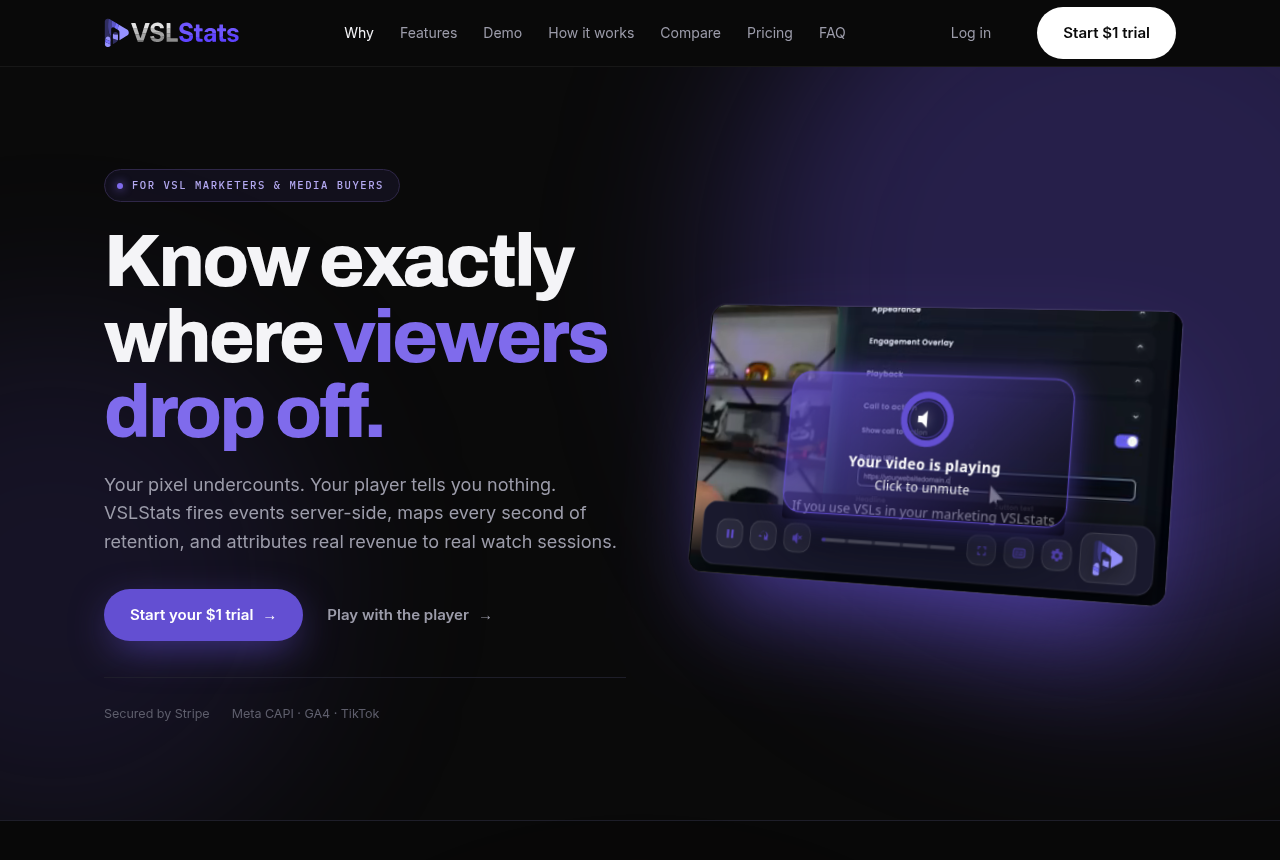
- It targets the gap most hosts leave open: server-side Meta CAPI, GA4 and TikTok forwarding, plus revenue attribution back to individual watch sessions, so in principle you see which traffic bought, not just who pressed play
- A complete VSL toolkit in one embed: second-by-second retention heatmaps, play gates, timed CTAs, AI captions and a fully brandable player, with no Zapier or tag manager
- You can drive the real player before paying: the site's interactive demo toggles every control live, and a $1, 7-day full-access trial promises a 24-hour warning email before the first charge
- Flat, public pricing that undercuts a dedicated VSL player: from $47 a month ($39 billed annually), Pro at $97, with the server-side forwarding and revenue attribution on the Pro tier
What to watch
- Almost no independent proof yet: it launched in March 2026, its Trustpilot profile holds just four reviews, all five-star, from a company that invites reviews, and there is next to no Reddit or forum track record to check
- A 40% recurring, lifetime-cookie affiliate program means much of the praise you find online is paid, so discount any glowing review that shows no data of its own
- HookBoost, a headline feature, deliberately inflates the progress bar so viewers believe they are further along than they are. It is an openly manipulative pattern that can be a compliance problem in regulated markets, so weigh it before you switch it on
- The $1 trial needs a card and auto-renews, and the terms make fees non-refundable except where law requires, disclaim any conversion or revenue lift, and put the GDPR controller burden on you
- None of the headline tracking claims (CAPI deduplication, attribution accuracy, reliability at ad scale) can be verified from outside yet, so you are the one testing them. Pilot on a non-critical funnel and reconcile against Stripe and Meta before you migrate a proven offer
Adilo: what works, what to watch
What works
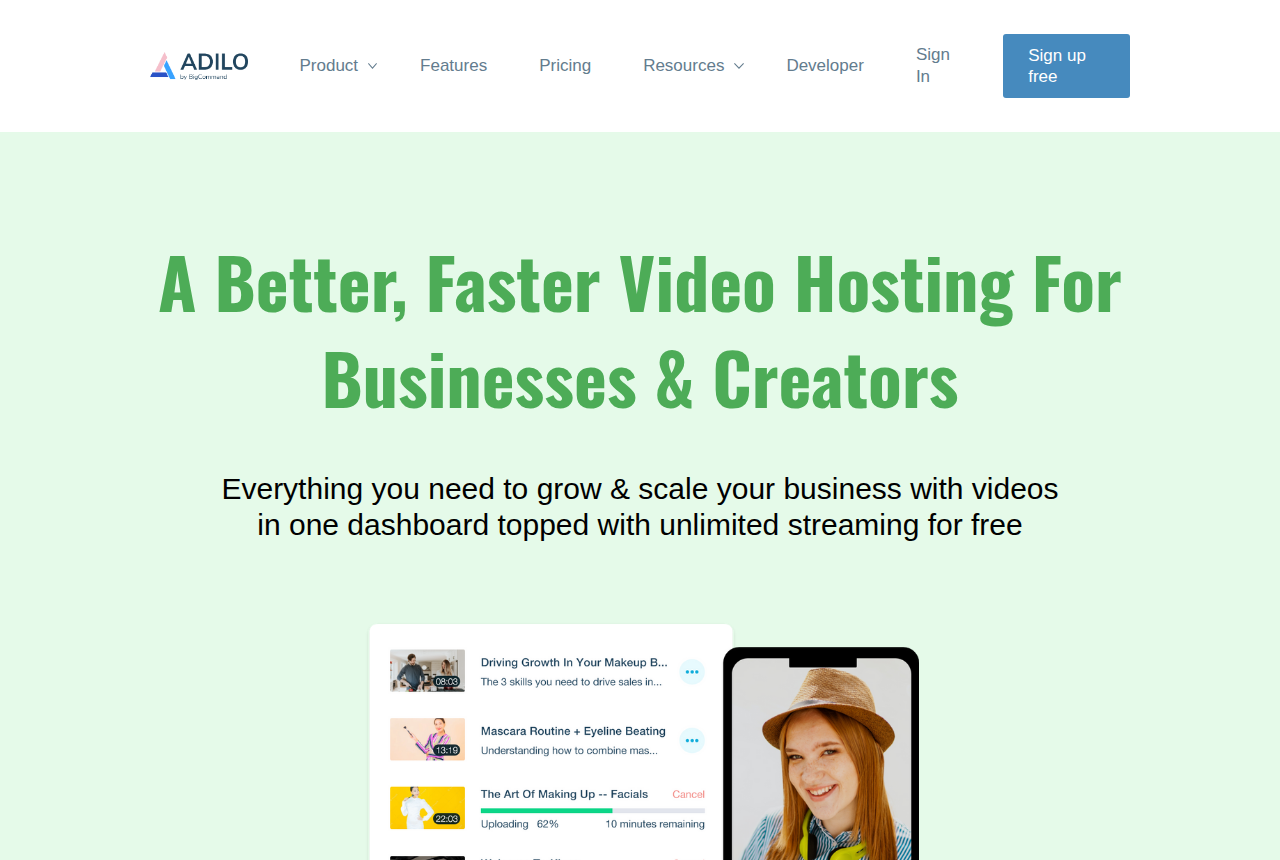
- Unlimited streaming and bandwidth on every plan, including the free one, so a video that suddenly gets traffic does not trigger the per-GB overage bill that meters a Bunny, Vimeo or SproutVideo. You pay for storage, not views
- Genuinely well-liked by day-to-day users: roughly 4.8 out of 5 on Capterra across hundreds of reviews and 4.6 across 720 on G2, with an easy on-brand player, simple course embedding and fast live-chat support the repeated praise
- Marketing hooks most cheap hosts skip, in one dashboard: in-video CTAs and buy buttons, lead capture, Facebook and Google retargeting pixels, A/B video split testing, chapters, and AI subtitles with translation into 31 languages
- It can replace several tools at once: a built-in screen and camera recorder, branded video channels for your library, heatmap analytics, and one-click import from Vimeo, Wistia and Dropbox
- Real content protection is available for course sellers worried about piracy: multi-DRM encryption and dynamic per-viewer watermarking, plus password, domain and region locking (sold as a paid add-on)
What to watch
- The dominant complaint is trust, not playback: Adilo sold thousands of AppSumo lifetime deals it later said it could not honour, restricting those accounts and pushing them onto paid subscriptions, and Trustpilot carries reports of charges after cancellation. Buy month to month, cancel in writing, and keep the confirmation
- It does not score a split test on the sale or attribute revenue: its A/B testing and heatmaps measure views and engagement, not which traffic actually bought, so a paid-traffic VSL still cannot prove ROI from inside Adilo
- The paid Unlimited plan's price is not published: the pricing page shows a free plan and one paid plan priced by how much storage you pick, with the figure only shown in-app at checkout, so you cannot compare it cleanly before you sign up
- DRM and simulated livestreaming are optional paid add-ons on top of the plan, not included, so the real cost for a course seller who needs encryption is higher than the base sticker
- It is a marketing-shaped host, not a dedicated VSL player: there is no sound-first smart autoplay or sales-scored optimisation built for direct response, so a serious paid-traffic funnel will still reach for a purpose-built player
TrackPlay: the paid-traffic VSL pick
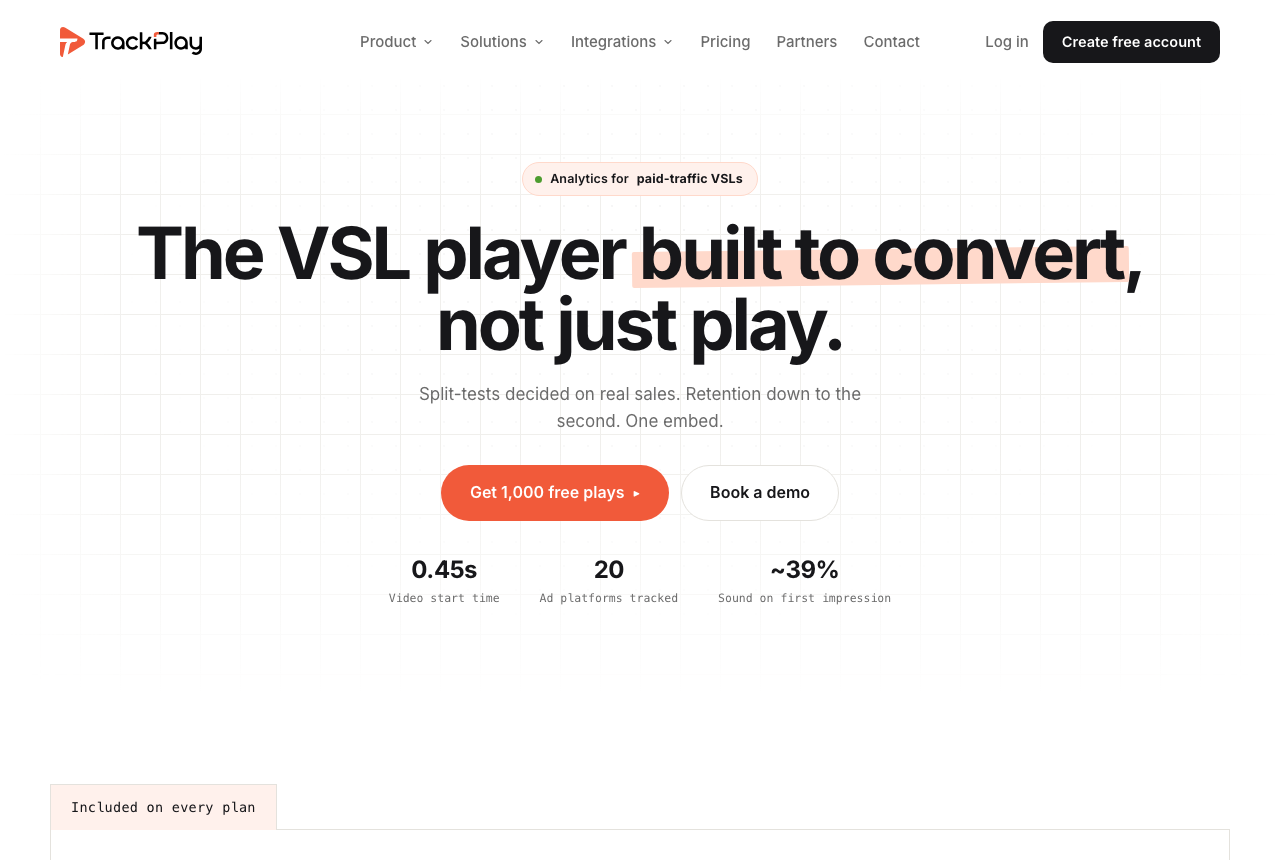
VSLStats and Adilo leave the same reader half-served, in opposite ways. VSLStats fires the server-side pixels and claims to attribute revenue, but its split test is not clearly scored on the sale, and its outside proof is thin enough that you are testing its tracking claims yourself. Adilo runs a real A/B test and fires ad pixels, but it decides those tests on views and stops at engagement heatmaps. If proving which traffic bought is the whole reason you are choosing a player, and you want the split test settled on the sale rather than on views or plays, a third tool is worth putting on the table. TrackPlay is a VSL player and analytics platform built for paid-traffic funnels. On the front end it holds attention with sound-first autoplay, timed CTAs and watch gates. On the back end it draws per-second retention split into buyers and non-buyers, with hook rate, hold rate and revenue per play, so you can see the exact seconds to cut or protect.
Where it goes further than either of these is what it settles the test on. VSLStats' A/B is not clearly scored on the sale and Adilo's is scored on views; TrackPlay decides its split test on the cart-verified sale, with a real z-test, p-value and confidence interval, and runs every variant under one embed so your ad links and campaign learning never reset. The cart posts the verified sale back onto the play that earned it from seven direct-response processors, including ClickBank, ClickFunnels and Digistore24, server to server, and TrackPlay fires that conversion server-side to Meta, TikTok and GA4 so the ad platform learns from the actual sale rather than a page-load pixel. It bills by plays rather than storage or bandwidth, every feature ships on every paid plan, and there is a no-card free plan of 1,000 plays a month plus a 14-day trial, with paid plans from $29 a month.
What works
- Split tests are decided on the cart-verified sale, with a real z-test, p-value and confidence interval, and every variant runs under one embed so ad links and campaign learning never reset
- Server-side conversion tracking to Meta, TikTok and GA4 fires on the watch-time milestone you choose and dedupes browser and server events, so the ad platform optimizes on the actual sale rather than a page-load pixel
- Cart postbacks tie each sale to the play that earned it from seven direct-response carts, including ClickBank, ClickFunnels and Digistore24, server to server
- Per-second retention split into buyers and non-buyers, with hook rate, hold rate and revenue per play
- Every feature ships on every paid plan and billing is by plays, with a no-card free plan of 1,000 plays a month and a 14-day trial; paid plans start at $29 a month
What to watch
- Narrow by design: built for paid-traffic VSL conversion, it is not a general video host or a B2B content library, so it has none of the channels, SEO pages or webinar tooling of a Wistia and is a poor fit if the video's job is content marketing rather than a direct-response sale
- Very new, with thin outside proof: the testimonials are on its own site, there is little third-party review or Reddit footprint yet, and signup is currently invite-only, so you cannot lean on independent validation before you commit paid traffic. That is what you would expect of a platform this recent
Where TrackPlay is not the answer
It is narrow by design. TrackPlay is built for paid-traffic VSL conversion, not general hosting or content marketing, so it is not a general video host or a B2B content library and it has none of the channels, SEO pages or webinar tooling of a Wistia. If the video's job is content marketing and feeding leads into a CRM rather than a direct-response sale, it is the wrong tool, and Adilo's unlimited-streaming library, or a host like Wistia, fits better. It is also very new, with thin outside proof: the testimonials are on its own site, there is little third-party review footprint yet, and signup is currently invite-only, which is what you would expect of a platform this recent. On that last point it shares VSLStats' problem, so pilot TrackPlay on one funnel and reconcile the numbers against your own cart before you trust it with a launch.
Visit TrackPlay for the current plans and the free tier.
Pricing, tier by tier
VSLStats sells flat, public plans: from $47 a month ($39 billed annually), with the server-side pixel forwarding and per-session revenue attribution on the $97 Pro tier. There is no free plan. The only way in is a $1, 7-day trial that requires a card and auto-renews into the paid plan, and the site promises a 24-hour warning email before the first charge. Read the terms before you commit: they make fees non-refundable except where law requires, disclaim any conversion or revenue lift, and put the GDPR controller burden on you. Because the pricing is flat rather than metered, a very high-volume sales letter pays the same as a small one, which is a genuine advantage at scale.
Adilo prices on the opposite model, and the headline is unlimited streaming. Bandwidth is unmetered on every plan, including the free one, so a video that suddenly gets traffic does not trigger the per-gigabyte overage bill that meters a Bunny, Vimeo or SproutVideo. You pay for storage, not views. The catch is that the paid Unlimited plan's price is not published: the pricing page shows a free plan and one paid plan whose figure depends on how much storage you pick, and it is only shown in-app at checkout, so you cannot compare it cleanly before you sign up.
Two of Adilo's features sit outside the base plan as paid add-ons: multi-DRM encryption with dynamic watermarking, and simulated (evergreen) livestreaming. So a course seller who needs real content protection, or a marketer who wants an evergreen webinar, pays more than the base sticker, and it is worth pricing the add-ons in before you decide. VSLStats bundles its tracking stack into the Pro tier rather than as add-ons, but that tier is $97, so the real cost of the feature you came for is the higher plan, not the $47 entry.
Which is cheaper depends on your traffic and on whether you need the tracking at all. At low volume Adilo's free plan already includes unlimited streaming and the marketing hooks, which is hard to beat if your storage is small and you do not need server-side attribution. VSLStats has no free way in, and the server-side stack you are buying it for is on the $97 tier, but its flat pricing means a viral or high-traffic sales letter does not push the bill up the way a metered host can. Budget the model that matches your real traffic, and be honest about whether proving the sale is worth stepping up to the Pro tier.
TrackPlay prices differently again, and it is worth a line because it changes the model. It bills by plays rather than storage or bandwidth, so a high-traffic sales letter is metered on views watched, not gigabytes served, and every feature ships on every plan. Paid plans start at $29 a month, and there is a no-card free plan of 1,000 plays a month, watermarked, plus a 14-day trial of the paid features. It is a cheaper door than VSLStats' $97 tracking tier, and unlike VSLStats there is a genuine free way to pilot it before you spend.
The verdict
Between these two, VSLStats wins for this site's core reader, the paid-traffic marketer, because it does the one job that defines this site and Adilo does not attempt: server-side pixel forwarding and revenue attribution on the VSL. Adilo hosts and markets a video well, but its A/B tests score views, its pixels are client-side retargeting tags and it attributes no revenue, so a paid-traffic sales letter cannot prove which traffic bought from inside it. VSLStats is built around exactly that gap. Two honest limits stay attached to the pick, and they are real. Its independent proof is almost non-existent: it launched in March 2026, its four Trustpilot reviews are solicited five-stars and a 40% lifetime-cookie affiliate program means much of the praise online is paid, so none of the headline tracking claims can be checked from outside yet. And HookBoost, a headline feature, deliberately inflates the progress bar, an openly manipulative pattern that is a compliance risk in regulated markets and one you should decide to switch off. Pilot it on a non-critical funnel and reconcile the pixel and revenue numbers against your own cart and ad accounts before you migrate a proven offer.
Adilo wins the other reader, and it is a real one. If proving the sale is not your job, and you want a well-liked host with unlimited bandwidth and a broad marketing toolkit in one dashboard, Adilo is the safer, more proven choice. It ships in-video CTAs and buy buttons, lead capture, A/B video, retargeting pixels, a screen recorder, branded channels and AI subtitles in 31 languages, its unmetered streaming means a spike in traffic never triggers an overage, and its day-to-day ratings are strong: 4.8 on Capterra and 4.6 across 720 reviews on G2. The trade is real: it scores its A/B on views, attributes no revenue, hides its paid price until checkout, and its billing history is the risk you manage, so buy month to month, cancel in writing and keep the confirmation. The tie-breaker is simple: if you need to prove which paid traffic bought, buy VSLStats and pilot it hard; if you want unlimited streaming and a broad marketing toolkit and can manage the billing, buy Adilo.
There is a third call for one specific reader. If you came here because your whole business is a paid-traffic sales letter and you want the split test settled on the actual sale, not on views and not on faith, look at TrackPlay before you commit. VSLStats fires the server-side pixels but its A/B is not clearly scored on the sale, and its outside proof is thin; TrackPlay decides its split test on the cart-verified sale with real statistics and posts that sale back to Meta, TikTok and GA4 server-side, so the ad platform optimizes on the purchase rather than a page-load pixel. It is the newer, narrower specialist and its outside proof is still thin too, so pilot it on one funnel first. For unlimited streaming with marketing tools built in, this does not change the answer: that is Adilo.
Our pick
VSLStats
VSLStats is real, and it is built for exactly the job a direct-response marketer is trying to do. It fires Meta CAPI, GA4 and TikTok events server-side so ad blockers and iOS cannot drop them, maps retention second by second, and attributes revenue back to individual watch sessions, in one branded player with play gates, timed CTAs and AI captions, from $47 a month on a $1, 7-day trial. On paper that closes the gap most hosts leave open. The reason to buy carefully is proof, not the product. It launched in March 2026, its Trustpilot profile holds four five-star reviews from a company that invites them, there is almost no independent Reddit or forum track record, and its 40% recurring affiliate program means much of the praise you find online is paid. It also ships HookBoost, a feature that deliberately inflates the progress bar to keep viewers watching, which is a compliance risk in regulated markets, and its terms disclaim any conversion lift and make fees non-refundable. None of that makes it a scam. It makes it an unproven tool to pilot on a non-critical funnel with a virtual card, reconciling its numbers against Stripe and Meta, before you trust it with a revenue offer.
Frequently asked questions
Is VSLStats or Adilo better?
Which is cheaper, VSLStats or Adilo?
Which one can prove which paid traffic actually bought?
Is VSLStats safe to trust, and what is HookBoost?
What is the deal with Adilo and AppSumo lifetime deals?
What if I want the split test scored on the sale, not on views?
Sources
Other sources
9 discussions and reviews read for this page. Quotes are excerpts; open a link to read the original in context.
Related reading
- Our full VSLStats review
- Our full Adilo review
- VSLStats vs TrackPlay: two brand-new VSL trackers, and which scores the split test on the sale
- Vidalytics vs VSLStats: the proven player that scores tests on sales against this new tracker
- Spotlightr vs Adilo: an encrypted course host against unlimited streaming with more marketing tools
- SproutVideo vs Adilo: a proven, secure host that streams live against unlimited streaming
- VSLStats alternatives, ranked by the job
- Adilo alternatives, ranked by the job
- The best VSL players and conversion video software
- All head-to-head comparisons