VSL hosting cost per 1,000 plays: Bunny, Gumlet and Cloudflare priced
We run one 20-minute sales letter through three billing meters and price every thousand plays.
Comments
No comments yet. Questions and your own experience are welcome.
Thank you. Your comment will appear once it has been reviewed.
You already know your cost per click. The number to set beside it is what a thousand viewers of your sales letter cost to serve. On the same 20-minute VSL, Bunny Stream delivers 1,000 plays for under a dollar, Gumlet Creator adds nothing per play until its bandwidth allowance runs out, and Cloudflare Stream bills about $8 for the same thousand.
Cost per 1,000 plays, side by side
Each host bills on a different meter, so the only fair comparison is one video run through all three. The per-play column is what grows with your ad spend. The fixed column is what you pay with no traffic at all.
| Host | Billed on | Per 1,000 plays | Fixed each month |
|---|---|---|---|
| Bunny Stream | Gigabytes delivered | $0.45 on the Volume tier | Storage per GB, $1 minimum |
| Gumlet | Gigabytes, inside a plan allowance | $0 inside 3,000 GB, then $13.50 | $6 a month billed annually (Creator) |
| Cloudflare Stream | Minutes delivered | $8.00 at any resolution | $5 per 1,000 stored minutes, prepaid |
What one play of a sales letter uses
The model is the one our cost calculator starts from: a 20-minute VSL, 40% watched on average, streamed at 1.5 Mbps. So the average play runs eight minutes and moves about 90 MB. A thousand plays is 8,000 delivered minutes and about 90 GB.
Your hook changes every figure on this page. If half your viewers leave at minute four, your average play shrinks and so does the bill on every meter. That makes a weak opening cheap to host and costly everywhere else in the funnel.
Bunny Stream: cents per thousand, billed by the gigabyte
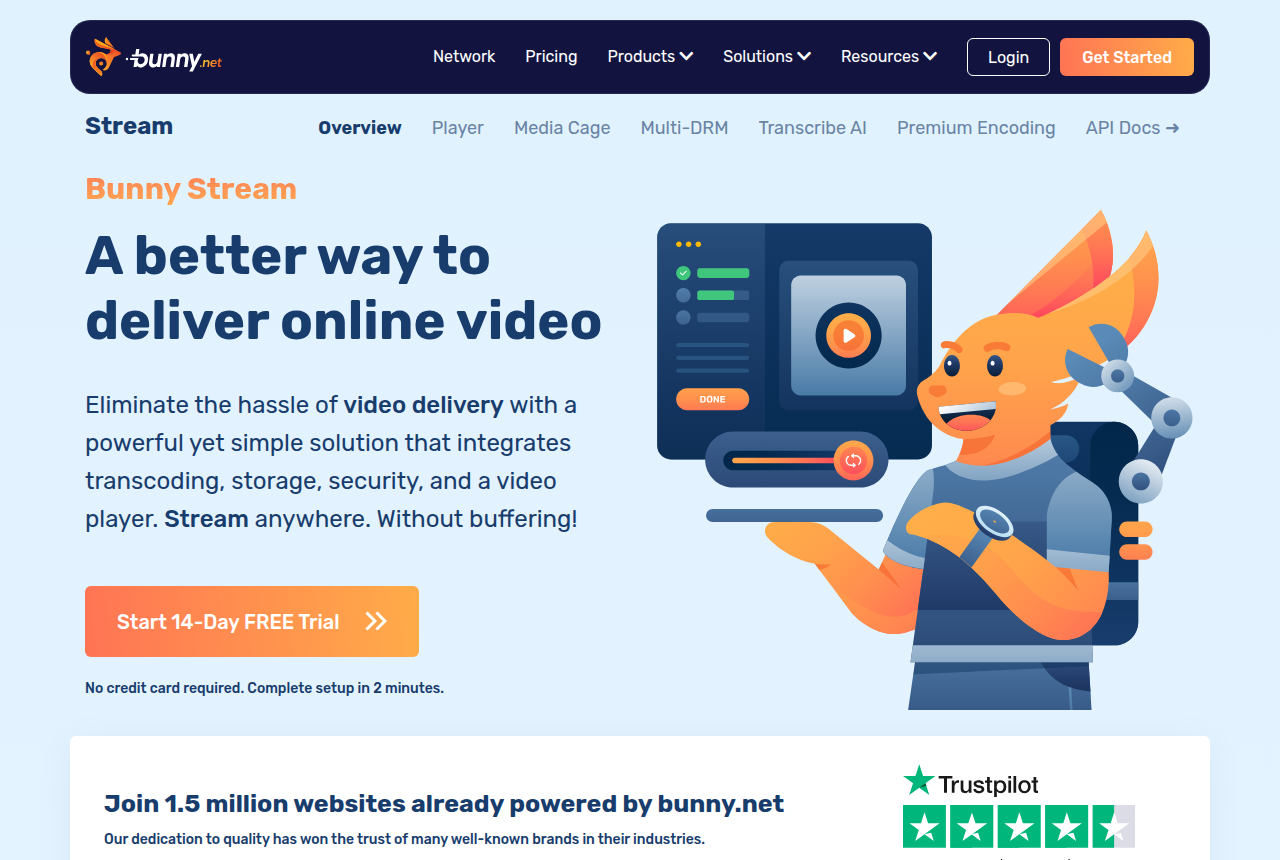
Bunny Stream charges $0.005 for each gigabyte that leaves its network on the Volume tier. Its pricing page lists the player, encoding and security features at no charge. Storage is $0.01 per GB, the account bills at least $1 a month, and a 14-day trial needs no card.
When you pay by the gigabyte, the cost of each play follows your bitrate. A sharper 1080p encode at twice the bitrate doubles the delivery line, and a lean 720p encode halves it. Even so, minute billing would only catch up at around 27 Mbps, far above anything a sales letter streams.
The line people miss is storage. Each resolution you enable is kept as its own file, so the library can hold several times the footage you uploaded. Switch off the renditions your buyers never watch. There is no Meta or Google pixel either, so tracking lives on your page or in a player such as Presto Player. The Bunny Stream review covers setup, and Vimeo vs Bunny Stream shows what changes when you leave a seat-based host.
Gumlet: a flat fee that thins out with every play
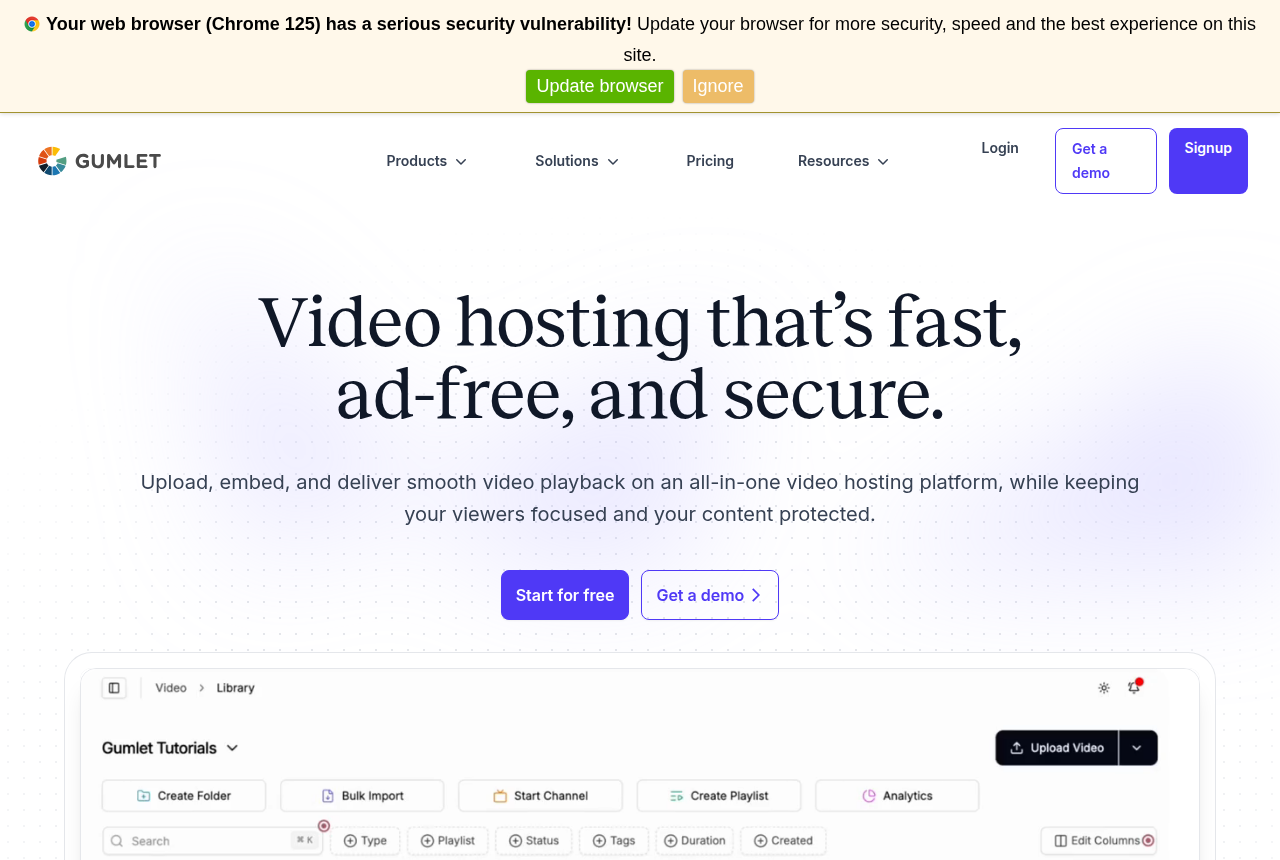
Gumlet prices the way a business budgets. Creator includes 3,000 GB of streaming a month, which this VSL fills at roughly 33,000 plays. Until then, each extra thousand viewers costs you nothing, and the fixed fee per thousand keeps falling as traffic climbs.
Past the allowance it turns into the most expensive meter on the page, at $0.15 for every extra gigabyte on Creator. Growth carries the same 3,000 GB with a lower overage of $0.10, which is why it wins once a campaign runs well past the allowance. Creator also caps storage at 1,000 minutes with no top-up, so a large library means moving up a plan.
Creator removes the Gumlet branding and adds Google and Meta pixel tracking. Of the three hosts, it is the only one that gives you retargeting data without code. An r/videohosting user who left Vimeo wrote that the migration tool kept their existing embed codes working. DRM costs $99 a month on top if you need it. See Bunny Stream vs Gumlet or the Gumlet review.
Cloudflare Stream: billed for every minute watched
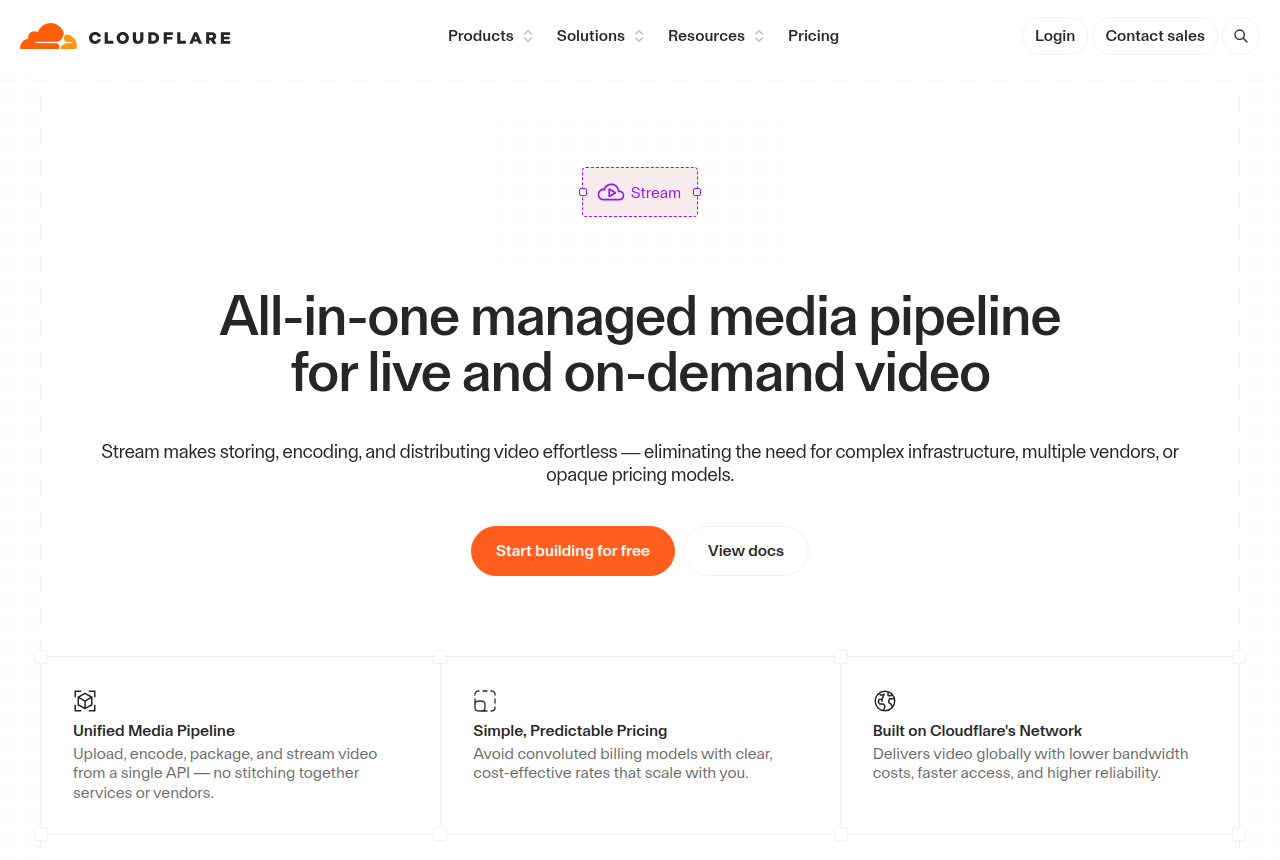
Cloudflare Stream bills $1 per 1,000 minutes delivered, after the month ends, plus storage bought ahead in blocks. Encoding and bandwidth sit inside those two rates, and uploads are free. Resolution does not change the price, so a crisp 1080p letter costs the same per minute as a 480p one.
That pricing hurts a long sales letter most. Every play here averages eight billed minutes, which puts Cloudflare Stream well above the other two per thousand viewers. Cloudflare's own docs add that preloading and buffering count as delivery, so the real cost runs a little above the figure in the table. One Cloudflare user on Reddit described overage as the subscription rising on its own with minutes watched.
It makes sense for a team already running its pages on Cloudflare through the API, with one account and one bill. The full rate table is on our Cloudflare Stream pricing page.
If you like minute billing but want a free allowance, Mux gives every plan 100,000 delivery minutes a month, about 12,500 plays of this VSL. Past that, 720p delivery costs $0.0008 a minute, or $6.40 per thousand plays. Like Cloudflare Stream, it is built for developers.
The monthly bill at 1,000, 10,000 and 50,000 plays
Cost per thousand tells only half the story, because fixed fees and allowances weigh differently at each traffic level. Here is the same VSL at three campaign sizes.
| Plays a month | Bunny Stream | Gumlet | Cloudflare Stream |
|---|---|---|---|
| 1,000 | $1 (the minimum) | $0 on Free | $13 |
| 10,000 | $4.50 | $6 on Creator | $85 |
| 50,000 | $22.50 | $169 on Growth | $405 |
On a test budget, Bunny Stream and Gumlet cost almost nothing, and Cloudflare Stream already costs more than both. At 50,000 plays the gap is wide. Gigabyte billing still comes to pocket change, while the other two run to hundreds of dollars.
When the cheapest play is the wrong buy
These three store and stream the file. None of them picks a split-test winner based on sales or sends the order back to your ad account. If you need to know which ad, hook or version of the letter brought the buyers, you want a VSL player, billed per play on a different budget line. The VSL player picker and our ranked list of VSL players handle that choice.
Seat-based hosts such as Vimeo can look cheaper at a few hundred plays, then hit a bandwidth ceiling once ads scale. If you need a host that costs nothing at all, see the free Vimeo alternatives.
Price your own funnel before you move a video
My take: with no developer and under about 30,000 plays a month, start on Gumlet Creator and watch the allowance. With a developer and a player already chosen, put the video on Bunny Stream and switch off every rendition the audience does not use. I would skip Cloudflare Stream for long sales letters unless the rest of your stack already runs on Cloudflare.
Your watch rate and bitrate will differ from the model. Enter yours and see which meter comes out lowest per thousand.
Frequently asked questions
How do I work out my own cost per 1,000 plays?
Does a 1080p encode cost more per play?
Do these hosts include a Meta pixel?
Is there a cap that stops the bill if an ad takes off?
Changelog
- 18 October 2026. Moved to this address and rebuilt around cost per 1,000 plays, with a monthly bill at three traffic levels. We checked every rate again on the vendors' pricing pages and none had changed.
- 14 October 2026. First published as a guide to three budget hosts, at the rates their pricing pages listed that day.
Sources
Other sources
7 discussions and reviews read for this page. Quotes are excerpts; open a link to read the original in context.
- [] Bunny Stream pricing page (vendor)
- [] Bunny Stream pricing docs (vendor)
- [] Gumlet pricing (vendor)
- [] Cloudflare Stream pricing (vendor docs)
- [] Mux pricing (vendor)
- [] Is anyone else getting killed by Vimeo's new pricing? (r/videohosting)
- [] Cloudflare not responding to billing issue (r/CloudFlare)
Related reading

Written by
Marcus Vale
Lead reviewer
Marcus Vale runs the VSLBench review desk. He has spent years buying paid traffic to video sales letters, and he now reads the player docs, pricing pages and long-term user reports to work out which tools actually move sales instead of just counting views. He writes the player and attribution reviews here, and he makes sure every ranking says which buyers should skip each tool.
Last checked 2026-10-18