Gumlet vs Spotlightr
Pick Gumlet if you want the cheapest branded host that still fires Meta and Google retargeting pixels and delivers fast 4K worldwide; pick Spotlightr if you sell courses and want encrypted, gated hosting with support and reviews you can actually check.
By Marcus Vale, Lead reviewer. Reviewed by the VSLBench editorial desk. Last updated 23 September 2026, and rechecked with prices every 90 days.
You are down to two, and on a features grid they look like cousins: both host your video behind a clean, branded, ad-free player, both protect it against casual downloading, and both cost a fraction of a Wistia bill. Gumlet and Spotlightr are built for slightly different buyers, though, and this comparison is about where they genuinely part.
This site judges video tools through a direct-response lens: does the player move viewers past the pitch, and can you prove which traffic bought. Neither of these two is a VSL player in the way a Vidalytics is, and neither scores a split test on the sale. But between them, Gumlet is the closer fit for a paid-traffic marketer. It is the only one of the pair that fires native Meta and Google pixels, so non-buyers become a retargeting audience, and it is the cheaper door, with a Free Forever tier and a $6 Creator plan.
Where Spotlightr answers back is protection, gating and proof. Every upload it hosts is HLS-encrypted from the $13 entry plan, wrapped in a dynamic IP watermark, one-time plays and GeoControl, and it gates with email, SMS, password or Stripe and plugs into WordPress and LearnDash. Gumlet protects too, but its strongest lock, Widevine and FairPlay DRM, is a $99 a month add-on on top of the plan. Spotlightr is also the more checkable buy, with a warm independent review base where Gumlet's is thin and aging. Below we put the two side by side on price, delivery, protection and analytics, then say plainly who each one is for.
One more name belongs on this page, because both of these tools share the same blind spot. Neither scores a split test on the sale or attributes revenue, so a paid-traffic VSL cannot prove with either which traffic actually bought. TrackPlay is a newer specialist built around exactly that gap: it decides split tests on the cart-verified sale and posts that sale back to your ad account server-side. Gumlet still wins this two-way head-to-head, but we put TrackPlay beside both below so the reader whose whole business is the sales letter can weigh it.
Quick answer
Pick Gumlet if you want the cheapest branded video host that still fires native Meta and Google retargeting pixels, delivers fast adaptive 4K and HDR on a global CDN, and can lock content down with Widevine and FairPlay DRM; pick Spotlightr if you sell or protect courses and membership video and want HLS encryption on every upload, email, SMS, password and Stripe gating and a LearnDash plugin, backed by a support team and an independent review base you can actually read.
One more option belongs on this page for a specific reader. If your whole business is a paid-traffic sales letter and you need to prove which traffic actually bought, not just fire a pixel on a page load, weigh TrackPlay against both. It is the newer specialist built to decide split tests on the cart-verified sale and post that sale back to your ad account, and we compare it beside these two below.
- Gumlet. The cheaper, delivery-first host. A Free Forever tier, then $6 a month on Creator (billed annually) that removes branding and switches on Google and Meta pixel tracking, with CRM integrations, VAST ad tags and dynamic watermarks higher up and Widevine and FairPlay DRM as a $99 a month add-on. Fast adaptive 4K and HDR on a global CDN, with 3,000GB of bandwidth on every paid tier. What it does not do is the direct-response job: no split test scored on sales, no per-second retention and no revenue attribution, and its review base is thin and aging.
- Spotlightr. The more thoroughly encrypted course host. Every upload is HLS-encrypted from the entry plan, with a dynamic IP watermark, one-time plays and GeoControl; the player and watch page are brandable on every plan, and hybrid hosting lets you keep files on YouTube, S3 or Dropbox. On top sit lead-capture forms, CTA overlays, email, SMS, password and Stripe gating, a WordPress and LearnDash plugin, quizzes and heatmaps. Flat pricing from $13 a month billed annually, a 14-day no-card trial, and a warm review base you can read. It runs no A/B tests and fires no native ad pixels.
- TrackPlay. Best when you need attribution tied to the actual cart-verified sale. Decides split tests on the verified sale with real statistics and fires the conversion server-side to Meta, TikTok and GA4, from $29 a month with a free tier. It is narrow by design: not a general host or a course-protection platform.
Gumlet vs Spotlightr at a glance
Prices and plan features checked on the vendors' own pages on 23 September 2026. TrackPlay is the direct-response specialist we line these two up against, so it wins the conversion rows and sits out the general-hosting ones.
| Feature | Gumlet | Spotlightr | TrackPlay |
|---|---|---|---|
| What it is | A cheap, delivery-first video host with ad pixels | A secure, encrypted course and membership host | A paid-traffic VSL player and attribution platform |
| Built for | Cheap branded hosting with fast global delivery | Cheap, secure, branded course delivery | Tying every play to the cart-verified sale |
| Starting price | Free Forever, then $6/mo (Creator, annual) | $13/mo billed annually (Light) | $29/mo, billed by plays |
| Free tier | Yes, Free Forever (60 storage mins) | No, 14-day no-card trial | Yes, no-card free plan (1,000 plays/mo, watermarked) |
| VSL player controls | In-player CTAs and forms, no smart autoplay | Brandable player, CTA overlays, lead forms | Sound-first autoplay, timed CTAs, watch gates |
| A/B testing | No | No | Yes, decided on the cart-verified sale |
| Ad-platform tracking | Meta and Google pixels (browser) | No native pixels (tracking codes, CRM tags) | Server-side to Meta, TikTok and GA4 |
| Retention analytics | Per-video play stats | Viewer heatmaps, session tracking | Per-second, split by buyers vs non-buyers |
| Revenue attribution | No | No | Yes, revenue per play plus cart postbacks |
| Content protection | Widevine and FairPlay DRM ($99/mo add-on), domain and geo blocking, dynamic watermarks | HLS encryption on every upload, IP watermark, one-time plays, GeoControl | Domain-locked hosting, access controls |
| Gating and lead capture | In-player CTAs and forms | Email, SMS, password, Stripe gating; lead forms | Lead forms over video, watch gates |
| Course and LMS tools | No | WordPress + LearnDash, quizzes, gallery modules | No, its focus is attribution |
| Delivery and quality | Adaptive 4K and HDR, global CDN, 3,000GB bandwidth included | Adaptive streaming, hybrid hosting (YouTube, S3, Dropbox) | Adaptive streaming under one embed |
| Pricing model | Free plus flat plans, then per-GB overages; DRM a $99/mo add-on | Flat plans, then $0.05/GB bandwidth, $0.03/GB storage | Billed by plays, every feature on every plan |
| Independent reviews | Thin and aging (Trustpilot ~78, few recent) | Warm but thin (Capterra 4.8/52, G2 4.3/29) | Very new, thin outside proof, invite-only |
| Best for | Cheapest branded hosting with ad pixels and DRM | Course sellers wanting encrypted, gated hosting | Paid-traffic VSLs measured on the cart-verified sale |
Strengths and trade-offs
Gumlet asks you to accept a thinner, aging review base and a real outage on its record in exchange for the cheapest branded hosting with native ad pixels; Spotlightr asks you to give up native ad pixels and A/B testing entirely in exchange for encrypted, gated hosting you can check the reviews on. Those are the two trade-offs.
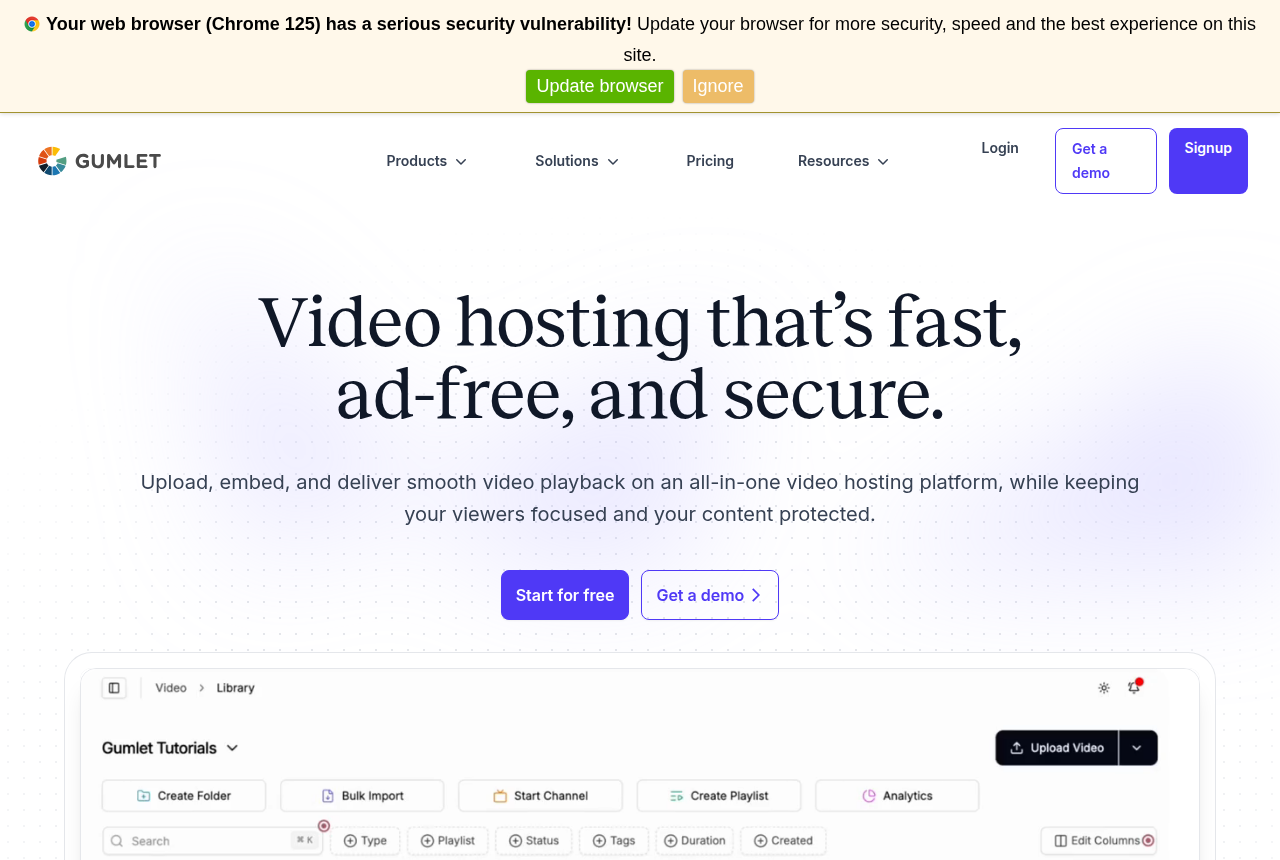
Gumlet: what works, what to watch
What works
- Cheapest branded entry point here: a Free Forever tier, then $6/mo (Creator, billed annually) that removes branding and switches on Google and Meta pixel tracking
- Marketing hooks most cheap hosts skip: Meta and Google pixels, CRM integrations, VAST ad tags, and in-player CTAs and forms
- Strong protection for paid content: Widevine and FairPlay DRM, domain and geo blocking, dynamic watermarks and expiring access tokens
- Fast adaptive 4K and HDR playback on a global CDN, with 3,000 GB of bandwidth included on every paid tier
What to watch
- No direct-response conversion measurement: no sales-scored A/B tests, no watch-depth pixel to prove retention, and no revenue attribution, so a paid-traffic VSL cannot prove which traffic buys
- A January 2025 platform update knocked embedded videos offline for many accounts for 12 hours or more, and support reviews are inconsistent, some calling it days-slow
- DRM is a $99/mo add-on on top of the plan, and bandwidth and storage overages bill per GB, so a high-traffic offer outruns the cheap sticker price
- The dashboard has a learning curve and the WordPress and Elementor integrations are less polished than users want
- The third-party review base is thin and aging (Trustpilot sits at 78 reviews, only a handful in the last year)
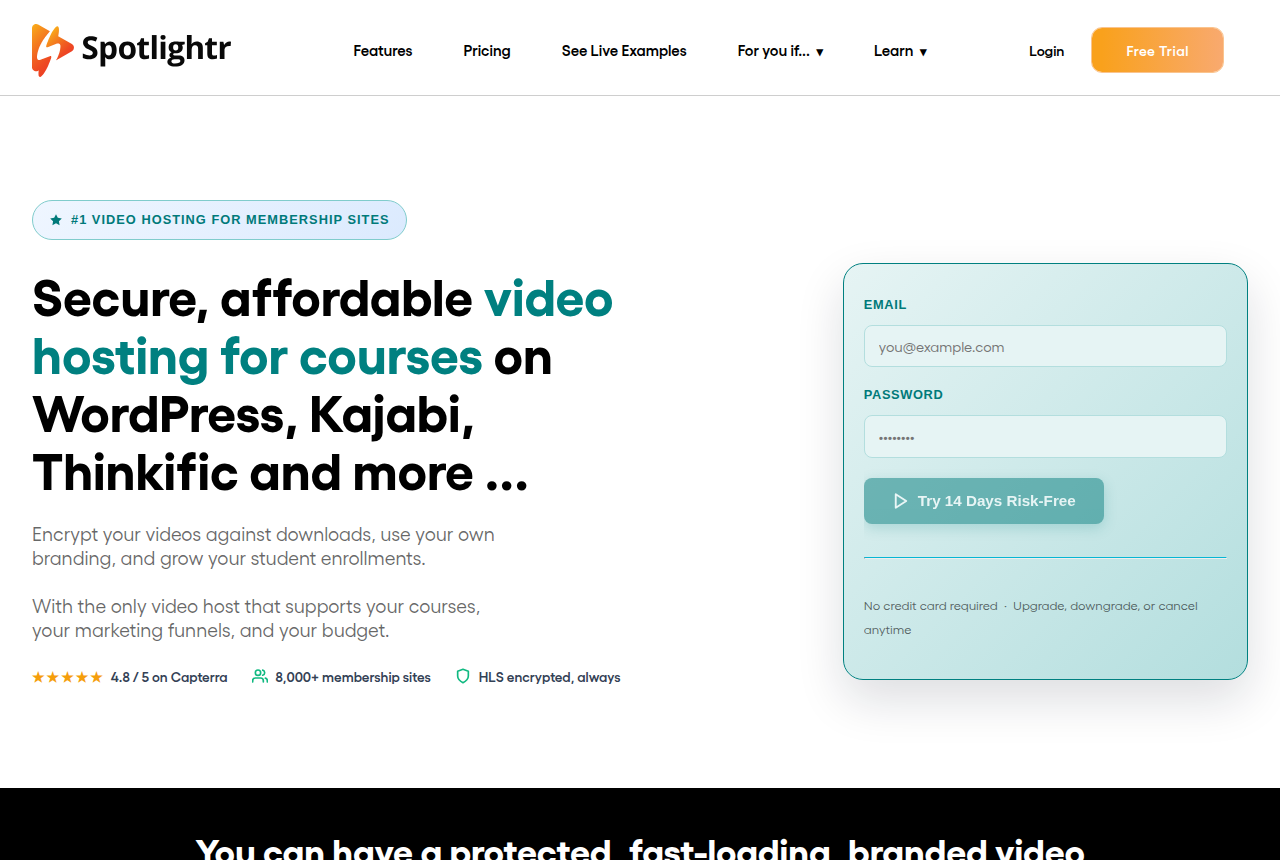
Spotlightr: what works, what to watch
What works
- HLS encryption with polymorphic access tokens on every upload, plus domain locking, dynamic IP watermarks, one-time plays and GeoControl, so course content is genuinely hard to rip
- Marketing hooks most hosts skip: in-video lead-capture forms, clickable CTA overlays, and email, SMS, password or Stripe-paywall gating
- Branding on every plan (player, watch page and a custom domain) and hybrid hosting, so you can keep files on YouTube, S3 or Dropbox and still use the Spotlightr player
- Flat, public pricing from $13/mo billed annually, a 14-day no-card trial and a 30-day refund window, with fast support praised across Capterra (4.8) and G2 (4.3)
- A free WordPress plugin with a LearnDash integration, in-video quizzes with progress tracking, and analytics with viewer heatmaps and session tracking
What to watch
- No sales-scored A/B testing and no revenue attribution: the analytics stop at engagement, so a paid-traffic VSL cannot prove which traffic actually bought
- The independent review base is warm but thin, 52 reviews on Capterra and 29 on G2, so there is less long-term proof to check than for Wistia or Vimeo
- Feature depth comes with a settings learning curve, and reviewers say a specific option can be hard to find
- Uploads go one file at a time and some report slow playback startup, to the point that a Reddit user advises pre-compressing footage with Handbrake before upload
- Every plan caps bandwidth and storage, with overages billed at $0.05/GB bandwidth and $0.03/GB storage, so a high-traffic library outgrows the cheap sticker
TrackPlay: the paid-traffic VSL pick
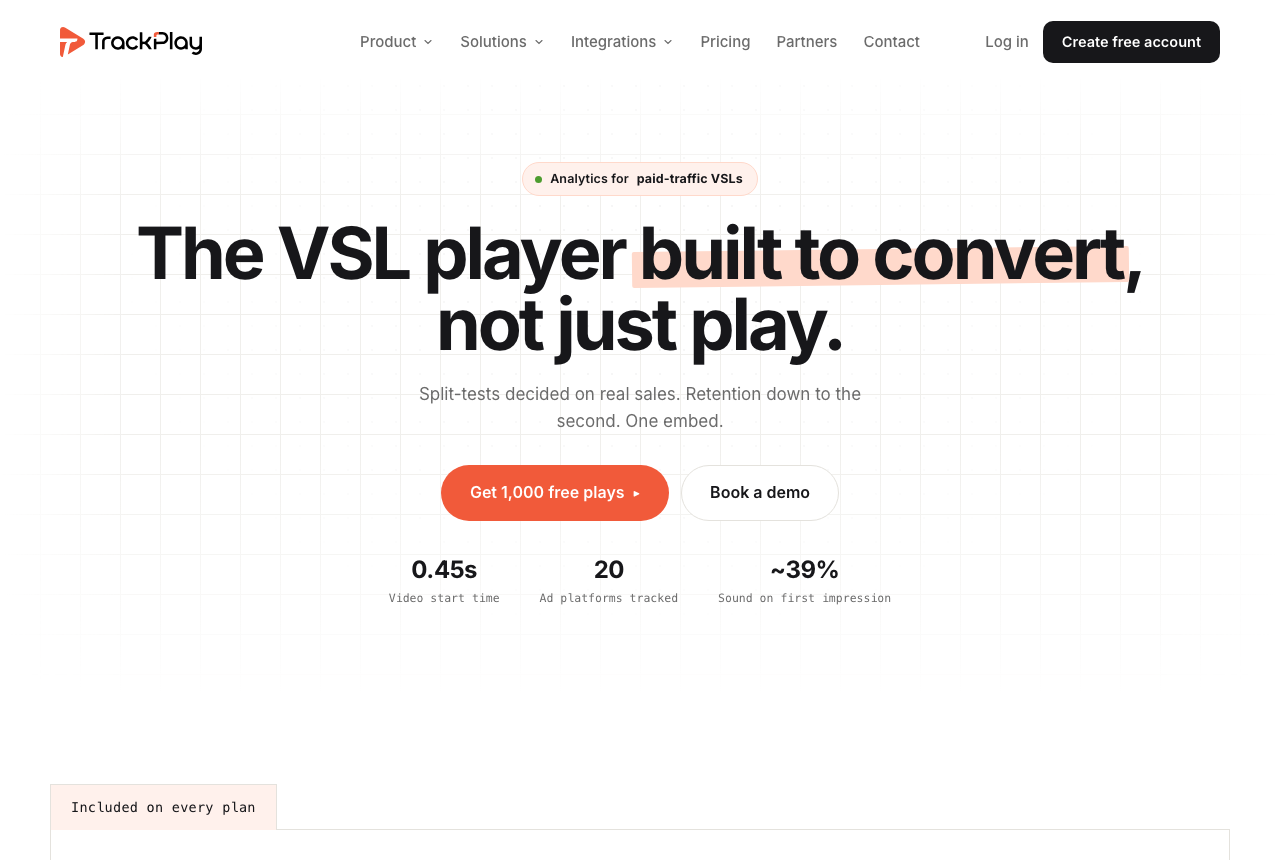
Gumlet and Spotlightr share one blind spot, and it is this site's first criterion: neither scores a split test on the sale or attributes revenue, so on a paid-traffic VSL you cannot prove with either which traffic actually bought. Gumlet fires a pixel on the page load and Spotlightr fires none, but a page-load pixel does not know whether the viewer bought. If that is the whole reason you are choosing a player, there is a third tool worth putting on the table. TrackPlay is a VSL player and analytics platform built for paid-traffic funnels. On the front end it holds attention with sound-first autoplay, timed CTAs and watch gates. On the back end it draws per-second retention split into buyers and non-buyers, with hook rate, hold rate and revenue per play, so you can see the exact seconds to cut or protect.
Where it goes further than either of these is attribution. The cart posts the verified sale back onto the play that earned it from seven direct-response processors, including ClickBank, ClickFunnels and Digistore24, server to server, and TrackPlay fires that conversion server-side to Meta, TikTok and GA4 so the ad platform learns from the actual sale rather than a page-load pixel. Its split tests are decided on that cart-verified sale with real statistics, a z-test with a p-value and a confidence interval, and every variant runs under one embed so your ad links and campaign learning never reset. It bills by plays rather than bandwidth, every feature ships on every paid plan, and there is a no-card free plan of 1,000 plays a month plus a 14-day trial, with paid plans from $29 a month.
What works
- Split tests are decided on the cart-verified sale, with a real z-test, p-value and confidence interval, and every variant runs under one embed so ad links and campaign learning never reset
- Server-side conversion tracking to Meta, TikTok and GA4 fires on the watch-time milestone you choose and dedupes browser and server events, so the ad platform optimizes on the actual sale rather than a page-load pixel
- Cart postbacks tie each sale to the play that earned it from seven direct-response carts, including ClickBank, ClickFunnels and Digistore24, server to server
- Per-second retention split into buyers and non-buyers, with hook rate, hold rate and revenue per play
- Every feature ships on every paid plan and billing is by plays, with a no-card free plan of 1,000 plays a month and a 14-day trial; paid plans start at $29 a month
What to watch
- Narrow by design: built for paid-traffic VSL conversion, it is not a general video host or a B2B content library, so it has none of the channels, SEO pages or webinar tooling of a Wistia and is a poor fit if the video's job is content marketing rather than a direct-response sale
- Very new, with thin outside proof: the testimonials are on its own site, there is little third-party review or Reddit footprint yet, and signup is currently invite-only, so you cannot lean on independent validation before you commit paid traffic. That is what you would expect of a platform this recent
Where TrackPlay is not the answer
It is narrow by design. TrackPlay is built for paid-traffic VSL conversion, not general hosting or content marketing, so it is not a video host or a B2B content library and it has none of the channels, SEO pages or webinar tooling of a Wistia. If the video's job is content marketing and feeding leads into a CRM rather than a direct-response sale, it is the wrong tool. It also does not try to protect a course or deliver a large media library the way these two do: it has nothing like Spotlightr's HLS encryption on every upload or Gumlet's studio-grade DRM and image optimization, so if that is your job Spotlightr is the cheaper protected buy and Gumlet the cheaper fast-delivery one. And it is very new, with thin outside proof: the testimonials are on its own site, there is little third-party review footprint yet, and signup is currently invite-only, which is what you would expect of a platform this recent. If you want an established host with a track record you can read today, Spotlightr's review base is warmer and Gumlet has been shipping longer. Pilot TrackPlay on one funnel and reconcile the numbers against your own cart before you trust it with a launch.
Visit TrackPlay for the current plans and the free tier.
Pricing, tier by tier
Gumlet is the cheaper host at the door, and it has a genuine free tier. Free Forever gives you 60 minutes of storage with Gumlet branding. Creator is $6 a month billed annually and is the plan most people start on: it removes the branding and turns on Google and Meta pixel tracking. Higher tiers add CRM integrations, VAST ad tags and dynamic watermarks, and every paid tier includes 3,000GB of bandwidth. Two costs scale beyond the sticker: bandwidth and storage bill per GB once you pass the included allowance, and Widevine and FairPlay DRM is a separate $99 a month add-on, not part of any plan.
Spotlightr has no free plan but is flat and public. Billed annually the per-month rates are Light $13, Plus $21, Premium $55 and Scale $163; billed monthly they are $15, $25, $65 and $195. Every plan includes HLS encryption, a brandable player and analytics with heatmaps. The gating options, dynamic watermarking and the course and gallery modules start on the $21 Plus tier, and quizzes, CRM tags and team seats on Premium. There is a 14-day trial with no card and a 30-day refund window. The caps are the thing to watch: bandwidth overage bills at $0.05 a GB and extra storage at $0.03 a GB, so a high-traffic library outgrows the cheap sticker.
So on running cost Gumlet wins clearly at the entry level, free or $6 against Spotlightr's $13, and it is the only one with a no-cost tier to test on. The gap narrows on features you may actually need. Gumlet's DRM is a $99 add-on, so if stopping downloads is the point, Spotlightr encrypts every upload from $13 and is far cheaper for that job. And Spotlightr's gating and course modules do not start until the $21 Plus plan, so a course seller who wants the full stack is comparing Spotlightr Plus at $21 with a Gumlet plan plus the DRM add-on, at which point Gumlet is no longer the cheap option.
One protection detail is worth stating plainly because it cuts against Gumlet's cheap sticker. Gumlet's strongest anti-piracy lock, studio-grade Widevine and FairPlay DRM, costs $99 a month on top of the plan, while Spotlightr wraps every upload in HLS encryption from $13. For stopping casual downloads on a budget, Spotlightr gives you more for less. Gumlet's answer is that its DRM is studio-grade and pairs with fast global 4K delivery and image optimization, which is what a large, high-traffic library is paying for.
TrackPlay prices differently again, and it is worth a line because it changes the model. It bills by plays rather than storage or bandwidth, so a high-traffic sales letter is metered on views watched, not gigabytes served, and there is no per-GB overage to watch. Paid plans start at $29 a month with every feature on every plan, and there is a no-card free plan of 1,000 plays a month (watermarked) plus a 14-day trial of the paid features. Gumlet is still cheaper at the door, free or $6; TrackPlay's case is not that it is the cheapest but that the plays model removes the overage surprise while it does the attribution work neither of the other two attempts.
The verdict
Between these two, pick on which job is the priority. Gumlet wins for this site's core reader because it is the closer fit for paid traffic: it is the cheaper host, it has a free tier to test on, and it is the only one that fires native Meta and Google pixels, so the non-buyers you paid to reach become a retargeting audience. Fast adaptive 4K delivery and studio-grade DRM round it out. Two honest limits stay attached to the pick: a January 2025 update knocked embedded videos offline for many accounts for 12 hours or more, which on a live paid offer is burned ad spend, and its independent review base is thin and aging, so pilot it before you point a launch at it.
Spotlightr wins when the video is a course or membership library and the priorities are protection, gating and proof you can read. It encrypts every upload from the $13 entry plan, gates with email, SMS, password or Stripe, plugs into WordPress and LearnDash, and carries a warm independent review base, 4.8 on Capterra and 4.3 on G2, with support that reviewers single out. It fires no native ad pixels, which only bites on a paid-traffic sales letter, not on a course. The tie-breaker is simple: if you run paid traffic to a VSL and want the cheapest host that still retargets, buy Gumlet; if you sell protected courses and want gating and checkable support, buy Spotlightr.
There is a third call for one specific reader. If you came here because your whole business is a paid-traffic sales letter and proving which traffic bought is what you actually need, look at TrackPlay before you commit: it decides split tests on the cart-verified sale with real statistics and fires that sale back to Meta, TikTok and GA4 server-side, so the ad platform optimizes on the purchase rather than a page-load pixel. It is the newer, narrower specialist and its outside proof is still thin, so pilot it on one funnel first. For hosting a course cheaply or delivering a large library fast, this does not change the answer: that is Spotlightr for encryption and gating, or Gumlet for price and delivery.
Our pick
Gumlet
Gumlet is the pick between these two for this site's core reader: someone running paid traffic to a video sales letter. It is the cheaper host of the pair, with a Free Forever tier and a $6 Creator plan, and it is the only one of the two that fires native Meta and Google pixels, so the watchers who do not buy become a retargeting audience without a middle step. It also delivers fast adaptive 4K and HDR on a global CDN and can lock paid content behind Widevine and FairPlay DRM. Two honest limits stay attached to the pick: a January 2025 platform update knocked embedded videos offline for many accounts for 12 hours or more, which on a live paid-traffic offer means burned ad spend, and its strongest DRM is a $99 a month add-on rather than part of the plan. Pilot it on one funnel before you point a launch at it.
Frequently asked questions
Is Gumlet or Spotlightr better?
Which is cheaper, Gumlet or Spotlightr?
Which has better content protection?
Can either one run a video sales letter for paid traffic?
Is Gumlet reliable enough for paid traffic?
What if I need to prove which paid traffic actually bought, not just fire a pixel?
Sources
Other sources
12 discussions and reviews read for this page. Quotes are excerpts; open a link to read the original in context.
- [] Gumlet video hosting (vendor)
- [] Gumlet pricing (vendor)
- [] Spotlightr home (vendor)
- [] Spotlightr pricing (vendor)
- [] Spotlightr features (vendor)
- [] TrackPlay (vendor)
- [] "Too unreliable for anything serious" (AppSumo review)
- [] Gumlet on Trustpilot
- [] Gumlet reviews on G2
- [] Spotlightr reviews on Capterra (4.8/5, 52 reviews)
- [] Spotlightr reviews on G2 (4.3/5, 29 reviews)
- [] Video streaming choice (r/elearning)
Related reading
- Our full Gumlet review
- Our full Spotlightr review
- Bunny Stream vs Gumlet: raw delivery you build on or a branded host with pixels baked in
- Bunny Stream vs Spotlightr: cheap raw delivery to build on or a finished, encrypted course host
- Panda Video vs Spotlightr: a finished VSL player or a cheaper, more encrypted course host
- Spotlightr alternatives, ranked by the job
- The best VSL players and conversion video software
- All head-to-head comparisons