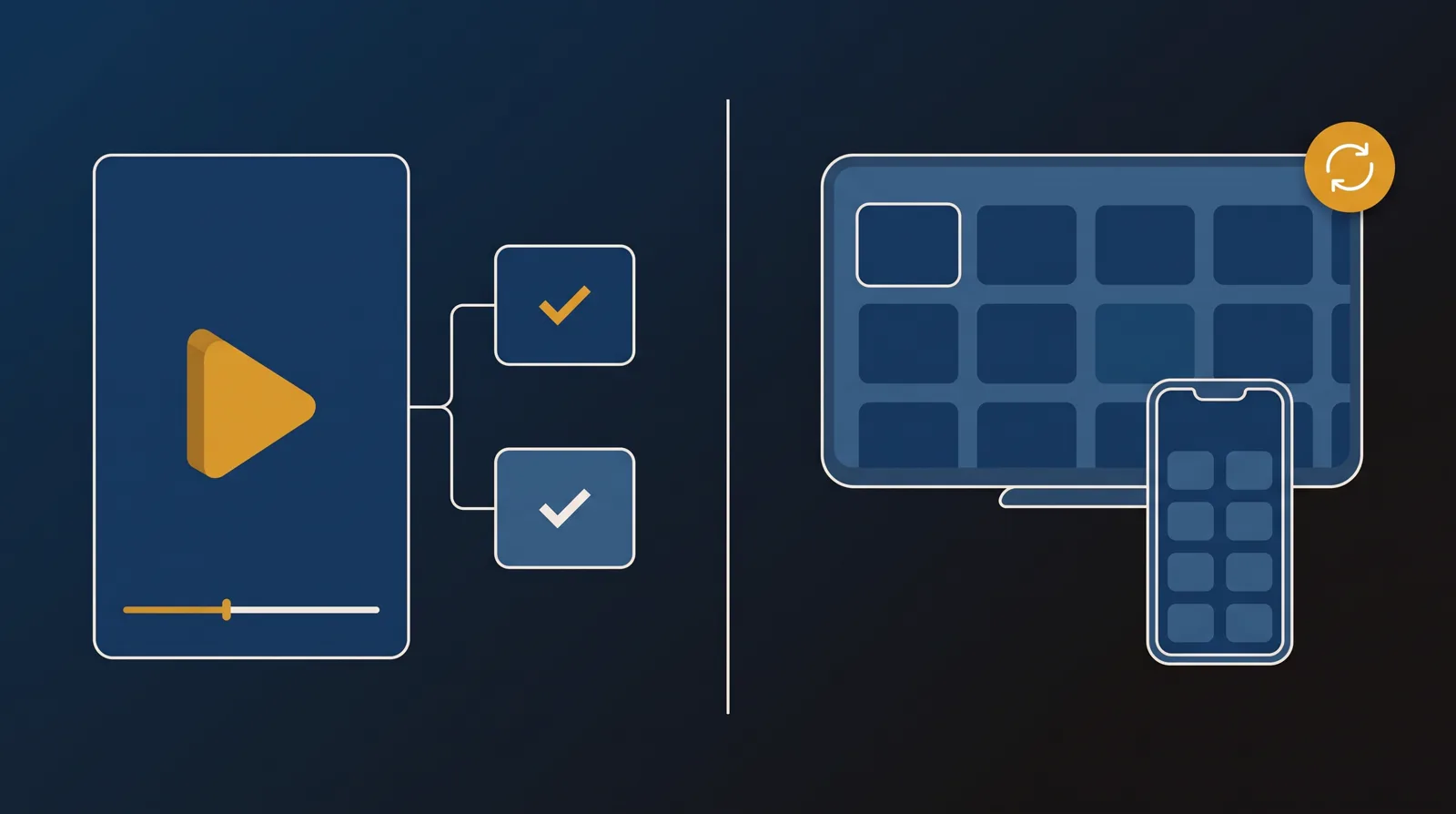
You are down to two, and the first thing to see is that they solve different problems. VTurb is a dedicated video sales letter player: it holds a viewer past the pitch with sound-first autoplay and progress controls, lets you style the player deeply, and split-tests the thing doing the holding. Uscreen is a subscription membership platform: it is built to turn a library of videos into a recurring business, with a Netflix-style catalog, a community, native live streaming and your own branded apps. Both will host and play your video. They are aimed at very different jobs.
This site judges video tools through one lens: does the player move viewers toward the sale, and can you prove what worked. On that test VTurb is the far more relevant tool of the two. It is a purpose-built VSL player, used at scale in Latin-American direct response for exactly this page, and it is one of our top-ranked players. Uscreen does not attempt that job: it has no sound-first marketing player, no sales-scored A/B test and no revenue attribution, because it is built to run a membership, not to sell from a recorded video to cold traffic. For a pre-recorded sales letter on paid traffic, VTurb is the closer fit by a wide margin.
Where Uscreen earns its place is the subscription job VTurb does not chase. It gives members a catalog to browse, a community to belong to and native live streaming for events, and its team builds you branded iOS, Android and TV apps with no code, which reviewers say is what makes a membership feel legitimate and lifts the share of viewing that happens in-app. Subscriptions, one-off sales and free trials are built in, a success manager and free migration get you launched, and over 4,000 creator businesses run on it. For a recurring membership, that is a genuine platform and VTurb is not.
There is a catch on each side. VTurb's is proof and transparency: its pricing is not publicly listed, its independent English-language review base is thin, and its docs and support lean toward the Portuguese-speaking market, so an English-market buyer has less to check before committing. Uscreen's is the bill and the terms: above Starter you pay $0.99 to $1.99 per subscriber on top of the base, the branded apps start at $449 a month, and reviewers report rigid annual contracts and delayed payouts after cancelling. And the catch they share matters most here: neither settles a split test on the sale or attributes revenue, so one more name belongs on this page, which we come to below.
Quick answer
Pick VTurb if your page is a pre-recorded video sales letter on paid traffic and you want a dedicated smart player built for it, with sound-first autoplay, progress controls, deep styling, built-in split testing and domain security, and you accept that its pricing is quoted on signup rather than published; pick Uscreen if your business is a recurring subscription membership and you want a Netflix-style catalog, a community and your own branded mobile and TV apps built for you, with the per-subscriber fees and the annual contract priced in.
One more option belongs on this page for a specific reader. Neither VTurb nor Uscreen settles a split test on the cart-verified sale or posts that sale back to your ad platforms server-side. VTurb split-tests the player, and Uscreen is built to bill members rather than to prove which ad bought. If your whole business is a paid-traffic sales letter and you want the test decided on the actual sale, TrackPlay is the newer specialist built for exactly that, and we line it up beside both below.
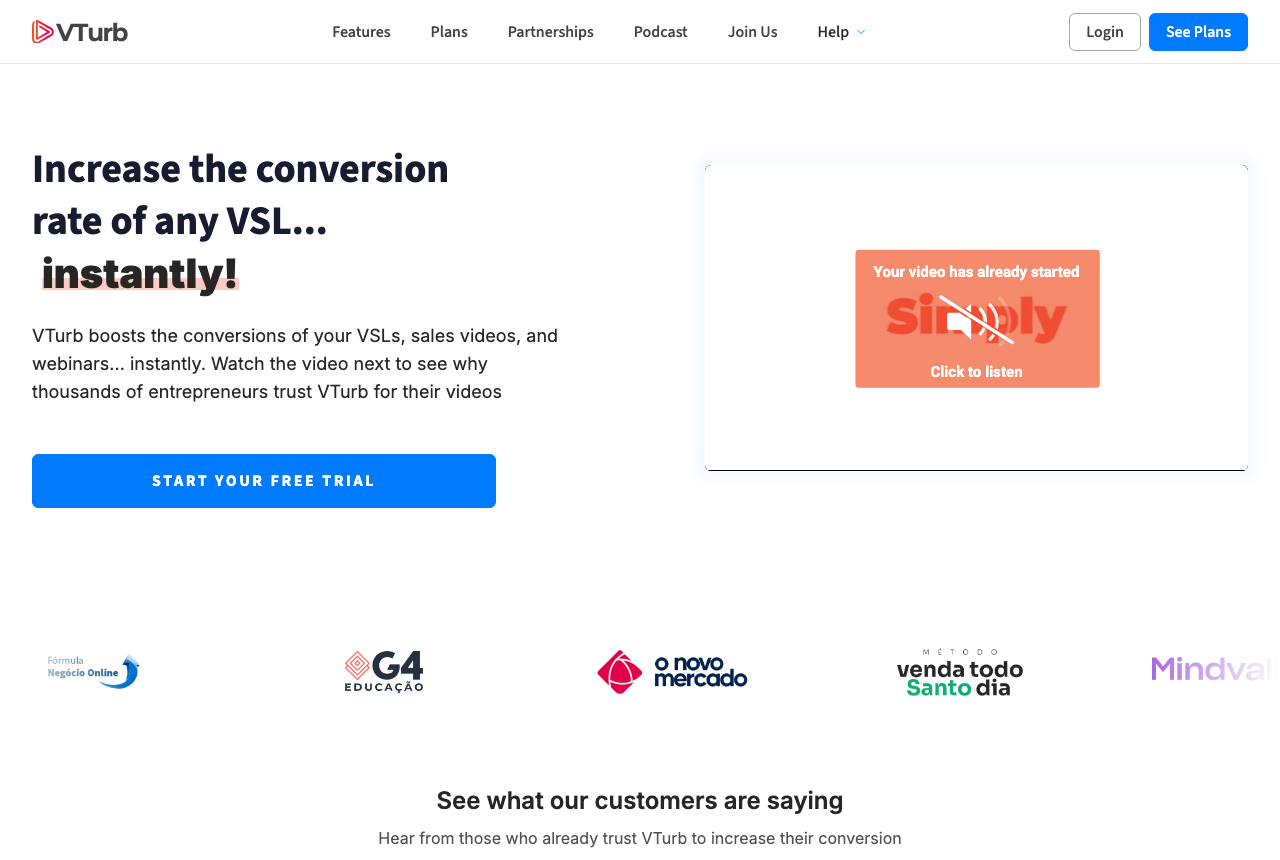
- VTurb. The dedicated VSL player of the two, and the one built for this site's core job of holding a viewer past the pitch. You get a smart player with sound-first autoplay, progress and playback controls, deep player styling, built-in split testing and domain security. It is widely used in Latin-American direct response, where it has a real track record. The catch is proof and price: its English-language review base is thin, its pricing is not publicly listed, and its docs and support lean toward the Portuguese-speaking market, so test it on a non-critical funnel first.
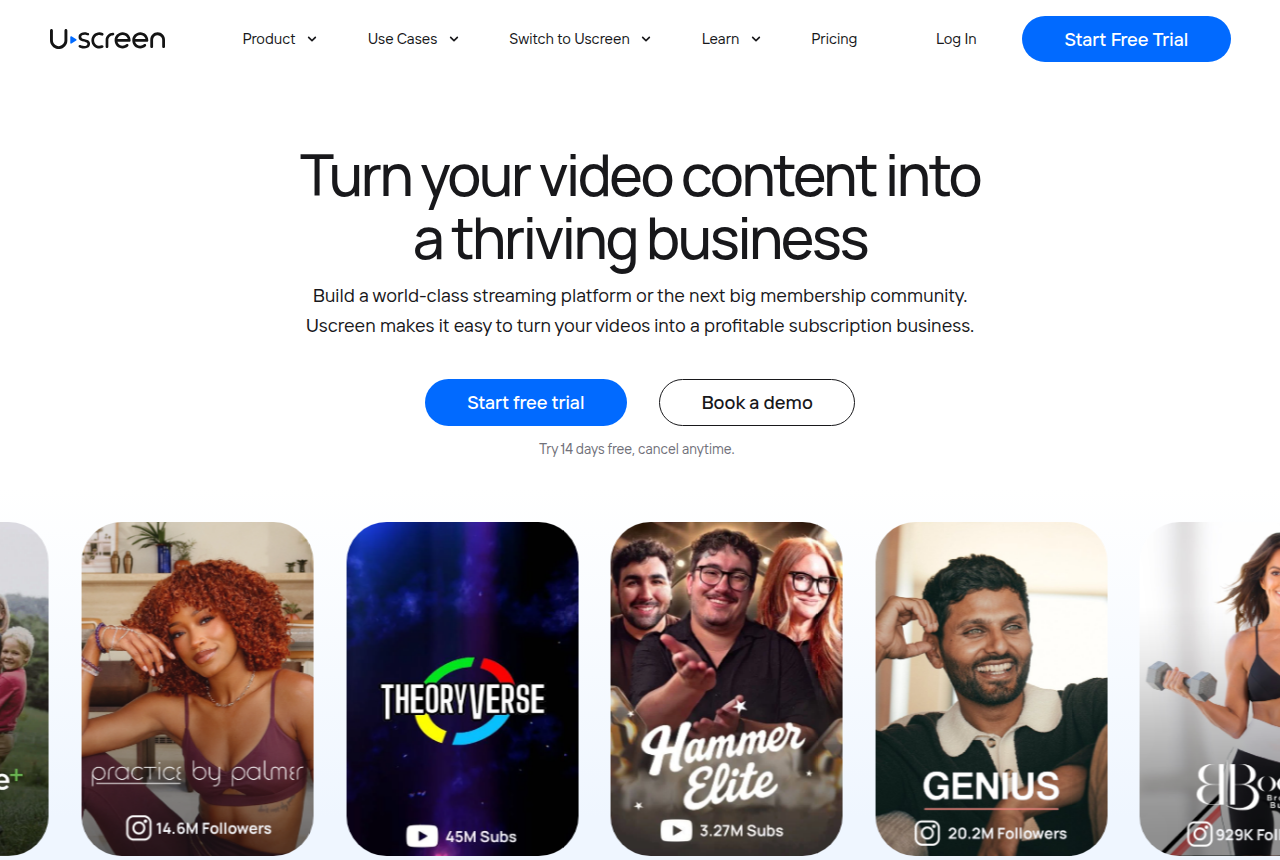
- Uscreen. The subscription-business platform of the two, and the pick when your video is a recurring membership rather than a one-time sale. It gives members a Netflix-style catalog, native live streaming and a built-in community, and its standout is the branded iOS, Android and TV apps its team builds for you with no code. Subscriptions, one-off sales, free trials, marketing and analytics sit in one place, with a success manager and free migration to get you launched, and it has over 4,000 creator businesses behind it. It starts at $49 a month on a monthly Starter plan with a 14-day no-card trial. The catches are the bill and the terms: above Starter you pay $0.99 to $1.99 per subscriber on top of the base, the branded apps start at $449 a month, and annual contracts are rigid with delayed-payout complaints attached. It is not a VSL player: no sound-first autoplay, no split test scored on the sale, no revenue attribution.
- TrackPlay. Best when you want the split test decided on the actual cart-verified sale and posted back to your ad platforms server-side. It scores tests on the verified sale with real statistics and fires that sale to Meta, TikTok and GA4, from $29 a month with a no-card free tier. It is narrow by design: not a membership platform or a general host, and very new.
VTurb vs Uscreen at a glance
Prices and plan features checked on the vendors' own pages on 29 September 2026. TrackPlay is the direct-response specialist we line these two up against, so it wins the conversion rows and sits out the general-hosting ones.
| Feature | VTurb | Uscreen | TrackPlay |
|---|---|---|---|
| What it is | A dedicated VSL smart player for direct response | A done-for-you subscription membership platform | A paid-traffic VSL player and attribution platform |
| Built for | Holding attention on a VSL and split-testing the player | Running a recurring subscription business | Tying every play to the cart-verified sale |
| Starting price | Not publicly listed (quoted on signup) | $49/mo Starter, billed monthly | $29/mo, billed by plays |
| Pricing model | Not published | Monthly base plus $0.99-$1.99 per subscriber above Starter | Billed by plays, every feature on every plan |
| Free tier or trial | Not clearly listed | No free plan; 14-day trial, no card | No-card free plan (1,000 plays/mo, watermarked) plus 14-day trial |
| Sales-scored A/B testing | Split testing on the player | No | Yes, decided on the cart-verified sale |
| Ad-platform tracking | Player-level tracking (client-side) | None built in | Server-side to Meta, TikTok and GA4, with dedup |
| Retention analytics | Player analytics and playback controls | Membership viewing and engagement analytics | Per-second, split by buyers vs non-buyers |
| Revenue attribution | Limited | No | Yes, revenue per play plus cart postbacks |
| Built-in monetization | None; it is the player, the cart is yours | Subscriptions, one-off sales and free trials, built in | No paywall; ties each play to your own cart's sale |
| Player and marketing hooks | Sound-first autoplay, progress controls, deep styling | Netflix-style catalog player for members | Sound-first autoplay, timed CTAs, watch gates |
| Live streaming | No, on-demand VSL focus | Yes, native live streaming | No, on-demand VSL focus |
| Community | No | Built-in community space | No |
| Mobile and TV apps | No | Branded iOS, Android and TV apps, from $449/mo | No |
| Content protection | Domain security built in | Membership login and access control | Domain-locked video hosting |
| Who drives it | No-code dashboard for marketers | Done-for-you onboarding with a success manager | No-code dashboard for marketers |
| Independent reviews | Thin in English; widely used in Latin-American direct response | 4,000+ creator businesses, mature and supported | Very new, thin outside proof, invite-only |
| Best for | Paid-traffic VSLs wanting a dedicated smart player | Subscription memberships with branded apps | Paid-traffic VSLs measured on the cart-verified sale |
Strengths and trade-offs
VTurb asks you to accept unlisted pricing and a thinner English-language track record in exchange for a purpose-built VSL smart player with split testing and domain security, which is the closest fit here for a sales letter. Uscreen gives a creator a complete subscription-membership platform with branded apps, at a per-subscriber price and with an annual contract to watch. Here is what each does well and where each will bite.
VTurb: what works, what to watch
What works
- VSL-specific player with smart autoplay and progress controls
- Split testing and domain security built in
- Deep player customization
What to watch
- Public English pricing is not clearly listed
- Thin English-language review track record
- Support and docs lean toward the Portuguese-speaking market
Uscreen: what works, what to watch
What works
- Purpose-built for subscription memberships: a Netflix-style catalog, native live streaming and a community space in one platform, so members watch, chat and pay without you stitching three tools together
- Branded mobile and TV apps are the standout feature. Uscreen builds iOS, Android and TV apps for you with no code, and reviewers say the app makes a membership feel legitimate and lifts the share of viewing that happens in-app
- Real monetization built in: subscriptions, one-off sales and free trials, plus marketing automations and analytics, so you charge members directly instead of bolting on a separate cart
- Hands-on onboarding and free migration. A dedicated success manager walks you through setup, and reviewers repeatedly credit the team with making the launch of a site and app easy
- A 14-day free trial with no card, and a Starter plan at $49/mo, so you can test the membership model before committing real money
What to watch
- It is a membership platform, not a direct-response VSL player: there is no sound-first smart autoplay, no split test scored on the sale and no revenue attribution, so a paid-traffic sales letter still cannot prove which traffic actually bought from inside Uscreen
- The per-subscriber fee is the loudest complaint. Above Starter you pay $0.99 to $1.99 per subscriber on top of the monthly base, so a growing membership pays far more than the headline price, and reviewers describe the total take as high once fees stack up
- Annual contracts are rigid: Trustpilot reviewers report no mid-term downgrade or cancellation and being billed through the full term, so treat the annual commitment as firm and start on the monthly Starter plan to test
- Support and payouts can go quiet at the worst time. Reviewers report delayed payouts after cancelling and difficulty reaching a person to resolve a billing problem, so keep your own records and cancel in writing
- The entry price is not the price to run apps. Starter caps at 100 subscribers and mobile apps only begin on App Essentials at $449/mo, and the dashboard and marketing tools draw usability complaints, so budget and pilot for the plan you will actually need
TrackPlay: the paid-traffic VSL pick
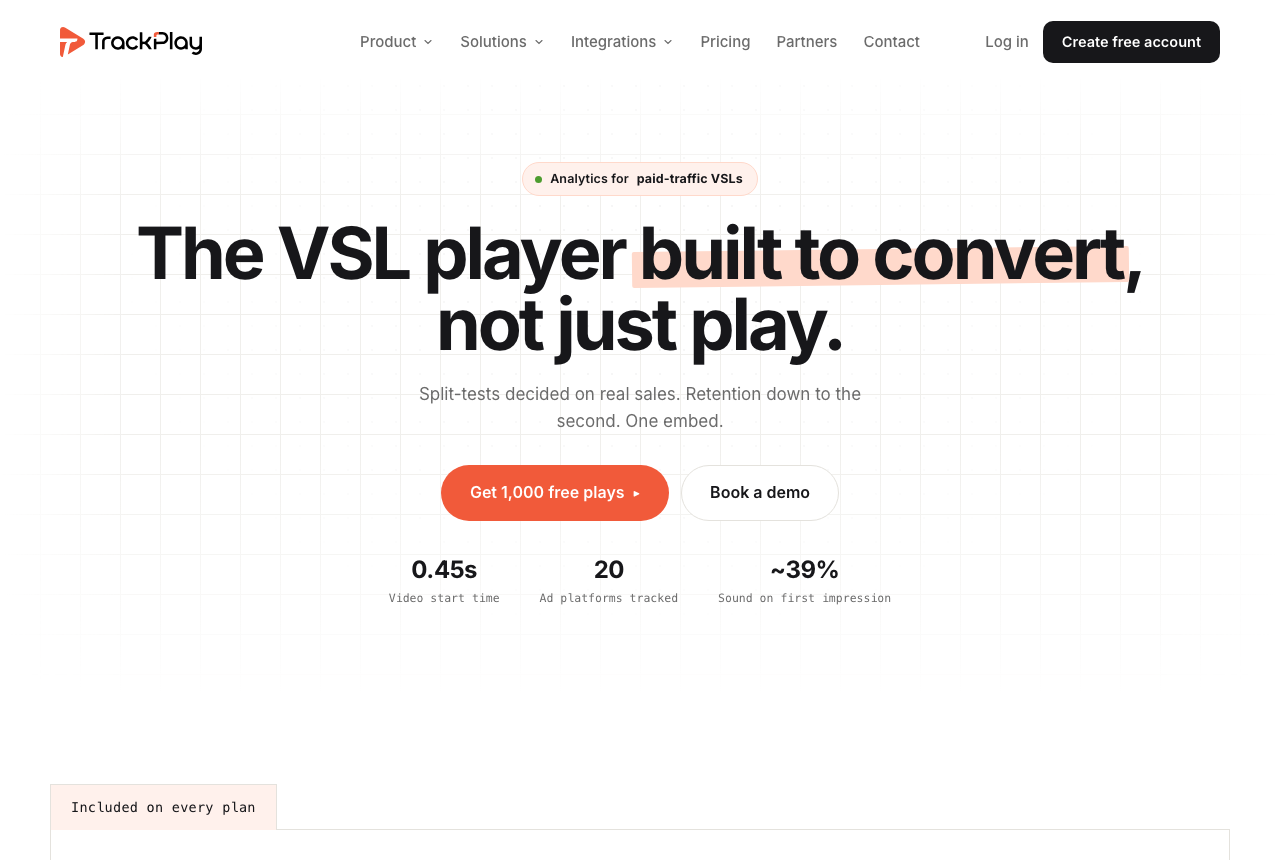
VTurb gives you a dedicated VSL player, and Uscreen gives you a subscription membership platform, and both stop short of the same thing: neither settles a test on the sale, and neither posts that sale back to the ad platforms server-side. VTurb split-tests the player itself, which tells you which cut held attention, not which cut sold, and Uscreen's analytics measure members and engagement, not which ad bought. If your whole business is a paid-traffic sales letter and you want the test decided on the money, a third tool belongs on the table. TrackPlay is a VSL player and analytics platform built for paid-traffic funnels. On the front end it holds attention with sound-first autoplay, timed CTAs and watch gates. On the back end it draws per-second retention split into buyers and non-buyers, with hook rate, hold rate and revenue per play, so you can see the exact seconds to cut or protect.
Where it goes further than either of these is what it settles the test on and how it reports the sale. VTurb tests the player and Uscreen runs no sales test at all; TrackPlay decides its split test on the cart-verified sale, with a real z-test, p-value and confidence interval, and runs every variant under one embed so your ad links and campaign learning never reset. The cart posts the verified sale back onto the play that earned it from seven direct-response processors, including ClickBank, ClickFunnels and Digistore24, server to server, and TrackPlay fires that conversion server-side to Meta, TikTok and GA4 so the ad platform learns from the actual purchase rather than a page-load pixel. It bills by plays rather than storage or bandwidth, every feature ships on every paid plan, and there is a no-card free plan of 1,000 plays a month plus a 14-day trial, with paid plans from $29 a month.
What works
- Split tests are decided on the cart-verified sale, with a real z-test, p-value and confidence interval, and every variant runs under one embed so ad links and campaign learning never reset
- Server-side conversion tracking to Meta, TikTok and GA4 fires on the watch-time milestone you choose and dedupes browser and server events, so the ad platform optimizes on the actual sale rather than a page-load pixel
- Cart postbacks tie each sale to the play that earned it from seven direct-response carts, including ClickBank, ClickFunnels and Digistore24, server to server
- Per-second retention split into buyers and non-buyers, with hook rate, hold rate and revenue per play
- Every feature ships on every paid plan and billing is by plays, with a no-card free plan of 1,000 plays a month and a 14-day trial; paid plans start at $29 a month
What to watch
- Narrow by design: built for paid-traffic VSL conversion, it is not a membership platform or a general content host, so it has none of the catalog, community, native live streaming or branded apps of a Uscreen, and is a poor fit if the video's job is a subscription membership or a content library rather than a direct-response sale
- Very new, with thin outside proof: the testimonials are on its own site, there is little third-party review or Reddit footprint yet, and signup is currently invite-only, so you cannot lean on independent validation before you commit paid traffic. That is what you would expect of a platform this recent
Where TrackPlay is not the answer
It is narrow by design. TrackPlay is built for paid-traffic VSL conversion, not for running a membership or hosting a content library, so it is not a general video host or a B2B content library, and it has none of Uscreen's catalog, community, native live streaming or branded mobile and TV apps. If the video's job is a subscription membership, a content-marketing library or a live channel rather than a direct-response sale, it is the wrong tool, and VTurb or Uscreen is the better home for it. It is also very new, with thin outside proof: the testimonials are on its own site, there is little third-party review footprint yet, and signup is currently invite-only, which is what you would expect of a platform this recent. Pilot it on one funnel and reconcile the numbers against your own cart before you trust it with a proven offer.
Visit TrackPlay for the current plans and the free tier.
Pricing, tier by tier
VTurb's price is the first thing you cannot check cleanly, because it is not publicly listed. The site does not publish a plan table, so the figure is quoted on signup rather than compared in advance, and there is no clearly listed free tier to trial it the way a Vidalytics lets you. That is normal for a tool whose sales motion runs through its home market, but it means an English-market buyer is committing to a number they have not seen next to a feature list. Ask for the plan and the terms in writing before you move an offer.
Uscreen runs a plan ladder billed on subscribers. Starter is $49 a month and carries the catalog, live streaming and community, but it caps at 100 subscribers and does not include the branded apps. Above Starter you pay a per-subscriber fee of $0.99 to $1.99 on top of the monthly base, so a growing membership pays well beyond the headline price. The branded mobile and TV apps, which are the reason many people choose Uscreen, begin on App Essentials at $449 a month. There is no permanent free plan, only a 14-day trial with no card.
The two meter different things, so there is no clean sticker comparison. For hosting and running a pre-recorded sales letter, VTurb is the relevant spend, because it bundles the smart-player features and split testing you came for into the product rather than charging for a subscription business you will never run. Uscreen's base buys that subscription business: catalog, live streaming, community and the option of branded apps, which is good value if you are running a membership and dead weight if your video is a single sales letter. Weigh them by what each one lets you deliver for the money, not by the headline price.
Each has a billing risk worth pricing in. VTurb's is transparency: there is no public plan table and no clearly listed free trial, so your first real look at the price comes at signup, and an English-market buyer has less to compare than they would for a Vidalytics or a Wistia. Uscreen's is the contract: reviewers on Trustpilot report annual plans with no mid-term downgrade or cancellation, being billed through the full term, and delayed payouts after cancelling, so start on the monthly Starter plan and cancel in writing. Neither is a reason to rule the tool out; both are things to pin down before you commit.
TrackPlay prices differently again, and it is worth a line because it changes the model. It bills by plays rather than storage, bandwidth or subscribers, so a high-traffic sales letter is metered on views watched, and every feature ships on every plan. Paid plans start at $29 a month, and there is a no-card free plan of 1,000 plays a month, watermarked, plus a 14-day trial of the paid features, so there is a genuine free way to pilot it before you spend, which is more than VTurb publishes here.
The verdict
Between these two, VTurb wins for this site's core reader, the marketer running a pre-recorded video sales letter. It is the only one of the pair actually built for that page: a dedicated VSL smart player with sound-first autoplay, progress controls, deep styling, built-in split testing and domain security, and it is proven at scale in Latin-American direct response. Uscreen is a real platform, but it is a subscription-membership platform: its catalog, community, native live streaming and branded apps are built to run a recurring business, not to sell to cold traffic from a recorded video, and a single VSL pays per subscriber for machinery it never uses. Two honest limits stay attached to the VTurb pick, and they are real. Its pricing is not published, so you cannot compare the number in advance, and its independent English-language review base is thin, with docs and support that lean toward the Portuguese-speaking market. Test it on a non-critical funnel and get the plan in writing, then commit.
Uscreen wins the other reader, and it is a real one. If your business is a recurring subscription membership, and you want members watching a catalog, joining a community and paying you every month through your own branded apps, Uscreen is the stronger platform by a distance and VTurb does not compete for that job at all. It gives you the catalog, native live streaming, the community space and iOS, Android and TV apps its team builds for you, with over 4,000 creator businesses behind it and a success manager to launch you. The trade is the bill and the terms: per-subscriber fees stack above Starter, the branded apps start at $449 a month, and annual contracts are rigid with delayed-payout complaints attached, so start monthly and cancel in writing.
The tie-breaker is simple. If your page is a sales letter and you want a player built for it without writing code, buy VTurb and get the plan in writing. If your business is a subscription membership with its own apps, buy Uscreen. And there is a third call for one specific reader: if your whole business is a paid-traffic sales letter and you want the split test settled on the actual cart-verified sale, not on which player variant held attention and not on member engagement, look at TrackPlay before you commit. VTurb tests the player and Uscreen scores no test on the sale; TrackPlay decides its split test on the cart-verified sale with real statistics and posts that sale back to Meta, TikTok and GA4 server-side. It is the newer, narrower specialist and its outside proof is still thin, so pilot it on one funnel first.
Our pick
VTurb
For a pre-recorded video sales letter on paid traffic, VTurb is the pick of these two, because it is the only one built for the job. It is a dedicated smart player with sound-first autoplay, progress controls, deep styling, built-in split testing and domain security, proven at scale in Latin-American direct response. Just go in with your eyes open on the two honest limits: its pricing is not published, so get the plan and terms in writing, and its independent English-language track record is thin, so pilot it on a non-critical funnel first. Choose Uscreen instead only if your business is a subscription membership, where its catalog, community, live streaming and branded apps are worth the per-subscriber price.
Frequently asked questions
Is VTurb or Uscreen better?
Which is cheaper, VTurb or Uscreen?
Does either one prove which paid traffic actually bought?
Can VTurb run a video sales letter for paid traffic?
Does Uscreen do subscriptions and branded apps that VTurb does not?
What if I want the split test scored on the cart-verified sale?
Sources
Other sources
6 discussions and reviews read for this page. Quotes are excerpts; open a link to read the original in context.
Related reading
- Our full VTurb review, a dedicated smart player for direct response
- Our full Uscreen review, a subscription video membership platform
- VTurb alternatives, ranked by whether they move sales
- Uscreen alternatives, ranked by whether they move sales
- TrackPlay vs Uscreen: sales letter or membership
- VTurb vs Vimeo: a dedicated VSL player against a finished host
- The best VSL players and conversion video software
- All head-to-head comparisons