Head to head
VTurb vs VSLStats
Two direct-response VSL players from opposite ends of the risk scale. VTurb is the proven, widely-used smart player; VSLStats is the brand-new tracker built for attribution but short on proof. Which to trust today, which to pilot, and who each is wrong for.
You are down to two, and they sit at opposite ends of the risk scale. VTurb and VSLStats are both direct-response VSL players, both built to hold a cold viewer through the pitch and move them to the cart. Line them up on a features grid and VSLStats looks like it does more. Look at how much of each you can actually check before you pay, and the picture changes.
This site judges video tools through a direct-response lens: does the player move viewers past the pitch, and can you prove which paid traffic actually bought. VTurb is the more proven of the two and this site's second-ranked player. It is a fast, deeply styled smart player with smart autoplay, playback controls, split testing and domain security, and it has a real following in Latin-American direct response. Its limits are proof, price and depth: it does not list public English pricing, its independent English-language track record is thin, and its split tests are decided on plays and views with limited revenue attribution, so it holds attention well but stops short of tying the edit to the sale.
VSLStats is built to fill exactly that attribution gap, and it is a few months old. It launched in March 2026 claiming server-side Meta CAPI, GA4 and TikTok forwarding that ad blockers and iOS cannot drop, plus revenue attribution back to individual watch sessions, in one branded player with play gates, timed CTAs and AI captions, from $47 a month. On paper it closes the loop most players leave open. The reason to read the rest of this page before buying is that almost none of it can be checked from outside yet: four five-star Trustpilot reviews, a 40 percent affiliate program behind much of its online praise, a headline feature that inflates the progress bar on purpose, and terms that guarantee nothing and refund nothing.
So the choice is not what the video is for. It is whether you buy the proven player and handle attribution around it, or gamble on the newcomer's tracking claim. Below we put the two side by side on price, player, testing and attribution, then say plainly who each one is for.
Quick answer
Pick VTurb if you want a proven, widely-used smart VSL player with smart autoplay, split testing and domain security that you can run on a live funnel today, and you are handling your pixels and attribution elsewhere; pick VSLStats if built-in server-side Meta, GA4 and TikTok forwarding with per-session revenue attribution is a hard requirement and you are willing to pilot a brand-new tool on a $1 card trial, weighing its inflated HookBoost progress bar and non-refundable terms before you trust it with a real offer.
One more option before the two-way call. VSLStats is chasing a job VTurb stops short of: the conversion posted back to the ad platforms server-side, tied to the actual sale rather than a play. That job has a purpose-built specialist, TrackPlay, which ties the cart-verified sale to the play that earned it. We line it up beside the two below.
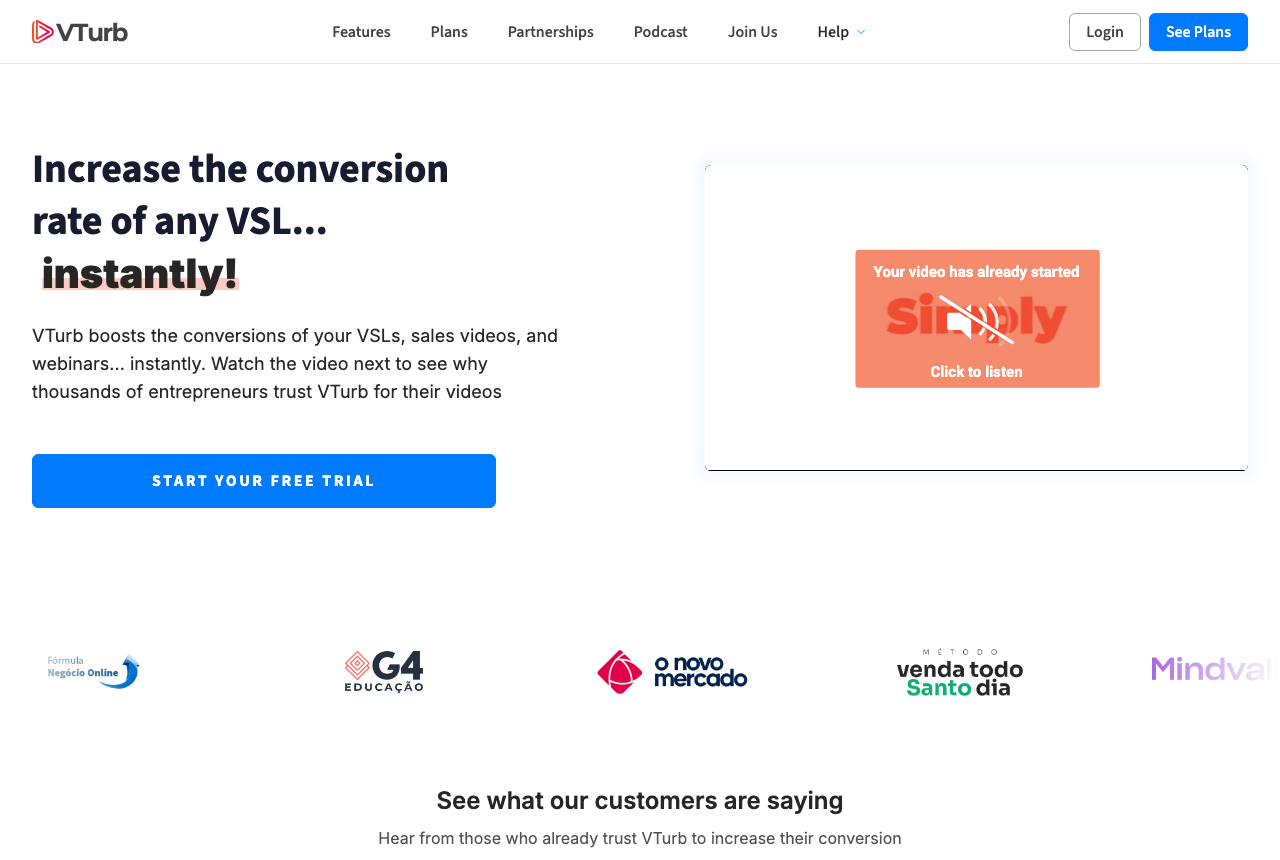
- VTurb. The proven pick, and this site's second-ranked player. Built around the VSL, with smart autoplay, playback controls, split testing, domain security and deep player styling, it is widely used in Latin-American direct response and has real advocates there. Its limits are proof, price and depth: public English pricing is not listed, so you request a quote; there is far less independent English-language track record to check; and its split tests are decided on plays and views with limited revenue attribution, so it holds attention well but stops short of tying the edit to the sale. Test it on a non-critical funnel before you move a serious offer onto it.
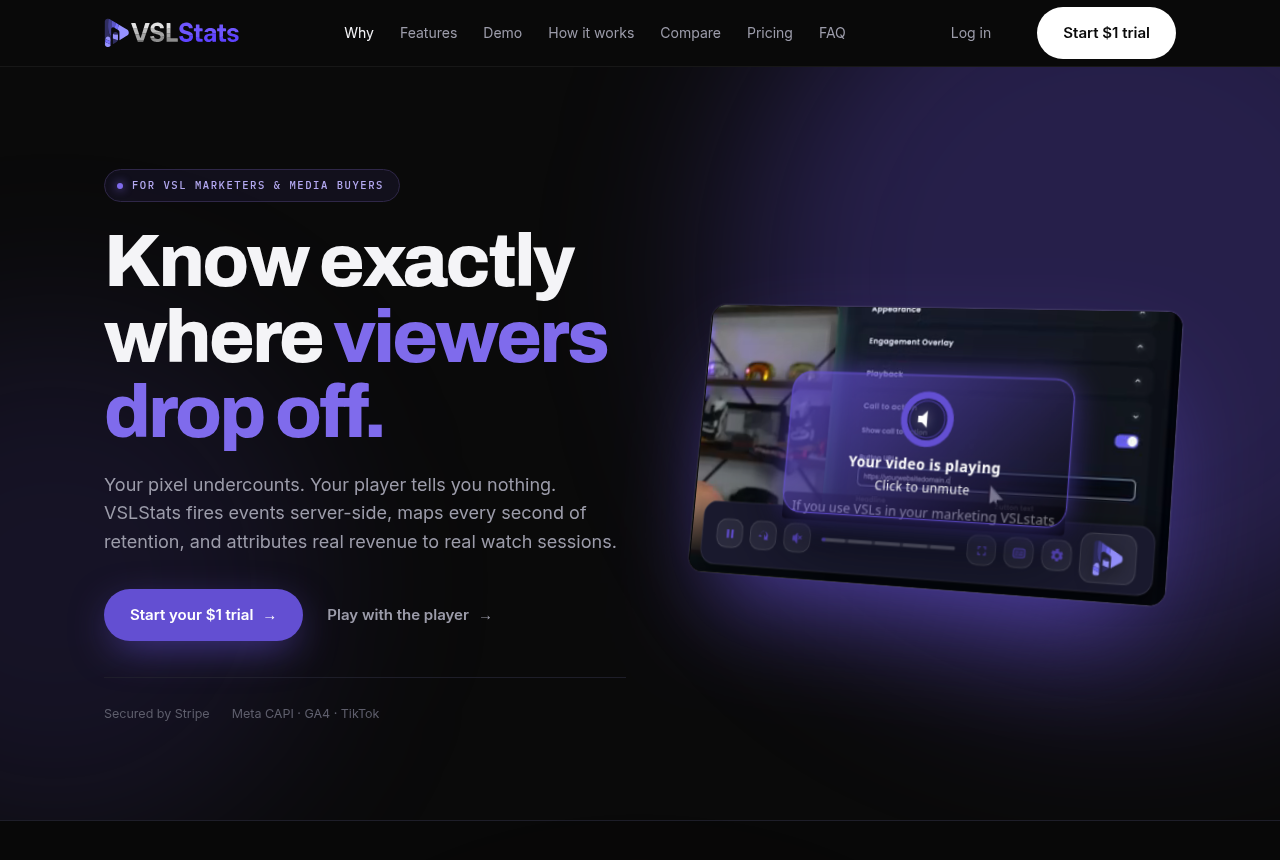
- VSLStats. The brand-new challenger aimed straight at the tracking gap. It claims server-side Meta CAPI, GA4 and TikTok forwarding that survives ad blockers and iOS, plus revenue attribution back to individual watch sessions, in one branded player with play gates, timed CTAs and AI captions, from $47 a month on a $1 trial. The catch is proof, not the pitch: it launched in March 2026 with four five-star Trustpilot reviews and a 40 percent affiliate program, its HookBoost feature deliberately inflates the progress bar, and its terms are non-refundable and disclaim any lift. Pilot it, do not migrate to it.
- TrackPlay. The paid-traffic VSL specialist for the exact job VSLStats claims. It decides split tests on the cart-verified sale and fires that conversion server-side to Meta, TikTok and GA4, tied to the play that earned it from seven direct-response carts, from $29 a month with a free tier. Like VSLStats it is new, so pilot it; unlike VSLStats it runs no inflated progress bar, and unlike VTurb its price is public. Not a general host or a B2B content library.
VTurb vs VSLStats at a glance
Prices and plan features checked on the vendors' own pages on 28 September 2026. TrackPlay is the direct-response specialist we line these two up against, so it wins the conversion rows and sits out the general-hosting ones.
| Feature | VTurb | VSLStats | TrackPlay |
|---|---|---|---|
| What it is | A lighter smart VSL player, strong in Latin-American DR | A brand-new server-side tracking player | A conversion-tracked VSL player and attribution platform |
| Track record | Widely used in Latin-American DR, thin English proof | Launched March 2026, almost none yet | New, thin outside proof yet |
| Built for | Holding a cold viewer through the pitch | Server-side pixel forwarding on a VSL | Proving which paid traffic bought, server-side |
| Starting price | Not publicly listed (quote-based) | $47/mo ($39 billed annually) | $29/mo, billed by plays |
| Free tier | Not listed publicly | No, a $1 7-day trial, card required | Yes, 1,000 plays/mo, watermarked |
| Player and play logic | Smart autoplay, playback controls, deep styling | Branded player, play gates, timed CTAs, AI captions | Sound-first autoplay, timed CTAs, watch gates |
| Split testing | Yes, decided on plays and views | A/B test on Pro, not clearly sales-scored | Yes, decided on the cart-verified sale |
| Revenue attribution | Limited | Claimed, to individual watch sessions (unverified) | Yes, cart-verified sale posted to the play |
| Ad-platform conversion tracking | Pixel firing; limited server-side | Claimed server-side to Meta CAPI, GA4, TikTok | Server-side to Meta, TikTok and GA4, deduped |
| Retention analytics | Per-viewer retention | Second-by-second retention heatmaps | Per-second, split by buyers vs non-buyers |
| Cart-verified sale postbacks | No | No, session-level attribution claim | Yes, from seven direct-response carts |
| Manipulative patterns | None | HookBoost inflates the progress bar by design | None |
| Independent reviews | Real following at home, thin English proof | Four 5-star Trustpilot reviews, 40% affiliate program | Almost none, very new |
| Best for | A proven smart player, especially LatAm DR | Testing server-side forwarding, if you pilot carefully | Server-side, cart-verified proof of which traffic bought |
Strengths and trade-offs
VTurb asks you to accept a hidden price and thin English-language proof in exchange for a fast, deeply styled player with real advocates in its home market. VSLStats asks you to trust a server-side tracking claim no one outside the vendor has verified, from a tool a few months old with an openly manipulative progress bar and non-refundable terms. Those are two very different levels of risk.
VTurb: what works, what to watch
What works
- VSL-specific player with smart autoplay and progress controls
- Split testing and domain security built in
- Deep player customization
What to watch
- Public English pricing is not clearly listed
- Thin English-language review track record
- Support and docs lean toward the Portuguese-speaking market
VSLStats: what works, what to watch
What works
- It targets the gap most hosts leave open: server-side Meta CAPI, GA4 and TikTok forwarding, plus revenue attribution back to individual watch sessions, so in principle you see which traffic bought, not just who pressed play
- A complete VSL toolkit in one embed: second-by-second retention heatmaps, play gates, timed CTAs, AI captions and a fully brandable player, with no Zapier or tag manager
- You can drive the real player before paying: the site's interactive demo toggles every control live, and a $1, 7-day full-access trial promises a 24-hour warning email before the first charge
- Flat, public pricing that undercuts a dedicated VSL player: from $47 a month ($39 billed annually), Pro at $97, with the server-side forwarding and revenue attribution on the Pro tier
What to watch
- Almost no independent proof yet: it launched in March 2026, its Trustpilot profile holds just four reviews, all five-star, from a company that invites reviews, and there is next to no Reddit or forum track record to check
- A 40% recurring, lifetime-cookie affiliate program means much of the praise you find online is paid, so discount any glowing review that shows no data of its own
- HookBoost, a headline feature, deliberately inflates the progress bar so viewers believe they are further along than they are. It is an openly manipulative pattern that can be a compliance problem in regulated markets, so weigh it before you switch it on
- The $1 trial needs a card and auto-renews, and the terms make fees non-refundable except where law requires, disclaim any conversion or revenue lift, and put the GDPR controller burden on you
- None of the headline tracking claims (CAPI deduplication, attribution accuracy, reliability at ad scale) can be verified from outside yet, so you are the one testing them. Pilot on a non-critical funnel and reconcile against Stripe and Meta before you migrate a proven offer
TrackPlay: the paid-traffic VSL pick
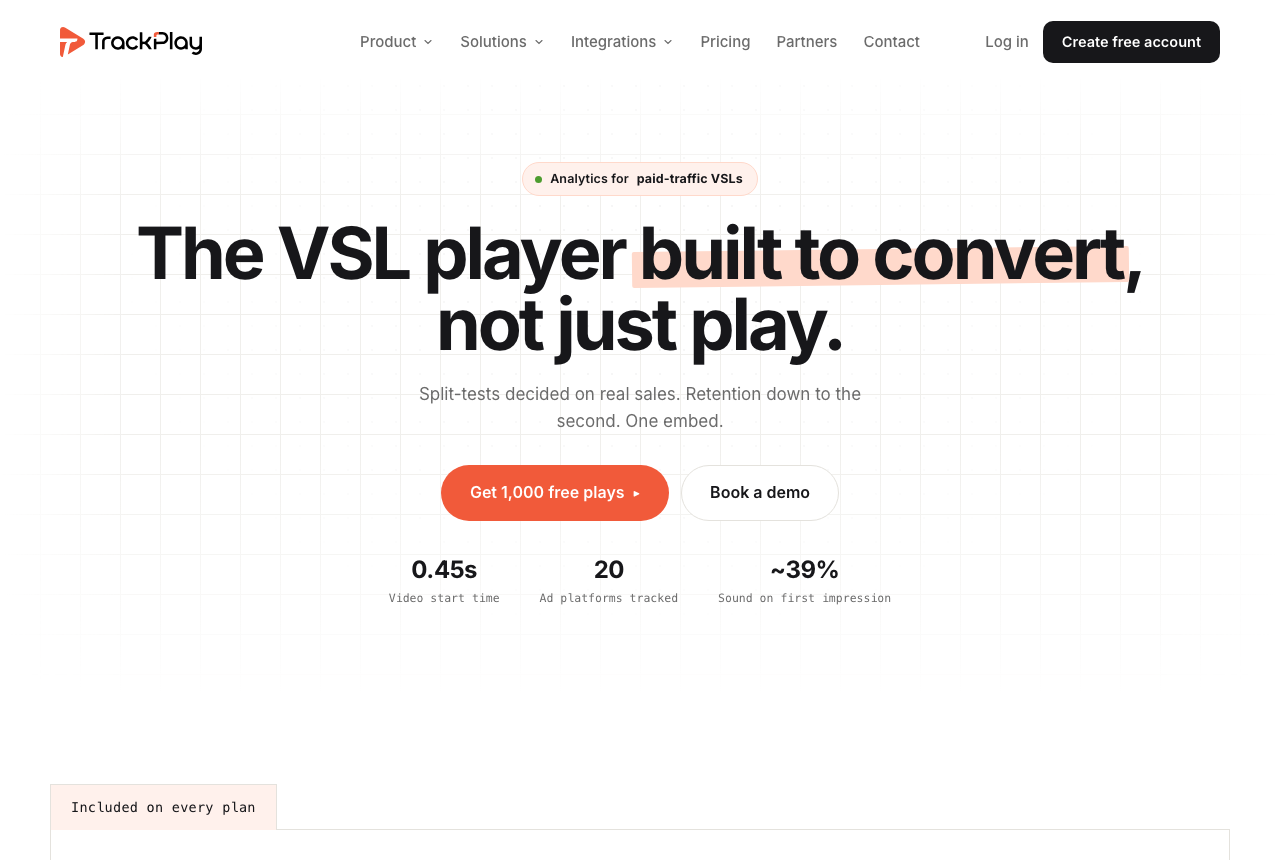
VTurb and VSLStats leave the same job half-done, and it is this site's first criterion in its hardest form: proving which paid traffic actually bought. VTurb tests on plays and views, so it stops a step short of the sale. VSLStats claims to forward events server-side, but the claim is unverified and it does not tie the conversion to the cart. If closing that gap is the whole reason you are choosing a player, there is a third tool worth putting on the table. TrackPlay is a VSL player and analytics platform built for paid-traffic funnels. On the front end it holds attention with sound-first autoplay, timed CTAs and watch gates. On the back end it draws per-second retention split into buyers and non-buyers, with hook rate, hold rate and revenue per play, so you can see the exact seconds to cut or protect.
Where it goes further than either of these is attribution, and how it is verified. It verifies the sale at the cart: the purchase posts back onto the play that earned it from seven direct-response carts, including ClickBank, ClickFunnels and Digistore24, server to server, and TrackPlay fires that conversion server-side to Meta, TikTok and GA4 so the ad platform learns from the actual sale rather than a page-load pixel, deduping browser and server events. Its split tests are decided on that cart-verified sale with real statistics, a z-test with a p-value and a confidence interval, and every variant runs under one embed so your ad links and campaign learning never reset. It bills by plays, every feature ships on every paid plan, and there is a no-card free plan of 1,000 plays a month plus a 14-day trial, with paid plans from $29 a month.
What works
- Split tests are decided on the cart-verified sale, with a real z-test, p-value and confidence interval, and every variant runs under one embed so ad links and campaign learning never reset
- Server-side conversion tracking to Meta, TikTok and GA4 fires on the watch-time milestone you choose and dedupes browser and server events, so the ad platform optimizes on the actual sale rather than a page-load pixel
- Cart postbacks tie each sale to the play that earned it from seven direct-response carts, including ClickBank, ClickFunnels and Digistore24, server to server
- Per-second retention split into buyers and non-buyers, with hook rate, hold rate and revenue per play
- Every feature ships on every paid plan and billing is by plays, with a no-card free plan of 1,000 plays a month and a 14-day trial; paid plans start at $29 a month
What to watch
- Narrow by design: built for paid-traffic VSL conversion, it is not a general video host or a B2B content library, so it has none of the channels, SEO pages or webinar tooling of a Wistia and is a poor fit if the video's job is content marketing rather than a direct-response sale
- Very new, with thin outside proof: the testimonials are on its own site and there is little third-party review or Reddit footprint yet, so you cannot lean on independent validation before you commit paid traffic. That is what you would expect of a platform this recent
Where TrackPlay is not the answer
It is narrow by design. TrackPlay is built for paid-traffic VSL conversion, not general hosting, so it is not a video host or a B2B content library and it has none of the channels, SEO pages or webinar tooling of a Wistia. If the video's job is content marketing rather than a direct-response sale, it is the wrong tool. Between these three that limit barely bites, since all of them are direct-response VSL players and a reader choosing here is not shopping for a content library. It is also very new, with thin outside proof: the testimonials are on its own site and there is little third-party review footprint to check yet, which is what you would expect of a platform this recent. Unlike VSLStats it runs no inflated progress bar and its split tests are settled on the verified sale, but it earns the same advice: pilot it on one funnel and reconcile against your own cart before you trust it with a launch.
Visit TrackPlay for the current plans and the free tier.
Pricing, tier by tier
VTurb does not clearly list public English pricing, so you will usually get a quote through sales or a partner rather than a plan page. We are not going to invent a number. Confirm the current price, the billing terms and what each tier includes directly with VTurb before you commit, and treat any third-party figure as unverified until VTurb states it. The friction of having to ask is itself a cost before you have watched a single play, and a reason to test it on a small funnel first.
VSLStats has no free tier. Every plan starts on a $1, 7-day full-access trial that needs a card and auto-renews, with a promised 24-hour warning email before the first charge. Monthly, Starter is $47, Pro is $97, Enterprise is $197 and Agency starts at $397. Billed annually the first three tiers drop to $39, $79 and $159. The one number that matters: the server-side forwarding and revenue attribution, the whole reason to look at VSLStats, sit on the Pro tier at $97 a month, not the $47 entry plan.
So you cannot really price these two against each other at the door, because one hides its number and the other's real number is the $97 Pro tier where its tracking lives. Read VSLStats' terms before the trial converts: fees are non-refundable except where law requires, the terms disclaim any conversion or revenue lift, and they put the GDPR data-controller burden on you. Use a card you can cap, set a reminder before the $1 trial renews at full price, and treat month one as a paid pilot you can still stop.
TrackPlay prices differently again, and it is worth a line because it is the only one of the three you can read from a public page. It bills by plays rather than storage or bandwidth, paid plans start at $29 a month with every feature on every plan, and there is a no-card free plan of 1,000 plays a month, watermarked, plus a 14-day trial. Read the play definition first: its own terms count a start, an unmute, a resume and a replay each as a play, so one viewer can register several. Its case is not that it is cheapest but that you can see the price and it does the attribution work the other two stop short of.
The verdict
For this site's core reader, someone buying cold traffic to a video sales letter, VTurb is the pick, and the reason is proof. Both are real direct-response players. But VTurb is a working, widely-used smart player with a genuine following, and VSLStats is a few months old with four solicited reviews, a manipulative progress bar and a server-side tracking claim no one outside the vendor has verified. When you are choosing which tool to run a live funnel on, a proven player you can trust today beats a better spec sheet you cannot check.
Buy VTurb with its two limits in view. It does not list public English pricing, so you have to request a quote before you can budget, and its split tests are decided on plays and views rather than the sale, with limited revenue attribution. So it holds a cold viewer through the pitch as well as anything here, but it will not tell you which edit or which traffic source made the money. If your stack already handles pixels and attribution, that is a manageable gap. If it does not, weigh the newcomer, or the specialist below.
VSLStats is worth a pilot, not a migration. Its server-side forwarding and per-session revenue attribution are the one thing VTurb does not do, and if they work as described they close the loop iOS opened. But it launched in March 2026, its four Trustpilot reviews are all five stars from a company that invites them, a 40 percent lifetime affiliate program sits behind much of its online praise, its HookBoost feature inflates the progress bar on purpose, and its terms refund nothing and guarantee nothing. Test it on a non-critical funnel with a card you can cap, reconcile its numbers against Stripe and Meta yourself, and only then decide.
And if the reason you are comparing these two is the attribution itself, proving which paid traffic actually bought at the level of the sale, look at TrackPlay in the section above. It is the specialist for that job: the cart posts the verified sale back onto the play that earned it, from seven direct-response carts, and TrackPlay fires that conversion server-side to Meta, TikTok and GA4, deciding split tests on the sale with real statistics. It is narrow by design, built for paid-traffic VSL conversion rather than general hosting or content marketing, so it is not the tool if the video's job is content marketing rather than a direct-response sale, and it is as new as VSLStats and thin on outside proof, so pilot it the same way. But it does the cart-verified version of the job VTurb stops short of and VSLStats only claims, without an inflated progress bar.
Our pick
VTurb
VTurb is the pick if you want a proven, widely-used smart VSL player you can run on a live funnel today, and you handle your pixels and attribution elsewhere. It holds a cold viewer through the pitch as well as anything here. Just confirm its price by quote, and know its testing stops at plays and views, not the sale.
Frequently asked questions
Is VTurb or VSLStats better?
Which is cheaper, VTurb or VSLStats?
Can VTurb prove which traffic bought?
What is HookBoost, and should it worry me?
What if I need the sale posted back to my ad platforms tied to the cart?
Sources
Other sources
9 discussions and reviews read for this page. Quotes are excerpts; open a link to read the original in context.
Related reading
- Our full VTurb review
- Our full VSLStats review
- VTurb vs TrackPlay: a proven player or a new one built to prove the sale
- VSLStats vs TrackPlay: two new trackers, one scored on the sale
- Vidalytics vs VTurb: two direct-response players compared
- VTurb alternatives, ranked by the job
- VSLStats alternatives, ranked by the job
- The best VSL players and conversion video software
- All head-to-head comparisons