Head to head
Vidalytics vs VTurb
Two direct-response VSL players. Vidalytics is the more complete, proven pick that scores split tests on sales and attributes revenue. VTurb is the lighter smart player, strongest in Latin-American funnels, but it tests on views and hides its price.
You are down to two, and this time they are the same kind of tool. Vidalytics and VTurb are both direct-response VSL players, both built to hold a cold viewer through the pitch and move them to the cart. So the choice is not what the video is for. It is which of the two does more of the exact job you are buying it for, and how much you can check before you commit.
This site judges video tools through a direct-response lens: does the player move viewers past the pitch, and can you prove which paid traffic actually bought. Both pass the first test. They part on the second, and on how much of the product you can see before you pay.
Vidalytics is the more complete of the two, and this site's top-ranked player. It scores native A/B tests on sales rather than views, draws a second-by-second engagement graph split by buyer and non-buyer, attributes revenue, and fires watch behaviour to Meta and Google for retargeting. Its price is public and there is a free plan to try it.
VTurb is the lighter, faster smart player, with deep styling and domain security, and it has a real following in Latin-American direct response. But its split tests are decided on plays and views, its revenue attribution is limited, and it does not list public English pricing, so you request a quote. Below we put the two side by side on price, player, testing and attribution, then say plainly who each one is for.
Quick answer
Pick Vidalytics if you run paid traffic to a video sales letter and want the more complete, proven player: native split tests scored on sales, second-by-second retention split by buyer and non-buyer, revenue tracking and public pricing from a free plan; pick VTurb if your funnel is in the Latin-American market, you value a fast, deeply styled player with domain security, and you are content to settle split tests on plays and views and to request a quote for the price.
If your whole problem is that iOS and cookie loss have made the ad platforms undercount your sales, neither of these fully closes it. TrackPlay is the third name to put on the table for that job: it verifies the sale at the cart and fires it back to the ad platforms server-side.
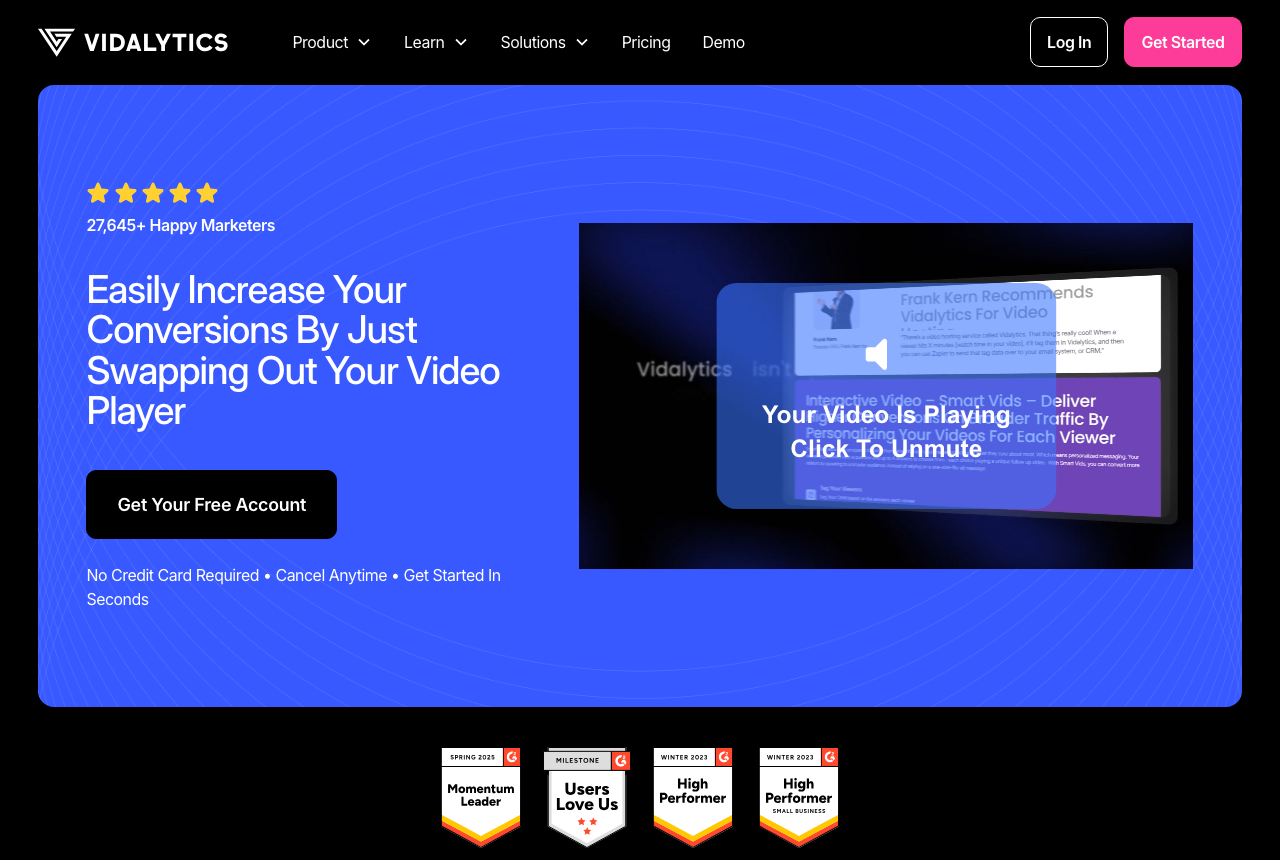
- Vidalytics. The more complete, proven player, and this site's top-ranked one. Built for direct response, with smart autoplay, resume play, timed CTAs and play gates on the front end, and a second-by-second engagement graph, heatmaps, buyer-versus-non-buyer segmentation, revenue tracking and native A/B tests scored on sales on the back. It fires watch behaviour to Meta and Google for retargeting. There is a Free Forever plan and paid plans from $24 a month. Two limits ride with it: the deepest conversion analytics sit on the higher Pro tier, and a high-traffic VSL is metered at $0.33 per GB over your plan.
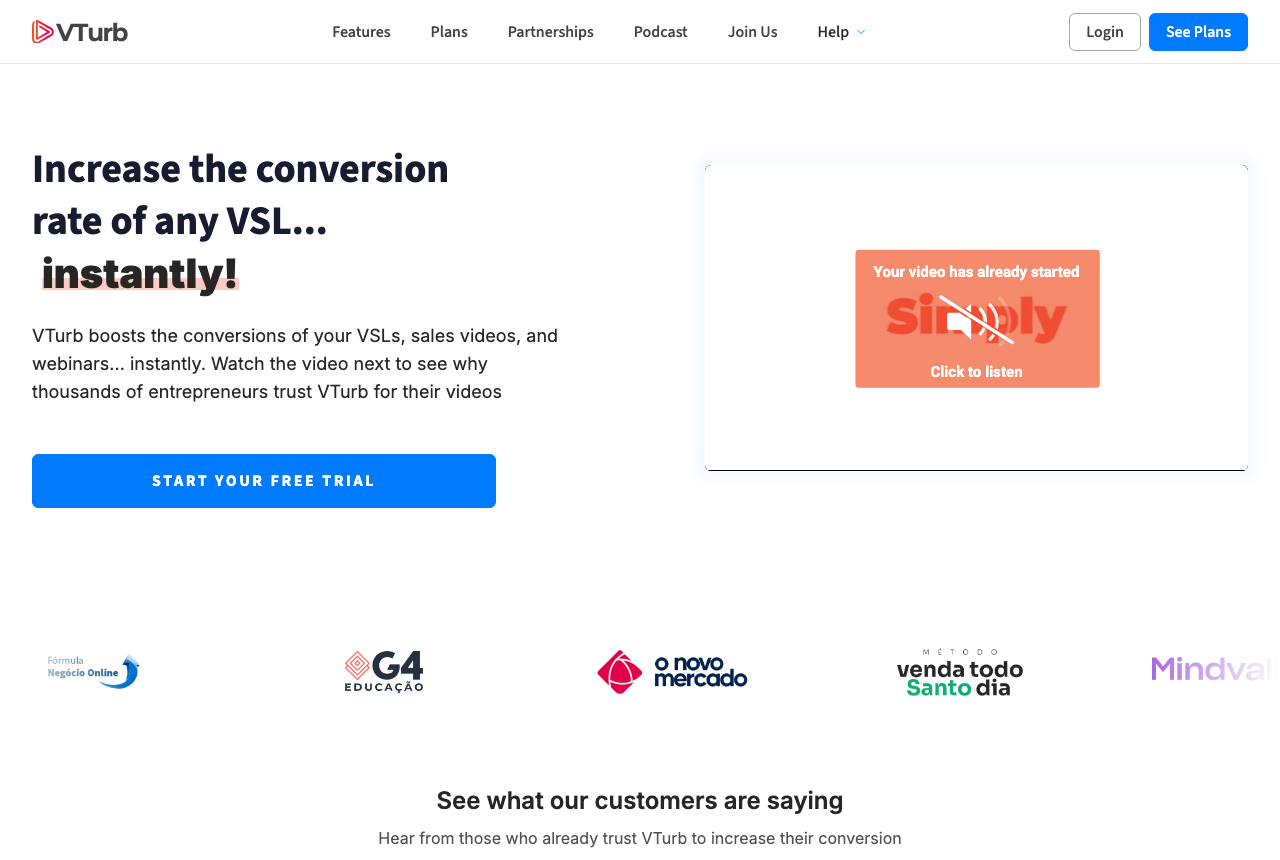
- VTurb. The lighter smart player. Built around the VSL, with smart autoplay, playback controls, split testing, domain security and deep player styling, it is widely used in Latin-American direct response. Its limits are proof, price and depth: public English pricing is not listed, so you request a quote; there is far less independent English-language track record to check; and its split tests are decided on plays and views with limited revenue attribution, so it holds attention well but stops short of tying the edit to the sale.
- TrackPlay. A VSL player and analytics platform built for paid-traffic funnels. It decides split tests on the cart-verified sale and posts that sale back to Meta, TikTok and GA4 server-side, the attribution job neither Vidalytics nor VTurb does server to server.
Vidalytics vs VTurb at a glance
Prices and plan features checked on the vendors' own pages on 27 September 2026. TrackPlay is the direct-response specialist we line these two up against, so it wins the conversion rows and sits out the general-hosting ones.
| Feature | Vidalytics | VTurb | TrackPlay |
|---|---|---|---|
| What it is | The proven, complete direct-response VSL player | A lighter smart VSL player, strong in Latin-American DR | A new VSL player built for cart-verified attribution |
| Track record | Established, real marketer user base | Widely used in Latin-American DR, thin English proof | Launched 2026, thin outside proof yet |
| Starting price | $24/mo ($19 billed annually) | Not publicly listed (quote-based) | $29/mo, billed by plays |
| Free tier | Free Forever (3 videos, 50 GB) | Not listed publicly | Free plan (1,000 plays/mo, watermarked) |
| Player controls | Smart autoplay, resume, timed CTAs, play gates | Smart autoplay, playback controls, deep styling | Sound-first autoplay, timed CTAs, watch gates |
| Split testing | Native, scored on sales | Yes, decided on plays and views | Native, decided on the cart-verified sale |
| Retention analytics | Second-by-second, buyer vs non-buyer | Per-viewer retention | Per-second, split by buyers vs non-buyers |
| Revenue attribution | Yes, second by second | Limited | Yes, revenue per play plus cart postbacks |
| Ad tracking | Meta and Google, browser-side | Pixel firing; limited server-side | Server-side Meta, TikTok and GA4, deduped |
| Cart postbacks | No, browser watch events | No | Yes, from seven direct-response carts |
| Domain security | Yes | Yes | Domain-locked hosting |
| Billing model | Metered bandwidth ($0.33/GB overage) | Quote-based | Billed by plays, every feature on every plan |
| Best for | A proven, complete DR VSL player | A proven smart player, especially LatAm DR | Server-side, cart-verified proof of the sale |
Strengths and trade-offs
Both are real direct-response players, so the trade-offs are fine ones. Vidalytics asks you to accept browser-side ad tracking and a per-gigabyte bandwidth meter, in exchange for a proven, complete player that scores tests on sales and attributes revenue. VTurb asks you to accept a hidden price and thin English-language proof, in exchange for a fast, deeply styled player with real advocates in its home market.
Vidalytics: what works, what to watch
What works
- Purpose-built VSL controls: smart autoplay, resume play, timed CTAs, play gates
- Second-by-second engagement graph, heatmaps and buyer/non-buyer segmentation
- Conversion and revenue tracking, plus native A/B tests judged on clicks or sales
- Free plan to start; paid from $24/mo ($19 billed annually)
What to watch
- Bandwidth beyond your plan is billed at $0.33/GB, so a high-traffic VSL can outrun the sticker price
- Smaller independent review base than mainstream hosts, so less third-party proof to check
- More player and analytics settings than you need if you only want to host and embed a clip
VTurb: what works, what to watch
What works
- VSL-specific player with smart autoplay and progress controls
- Split testing and domain security built in
- Deep player customization
What to watch
- Public English pricing is not clearly listed
- Thin English-language review track record
- Support and docs lean toward the Portuguese-speaking market
TrackPlay: the paid-traffic VSL pick
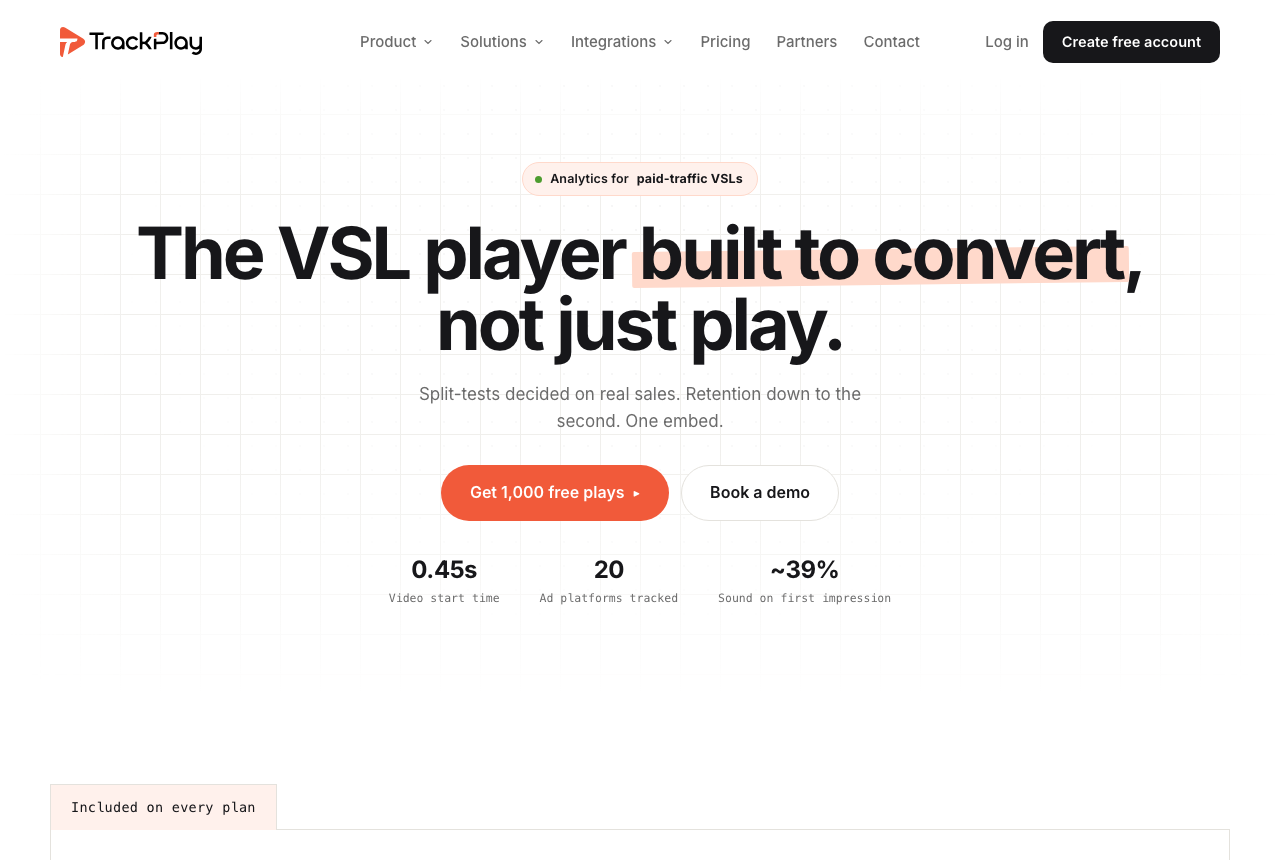
Vidalytics and VTurb share one blind spot, and it is this site's first criterion in its hardest form: proving which paid traffic actually bought. Vidalytics scores tests on sales, but browser-side, so iOS and cookie loss can drop the event before the ad platform sees it. VTurb tests on plays and views, so it stops a step short of the sale entirely. If closing that gap is the whole reason you are choosing a player, there is a third tool worth putting on the table. TrackPlay is a VSL player and analytics platform built for paid-traffic funnels. On the front end it holds attention with sound-first autoplay, timed CTAs and watch gates. On the back end it draws per-second retention split into buyers and non-buyers, with hook rate, hold rate and revenue per play, so you can see the exact seconds to cut or protect.
Where it goes further than either of these is attribution. It verifies the sale at the cart: the purchase posts back onto the play that earned it from seven direct-response carts, including ClickBank, ClickFunnels and Digistore24, server to server, and TrackPlay fires that conversion server-side to Meta, TikTok and GA4 so the ad platform learns from the actual sale rather than a page-load pixel. Its split tests are decided on that cart-verified sale with real statistics, a z-test with a p-value and a confidence interval, and every variant runs under one embed so your ad links and campaign learning never reset. It bills by plays, every feature ships on every paid plan, and there is a no-card free plan of 1,000 plays a month plus a 14-day trial, with paid plans from $29 a month.
What works
- Split tests are decided on the cart-verified sale, with a real z-test, p-value and confidence interval, and every variant runs under one embed so ad links and campaign learning never reset
- Server-side conversion tracking to Meta, TikTok and GA4 fires on the watch-time milestone you choose and dedupes browser and server events, so the ad platform optimizes on the actual sale rather than a page-load pixel
- Cart postbacks tie each sale to the play that earned it from seven direct-response carts, including ClickBank, ClickFunnels and Digistore24, server to server
- Per-second retention split into buyers and non-buyers, with hook rate, hold rate and revenue per play
- Every feature ships on every paid plan and billing is by plays, with a no-card free plan of 1,000 plays a month and a 14-day trial; paid plans start at $29 a month
What to watch
- Narrow by design: built for paid-traffic VSL conversion, it is not a general video host or a B2B content library, so it has none of the channels, SEO pages or webinar tooling of a Wistia and is a poor fit if the video's job is content marketing rather than a direct-response sale
- Very new, with thin outside proof: the testimonials are on its own site, there is little third-party review or Reddit footprint yet, so you cannot lean on independent validation before you commit paid traffic. That is what you would expect of a platform this recent
Where TrackPlay is not the answer
It is narrow by design. TrackPlay is built for paid-traffic VSL conversion, not general hosting or content marketing, so it is not a video host or a B2B content library and it has none of the channels, SEO pages or webinar tooling of a Wistia. If the video's job is content marketing and feeding leads into a CRM rather than a direct-response sale, it is the wrong tool. Between these three that limit barely bites, since all of them are direct-response VSL players and a reader choosing here is not shopping for a content library. It also does not stream live, so webinars or live launches are a different tool's job. And it is very new, with thin outside proof: the testimonials are on its own site and there is little third-party review footprint to check yet, which is what you would expect of a platform this recent. Pilot it on one funnel and reconcile the numbers against your own cart before you trust it with a launch.
Visit TrackPlay for the current plans and the free tier.
Pricing, tier by tier
Vidalytics starts at $24 a month, or $19 billed annually, and there is a genuine Free Forever plan for three videos and 50 GB to try it. The plan you pick is set by bandwidth, and overages bill at $0.33 per GB on top, so a high-traffic VSL can cost more than the sticker. One thing to check before you commit: the deepest conversion analytics, including native A/B testing scored on sales, sit on the higher Pro tier rather than the entry plan, so price the tier that actually carries the features you came for.
VTurb does not clearly list public English pricing, so you will usually get a quote through sales or a partner rather than a plan page. We are not going to invent a number. Confirm the current price, the billing terms and what each tier includes directly with VTurb before you commit, and treat any third-party figure as unverified until VTurb states it.
Because VTurb hides its price and Vidalytics meters bandwidth, budget on your real traffic rather than a headline. Vidalytics is the one you can price today: a $24 entry, a free plan with no meter to watch, and a clear $0.33 per GB overage you can model against your expected views. VTurb you have to ask for, which is a friction cost of its own before you have watched a single play, and a reason to test it on a small funnel first.
TrackPlay prices differently again, and it is worth a line because it changes the model. It bills by plays rather than storage or bandwidth, so a high-traffic sales letter is metered on views watched, not gigabytes served. Paid plans start at $29 a month with every feature on every plan, and there is a no-card free plan of 1,000 plays a month, watermarked, plus a 14-day trial. Read the play definition first: its own terms count a start, an unmute, a resume and a replay each as a play, so one viewer can register several. Its case is not that it is cheapest but that you can see the price and it does the attribution work the other two do not.
The verdict
Between these two, Vidalytics is the buy for most of this site's readers, and it is not close on the things that matter here. It is the more complete player and this site's top-ranked one: native split tests scored on sales, a second-by-second engagement graph split by buyer and non-buyer, revenue tracking, and watch behaviour fired to Meta and Google for retargeting, all from a Free Forever plan and a price you can read on the page. Two honest limits ride with the pick: the deepest conversion analytics sit on the higher Pro tier, so price that tier, and a high-traffic VSL is metered at $0.33 per GB over your plan. Both are the cost of buying the settled, proven option.
VTurb is not a weak tool, and it wins a real reader. If your funnel is in the Latin-American market, where VTurb is widely used and its support and docs lean toward Portuguese, and you value a fast, deeply styled player with domain security over sale-scored attribution, it is a genuine contender and often the more familiar one in that market. Its cost is proof and price transparency: there is far less independent English-language track record to check, and you request a quote rather than read the price, so test it on a non-critical funnel and confirm the number with VTurb before you move a serious offer onto it.
There is a third call for one specific reader. If your whole problem is that iOS and cookie loss have made the ad platforms undercount your sales, neither of these closes it: Vidalytics tracks browser-side and VTurb tests on views. TrackPlay is built for exactly that gap, verifying the sale at the cart and firing it back to Meta, TikTok and GA4 server-side, decided with statistical significance. It is the newer, narrower specialist and its outside proof is still thin, so pilot it on one funnel first. For a proven, complete player you can trust today, this does not change the answer: that is Vidalytics.
Our pick
Vidalytics
Vidalytics is the pick for this site's core reader: someone running paid traffic to a video sales letter. Of these two it is the more complete and the more proven, and the one you can price on the page. It has a real base of marketer use behind it, native A/B tests scored on sales, a second-by-second engagement graph with buyer-versus-non-buyer segmentation, and revenue tracking, and it fires watch data to Meta and Google so viewers who did not buy become a retargeting audience. Its limits are the price of the settled option: the deepest analytics sit on the Pro tier and its ad tracking is browser-side. VTurb wins the reader whose funnel is in the Latin-American market and who values a fast, deeply styled player over sale-scored attribution, once they have confirmed the quote.
Frequently asked questions
Is Vidalytics or VTurb better?
Which is cheaper, Vidalytics or VTurb?
Can VTurb prove which traffic bought?
Is VTurb only for the Latin-American market?
What if I need to prove which paid traffic actually bought, not just track engagement?
What is Vidalytics best at?
Sources
Other sources
7 discussions and reviews read for this page. Quotes are excerpts; open a link to read the original in context.
Related reading
- Our full Vidalytics review
- Our full VTurb review
- Vidalytics vs TrackPlay: the proven player versus a new server-side tracker
- VTurb vs TrackPlay: a proven player or a new one built to prove the sale
- Vidalytics vs Panda Video: two direct-response players compared
- Vidalytics alternatives, ranked by the job
- VTurb alternatives, ranked by the job
- The best VSL players and conversion video software
- All head-to-head comparisons