Vidalytics vs Panda Video
Pick Vidalytics if the video has to sell and prove which traffic bought; pick Panda Video if it is a course that has to stay protected and convert for less.
By Marcus Vale, Lead reviewer. Reviewed by the VSLBench editorial desk. Last updated 23 September 2026, and rechecked with prices every 90 days.
You are down to two, and this time they are the same kind of product. Both Vidalytics and Panda Video are finished, branded VSL players: you upload a file, copy an embed, and a clean ad-free player is live on your page, with your logo and none of YouTube's chrome. Both fire Meta and Google pixels, both run A/B tests, and both put smart autoplay and calls to action inside the player. On a features grid they look level. This comparison is about the one line where they genuinely part.
This site judges video tools through a direct-response lens: does the player move viewers past the pitch, and can you prove which traffic bought. Both clear the first half. They split on the second. Vidalytics is built to prove which traffic bought: it scores split tests on sales rather than views, attributes revenue back to the video, and its second-by-second engagement graph shows exactly where viewers drop. Panda runs A/B tests and fires the same ad-platform pixels, but it does not score those tests on sales or attribute revenue, so it optimises attention and clicks, not the sale itself. What Panda answers instead is protection and completeness: DRM watermarking, anti-download locking, AI dubbing and a course-shaped toolkit.
So the real decision is what you most need to do: optimise the sale, or protect and localise the content. If the whole business is the sales letter and you have to prove which traffic bought, that points one way. If you sell courses that must not leak and you want AI localization out of the box for less money, it points the other. Below we put the two side by side on price, the player, protection and analytics, then say plainly who each one is for.
Quick answer
Pick Vidalytics if you run paid traffic to a video sales letter and need to score split tests on sales, attribute revenue and see second-by-second where viewers drop; pick Panda Video if you sell online courses that need real download protection and AI localization, and you want a converting, flat-priced player that costs less to run at volume.
- Vidalytics. A purpose-built VSL player. Smart autoplay, resume play, timed CTAs and play gates up front; a second-by-second engagement graph, heatmaps, buyer-versus-non-buyer segmentation, revenue tracking and A/B tests scored on sales behind it. Free Forever plan, paid from $24 a month ($19 billed annually), with bandwidth overage at $0.33 a GB.
- Panda Video. A finished VSL and course host. Smart autoplay, a dummy progress bar, in-player CTAs, A/B tests and Meta and Google pixels, plus DRM watermarking, anti-download and allowed-domains locking, and AI dubbing into up to 34 languages. Flat public pricing from $17.90 a month, no free plan, a 14-day trial capped at 100GB. Its A/B tests are not scored on sales, and independent English reviews are almost non-existent.
Vidalytics vs Panda Video at a glance
Prices and plan features checked on the vendors' own pages on 23 September 2026.
| Feature | Vidalytics | Panda Video |
|---|---|---|
| What it is | A conversion VSL player | A finished VSL and course host |
| Built for | Proving which paid traffic bought | Selling and protecting course and VSL video |
| Starting price | $24/mo ($19 billed annually) | $17.90/mo (Bronze), flat and public |
| Free tier | Yes, Free Forever (3 videos, 50 GB/mo) | No, 14-day trial (100GB cap) |
| Smart autoplay and resume | Yes | Yes |
| VSL player controls | Timed CTAs, play gates | Dummy progress bar, in-player CTAs |
| A/B testing | Yes, scored on sales or revenue | Yes, not scored on sales |
| Retention analytics | Second-by-second, heatmaps (Pro and up) | Per-video retention |
| Buyer vs non-buyer segmentation | Yes | No |
| Revenue attribution | Yes | No |
| Meta and Google pixels | Yes | Yes |
| Download protection | Domain security, access controls | DRM watermark, anti-download, allowed domains |
| AI features | No | In-player tutor, dubbing to 34 languages, subtitles |
| Pricing model | Plan allowance, then $0.33/GB bandwidth overage | Flat plans, then $0.06/GB storage and $0.03/GB bandwidth |
| Independent English reviews | Smaller base than mainstream hosts, Trustpilot present | Almost none (G2 and GetApp list zero) |
| Best for | Selling to paid traffic, measured on the sale | Course sellers wanting protection and AI localization |
Strengths and trade-offs
Vidalytics asks you to pay a premium, watch a steeper bandwidth meter and accept lighter download protection; Panda asks you to buy on the vendor's own testimonials and accept that its A/B tests do not score on sales. Those are the two trade-offs.
Vidalytics: what works, what to watch
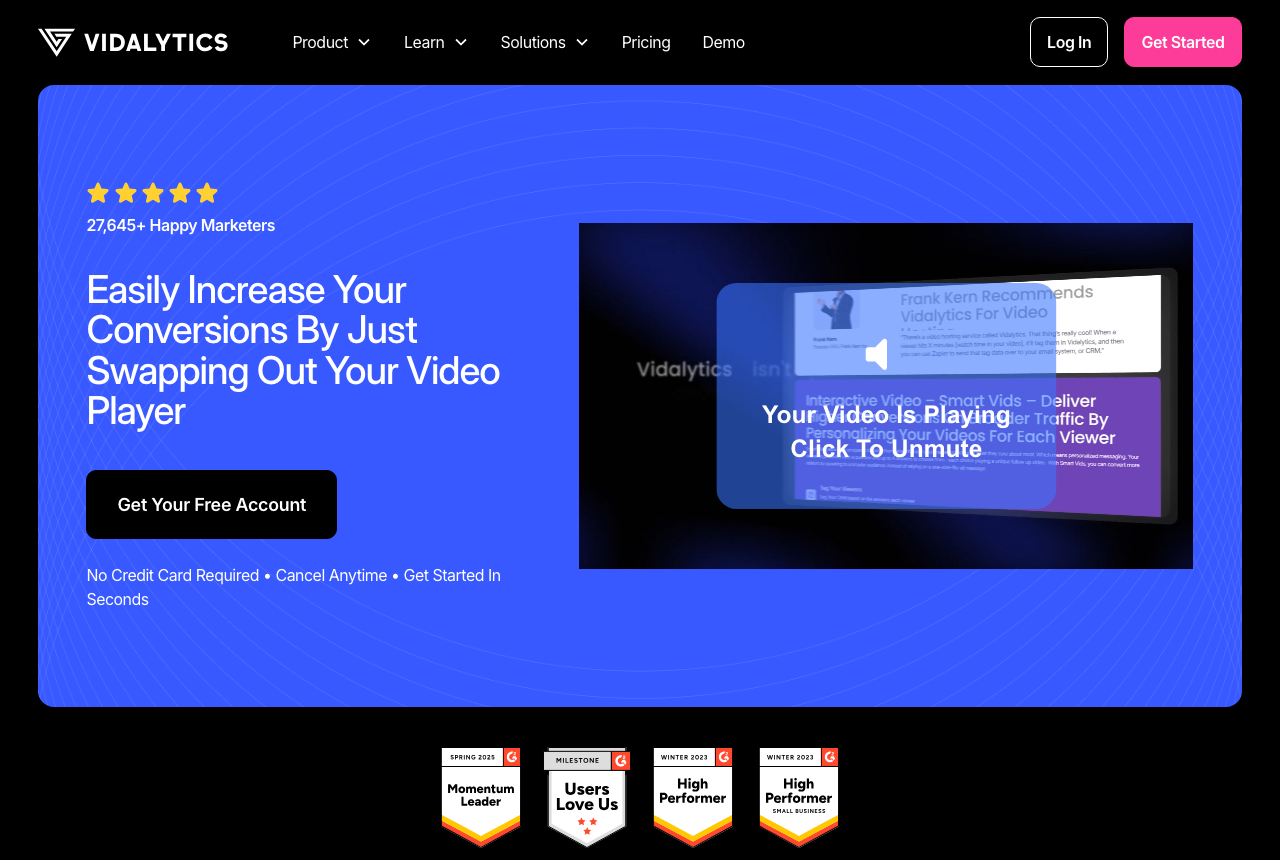
What works
- Purpose-built VSL controls: smart autoplay, resume play, timed CTAs, play gates
- Second-by-second engagement graph, heatmaps and buyer/non-buyer segmentation
- Conversion and revenue tracking, plus native A/B tests judged on clicks or sales
- Free plan to start; paid from $24/mo ($19 billed annually)
What to watch
- Bandwidth beyond your plan is billed at $0.33/GB, so a high-traffic VSL can outrun the sticker price
- Smaller independent review base than mainstream hosts, so less third-party proof to check
- More player and analytics settings than you need if you only want to host and embed a clip
Panda Video: what works, what to watch
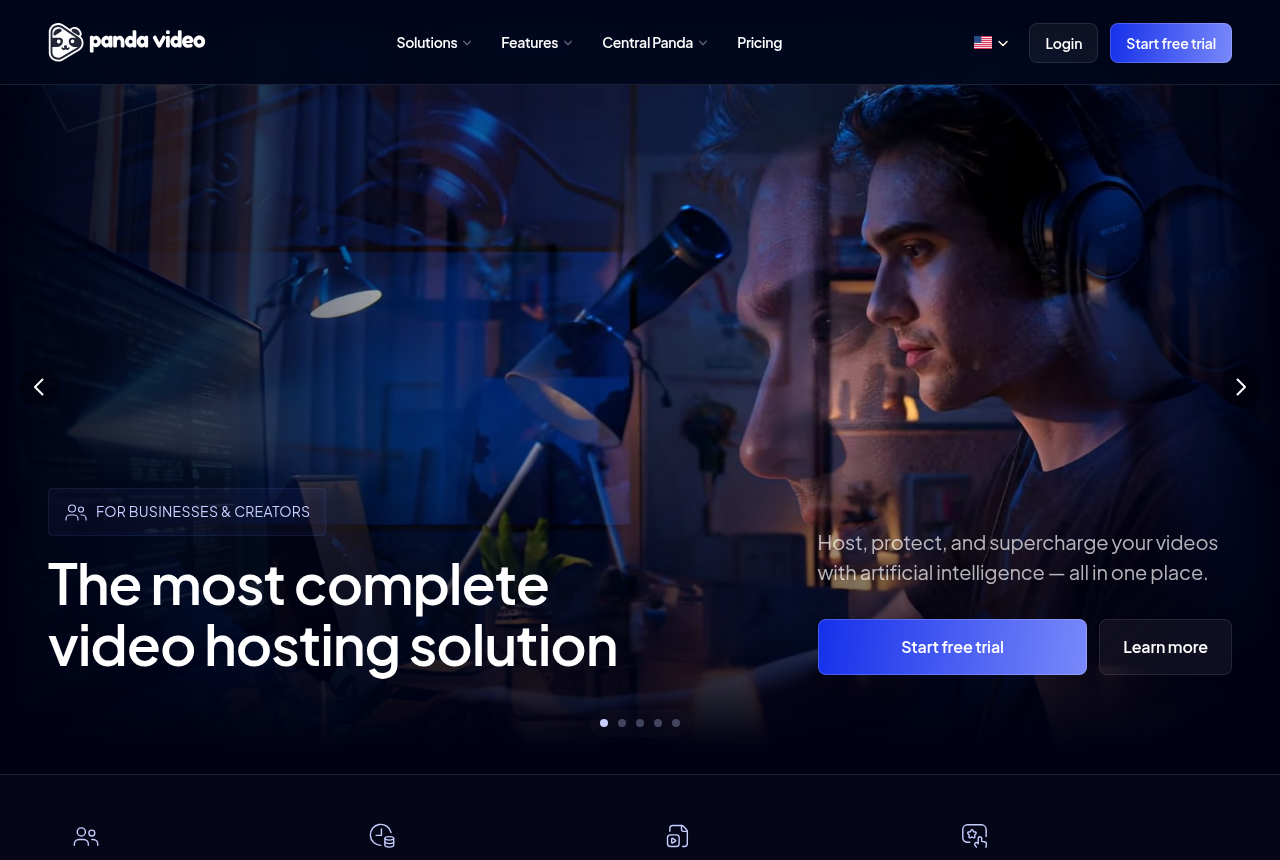
What works
- A real VSL toolkit: smart autoplay, a dummy progress bar, resume play, in-player CTAs, A/B tests and Meta and Google tracking pixels
- Strong content protection: DRM watermarking, anti-download, allowed-domains locking and encryption
- Flat, public pricing from $17.90/mo, with a real-time usage chart so the bandwidth and storage bill is predictable
- A one-click Chrome extension imports a Vimeo library in minutes, and support is fast and in Portuguese
- Built-in AI: an in-player tutor, dubbing into up to 34 languages, and auto-generated subtitles, quizzes and mind maps
What to watch
- Almost no independent English-language proof: G2 and GetApp both show zero user reviews and there is no Trustpilot profile, so you are buying on the vendor's own testimonials
- It does not score a split test on sales or attribute revenue, so a paid-traffic VSL cannot prove which traffic actually bought
- Biggest in the Latin-American market: the dashboard, docs and support lean Portuguese-first, and pricing shows in a mix of dollars and reais
- Extra storage ($0.06/GB), extra bandwidth ($0.03/GB) and DRM watermarking ($0.60/GB) all bill per GB, so a high-traffic offer outruns the flat sticker price
- Credit card is the only payment method, and anti-download unlocks only on the Gold plan
Pricing, tier by tier
Vidalytics has a Free Forever plan: one user, three videos and 50 GB of monthly bandwidth with restricted analytics, enough to try the player but not to run a funnel. Paid plans billed monthly are Starter at $24, Pro at $79 and Premium at $149; billed annually they drop to $19, $63 and $119 a month. Enterprise is custom, and paid plans start a 14-day trial. The line that matters for direct response is Pro: heatmaps, buyer segmentation and conversion tracking begin there, so Starter is a starter and Pro is the plan most VSL operators actually run.
Panda Video sells flat, public plans. Bronze is $17.90 a month (200GB storage, 500GB bandwidth, one user), Silver is $37.90 (512GB, 1TB, two users), Gold is $97.90 (1TB, 4TB, ten users, plus the anti-download lock and free AI generation), and Enterprise is on request. There is no free plan, only a 14-day trial capped at 100GB, and credit card is the only payment method. The costs that scale are the overages: storage at $0.06 a GB, bandwidth at $0.03 a GB, and DRM watermarking as a $0.60-per-GB add-on. A real-time usage chart shows the running total, so the bill is predictable.
The running cost is where the money genuinely favours Panda, which is worth stating plainly because it is the opposite of the usual VSL-player comparison. Panda is cheaper at entry, $17.90 against Vidalytics' $24, and its bandwidth overage is $0.03 a GB against Vidalytics' $0.33, more than ten times cheaper per GB. For a high-traffic sales letter, where bots and cheap clicks pad the bandwidth, that gap compounds fast, and Panda's bill can end up well below Vidalytics' at the same volume. The one place Vidalytics is cheaper is $0: its Free Forever plan lets you test the player at no cost, which Panda's card-only trial does not.
So the money is not the deciding factor here, and if anything it leans Panda's way at scale. The question is whether Vidalytics' sales-scored testing and revenue attribution are worth the premium and the steeper meter. If the whole business is the sales letter and one round of optimization on real drop-off data pays for the year, yes. If you sell protected courses and you only need the player to convert decently while the content stays locked, Panda does that for less, and paying Vidalytics' bandwidth rate for attribution you will not act on is money lost.
The verdict
Between these two, pick on what you most need to prove or protect. Vidalytics wins for this site's core reader because it is the only one of the pair that scores a split test on sales, attributes revenue, and shows second-by-second where viewers drop. For a paid-traffic VSL where the whole business is the sales letter, that measurement is the job, and it is worth the premium and the steeper bandwidth bill. Two honest limits stay attached to the pick: its bandwidth overage is $0.33 a GB, far above Panda's, and its download protection stops at domain security, short of Panda's DRM and anti-download.
Panda Video wins when the priority is protecting course content and getting a converting, localised player for less. Its DRM watermarking, anti-download and allowed-domains locking go beyond Vidalytics' domain security, its AI dubbing into up to 34 languages is genuinely useful, and it is cheaper to run at volume. Two cautions attach to it, though. It does not score a test on sales or attribute revenue, so it cannot prove which traffic actually bought, and its independent English-language proof is almost empty, with G2 and GetApp both listing zero reviews, so pilot it on a low-stakes funnel before you migrate a proven offer. The tie-breaker is simple: if you need to know which traffic bought, buy Vidalytics; if you need to protect a course and localise it cheaply, buy Panda.
Our pick
Vidalytics
Vidalytics is the pick for this site's core reader: someone buying cold traffic and sending it to a video sales letter, where the whole business is the sales letter. Both of these players convert, fire Meta and Google pixels and run A/B tests, but Vidalytics is the only one that scores those tests on sales rather than views, attributes revenue, and shows second-by-second where viewers drop. On the site's first criterion, proving which traffic bought, it is ahead. Two honest limits keep that in perspective. Its bandwidth overage is $0.33 a GB, far steeper than Panda's $0.03, so a high-traffic VSL runs up a bigger bill. And its download protection stops at domain security and access controls, short of Panda's DRM watermarking and anti-download. Choose Panda Video instead when you sell online courses that must not leak: its DRM watermarking, anti-download and allowed-domains locking go further, it dubs into up to 34 languages with AI, and its flat plan from $17.90 a month costs less to run at volume. Just weigh Panda's two cautions before you migrate a proven offer: it does not score a split test on sales or attribute revenue, and its independent English-language proof is almost empty, with G2 and GetApp both listing zero reviews.
Frequently asked questions
Is Vidalytics or Panda Video better?
Which is cheaper, Vidalytics or Panda Video?
Can Panda Video prove which traffic bought, the way Vidalytics does?
Which has better content protection?
Is Panda Video trustworthy given how few reviews it has?
Can either one run a video sales letter for paid traffic?
Sources
Other sources
9 discussions and reviews read for this page. Quotes are excerpts; open a link to read the original in context.
- [] Vidalytics pricing (vendor)
- [] Vidalytics for VSLs and video funnels (vendor)
- [] Panda Video home (vendor)
- [] Panda Video pricing (vendor)
- [] Panda Video VSL player (vendor)
- [] Vidalytics customer reviews (Trustpilot)
- [] Panda Video reviews on G2
- [] Where are you hosting client videos now that Vimeo changed pricing (r/videoproduction)
- [] Trouble downloading from Panda Video (r/youtubedl)