Head to head
Vimeo vs TrackPlay
One hosts video beautifully; the other proves which paid traffic bought. The pick turns on what the video is actually for.
You are down to two, and this pairing is wider than most on this site. Vimeo and TrackPlay are not two flavours of the same tool. Vimeo is clean, professional video hosting: a place to store, embed and present video so it looks good and loads fast. TrackPlay is a paid-traffic VSL player built to prove which traffic, which edit and which second of the pitch actually made the sale. So the real question is not which is better in the abstract. It is what the video is for.
This site judges video tools through one lens: does the player move a cold viewer past the pitch, and can you prove which paid traffic actually bought. On that test the two split cleanly. Vimeo does not try to do it. There is no smart autoplay, no split test scored on sales, no per-second retention split by buyer, no revenue attribution. It hosts the video, and it hosts it well. TrackPlay is built for nothing else.
So this comparison is really a decision about the job. If the video is a portfolio reel, a client review link, a course library or an event replay, Vimeo is the simpler, cheaper, more proven answer, and TrackPlay is the wrong tool. If the video is a sales letter you are buying cold traffic to, Vimeo will host it fine and tell you almost nothing about why it did or did not convert, while TrackPlay is built around that exact question.
Below we put the two side by side on price, player, analytics and attribution, then say plainly who each one is for. One caution rides on TrackPlay throughout, and it is about age rather than capability: it launched in 2026 with almost no independent track record, so it is a pilot, not a foundation, until its own numbers check out against yours.
Quick answer
Pick Vimeo if the video's job is clean, ad-free, professional hosting for a portfolio, client review, a course library or an event, and you are not running cold paid traffic to a sales letter; pick TrackPlay if you buy traffic to a video sales letter and need to prove which traffic, which edit and which second of the pitch actually made the sale, with per-second retention split by buyer, split tests decided on the cart-verified sale, and server-side conversion tracking to Meta, TikTok and GA4, and you will pilot it on one funnel first because it is new.
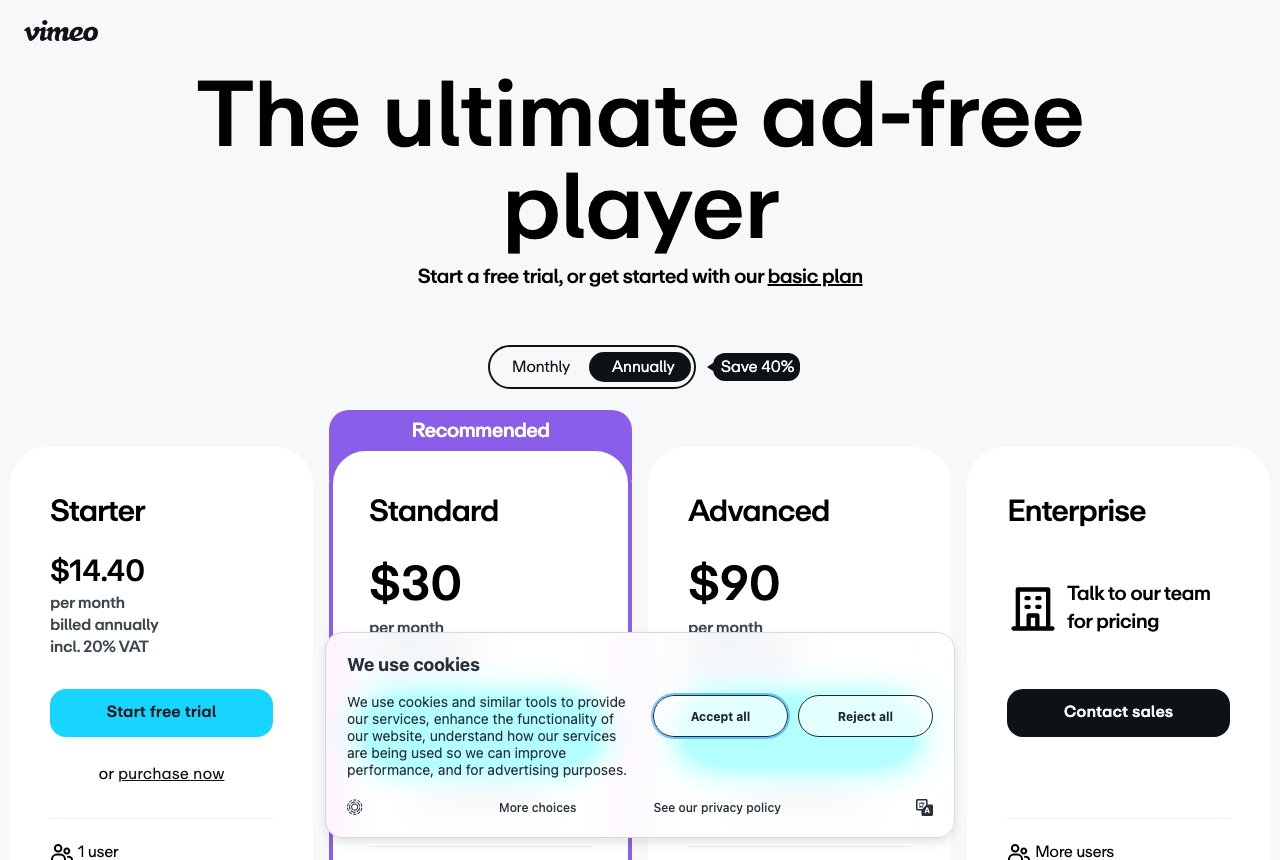
- Vimeo. Clean, ad-free, reliable video hosting, and the simplest pick when the video just needs to look good and load fast: portfolios, client review, course libraries and events. Player-branding removal, custom CTAs and lead-capture forms arrive on the $25 Standard seat, and live events on the $75 Advanced seat. What it does not do is the direct-response job: no smart autoplay, no A/B tests scored on sales, no per-second retention split by buyer, no revenue attribution. Entry is about $12 a seat with a genuine free tier, but a 2 TB bandwidth threshold and steep 2025-2026 renewal increases have bitten long-time subscribers, so price the running cost, not the sticker.
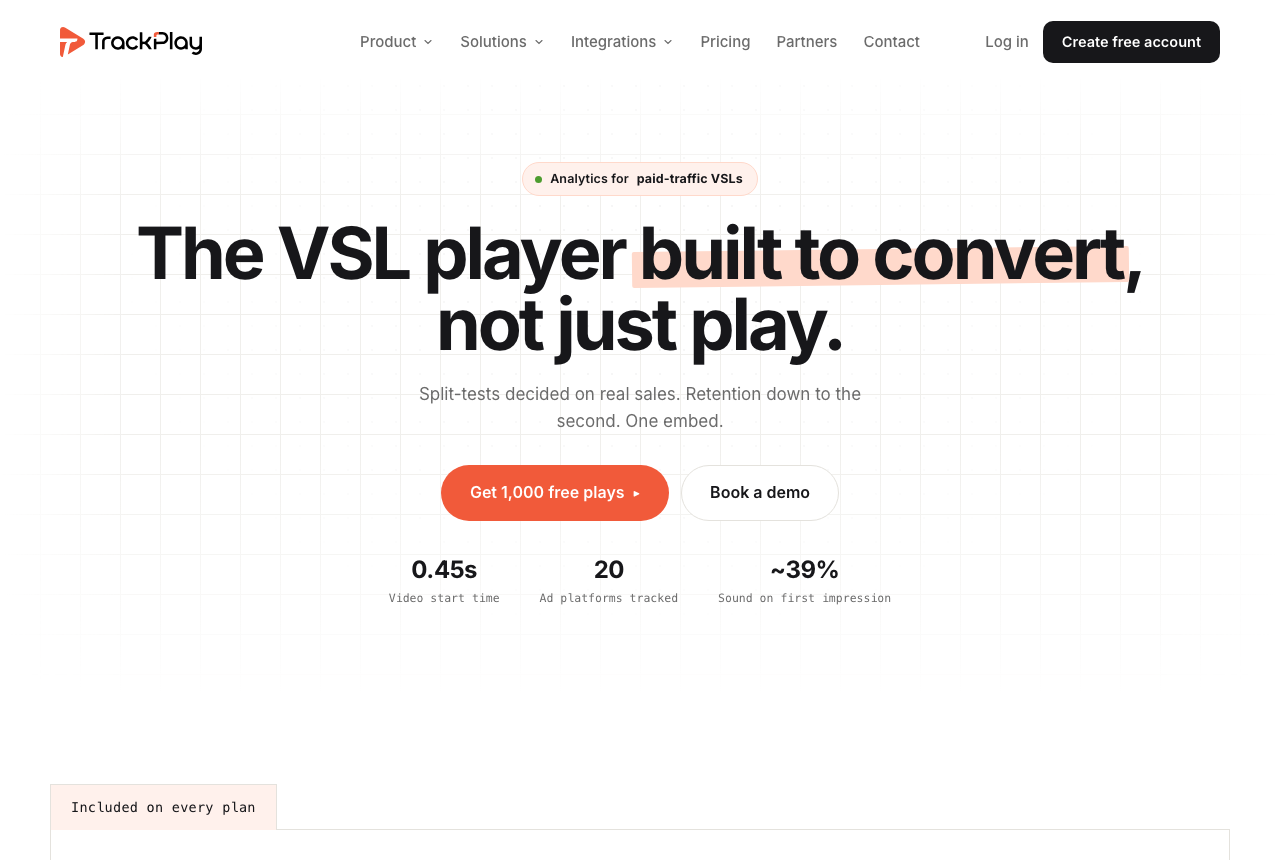
- TrackPlay. A paid-traffic VSL player and attribution platform built for one job: proving which traffic bought. It holds a cold viewer with sound-first autoplay, timed CTAs and watch gates, draws per-second retention split into buyers and non-buyers, and decides split tests on the cart-verified sale with a p-value and confidence interval. Its focus is attribution: the cart posts the purchase back onto the play that earned it, server-to-server from seven direct-response carts, and TrackPlay fires that conversion server-side to Meta, TikTok and GA4. Every feature ships on every plan, billing is by plays, and there is a no-card free plan plus a 14-day trial, from $29 a month. The catch is age, not capability: it launched in 2026 with almost no outside proof, so pilot it before a proven offer.
Vimeo vs TrackPlay at a glance
Prices and plan features checked on the vendors' own pages on 27 September 2026.
| Feature | Vimeo | TrackPlay |
|---|---|---|
| What it is | Clean professional video hosting | A paid-traffic VSL player and attribution platform |
| Built for | Portfolios, client review, courses, events | Proving which paid traffic bought |
| Starting paid price | About $12/seat/mo (Starter) | $29/mo, every feature included |
| Free tier | Yes, limited | Yes, 1,000 plays/mo, watermarked |
| Smart autoplay | No | Yes, sound-first |
| VSL player controls | Custom CTAs and forms on Standard ($25) and up | Timed CTAs and watch gates |
| Split testing | No | Native, decided on the cart-verified sale |
| Retention analytics | Aggregate views only | Per second, buyers vs non-buyers |
| Conversion pixels | No | Server-side to Meta, TikTok and GA4, deduped |
| Cart postbacks | No | Yes, from seven direct-response carts |
| Revenue attribution | No | Yes, revenue per play |
| Live events and webinars | Yes, on Advanced ($75) and up | No |
| Pricing model | Per seat; 2 TB/mo bandwidth threshold | Flat plans billed by plays, not bandwidth |
| Independent reviews | Large, mature public review base | Almost none, launched 2026 |
| Best for | Clean hosting, portfolios, client review, events | Paid-traffic VSLs that must prove the sale |
Strengths and trade-offs
The trade-off here is not feature against feature, because the two barely overlap. It is which job you are buying for. Vimeo gives you a proven, ad-free host with a large public track record and almost none of the direct-response stack. TrackPlay gives you the entire direct-response stack, scored on the sale, and almost no outside track record yet. Read each list against the job the video has to do.
Vimeo: what works, what to watch
What works
- Clean, ad-free, reliable hosting
- Strong client-review and portfolio tools
- Cheap entry plan and a free tier
What to watch
- No VSL player controls or sales-focused analytics
- Bandwidth caps and 2025-2026 billing changes bite at scale
- Not built to fire watch-depth pixels or attribute revenue
TrackPlay: what works, what to watch
What works
- Split-test winners are decided on the sale, with a p-value and confidence interval, and both variants run under one embed so your ad links and campaign learning never reset.
- Server-side pixels fire to Meta and Google Ads at the watch-time milestone you choose, and cart postbacks credit the sale to the play that earned it from ClickBank, BuyGoods, Digistore24, WarriorPlus, JVZoo and Kiwify.
- Retention is drawn second by second and split into buyers versus non-buyers, alongside revenue per play, so you can see the exact seconds costing you the sale.
- Every feature ships on every plan, billing is on plays rather than seats or tiers, and there is a real free plan of 1,000 plays a month with no card. Paid plans start at $29.
What to watch
- It launched in 2026 and has almost no independent track record. The testimonials are all on its own site, with no Reddit or review-site record to check yet, so you are relying on vendor claims until you pilot it.
- It is narrow on purpose: a paid-traffic VSL player, not a general video host or a B2B content library, so it has none of the channels, SEO pages or webinar tooling of a Wistia. If the video's job is content marketing rather than a direct-response sale, it is the wrong tool.
- Billing is by plays, and its own terms count a start, an unmute, a resume and a replay as separate plays, so one viewer can register several. At volume that changes the cost, though you can cap it and usage is live in the dashboard.
- The contract declines to promise a specific uptime percentage despite the 99.99% marketing figure, and the service is provided as is with no revenue warranty.
Pricing, tier by tier
Vimeo is cheap for plain hosting. There is a free tier, then Starter at about $12 a seat a month with 2 TB of storage, Standard at about $25 a seat which adds player-branding removal, custom CTAs and lead-capture forms, and Advanced at about $75 a seat which adds live events, Q&A and polls. Enterprise is custom. Check the current number before you buy, because Vimeo has changed its plans more than once recently, and self-serve accounts carry a 2 TB per month bandwidth threshold that its help center says can prompt a move toward a custom plan.
TrackPlay prices on plays rather than storage, bandwidth or seats. There is a genuine free plan of 1,000 plays a month, watermarked, with no card and no time limit, plus a 14-day trial of the paid features. Paid plans are Basic at $29 a month, PRO at $79 and SCALE at $199, and every feature ships on every plan, including the free one. Plans differ only on how many plays are included and what an extra play costs. Read the play definition first: its own terms count a start, an unmute, a resume and a replay each as a play, so one viewer can register several, and at volume that changes the sum. You can cap it, and usage is live in the dashboard.
The two do not bill on the same thing, so a straight sticker comparison misleads. Vimeo meters seats and bandwidth; TrackPlay meters plays. Vimeo Starter at roughly $12 a seat is cheaper at the door than TrackPlay's $29, and Vimeo's free tier has no play counter to watch. But the deciding number is not the entry fee, because the two are not selling the same thing. Vimeo's few dollars buy hosting. TrackPlay's buy the split testing, the per-second buyer retention and the server-side, cart-verified attribution Vimeo does not offer at any tier.
One real cost note on each side. Vimeo's surprise has been the renewal, not the meter: through 2025 and 2026 long-time subscribers have posted about steep price increases and plan migrations, one thread titled simply "Stop paying Vimeo after a decade", and Vimeo agreed in September 2025 to be acquired by Bending Spoons for $1.38 billion, which has left buyers unsure where pricing goes next. TrackPlay's is the play count: a high-traffic offer can register several plays per viewer, so budget the plan that fits real traffic and cap it. Neither is a reason to rule the tool out; both are numbers to price before you commit.
The verdict
For this site's core reader, someone buying cold traffic to a video sales letter, TrackPlay is the pick, and it is not close. Vimeo will host that sales letter and load it quickly, but it will tell you almost nothing about why the traffic did or did not convert. There is no smart autoplay to hold the cold viewer, no split test scored on sales, no per-second retention split by buyer, and no way to attribute revenue to the play. TrackPlay is built for exactly that gap: it decides split tests on the cart-verified sale with a p-value and confidence interval, draws retention to the second split by who bought, and fires the conversion server-side to Meta, TikTok and GA4 with cart postbacks crediting the play that earned the sale. If your whole problem is proving which paid traffic made the money, that is the concrete fix, and it earns TrackPlay the win here.
Two honest cautions ride with that win. The first is age, not capability: TrackPlay launched in 2026 with almost no independent track record. The testimonials are on its own site, there is little third-party review or Reddit footprint to check, and its contract declines to promise a specific uptime figure. So pilot it. Start on the free plan or the 14-day trial, run one non-critical funnel, and reconcile its pixel, attribution and play counts against your own cart and ad accounts before you move a proven offer onto it.
The second is scope. TrackPlay is narrow by design: it is built for paid-traffic VSL conversion, not general video hosting or content marketing, so it has none of the channels, SEO pages or webinar tooling of a Wistia and does not stream live events. That is not a flaw so much as the reason it does the conversion job so well, but it is also the exact case where Vimeo wins. If the video's job is a portfolio, a client review link, a course library or a live event, TrackPlay is the wrong tool and Vimeo is the right one. Vimeo does clean, ad-free, professional hosting cheaply, with a large public track record you can check, which is what most non-sales video actually needs.
So the tie-breaker is the job, not the scoreboard. If the video has to sell to cold paid traffic and you need to prove which traffic bought, buy TrackPlay, and treat it as a pilot until its own numbers hold up. If the video's job is to be hosted and presented well, and it is not a direct-response sales letter, buy Vimeo.
Our pick
TrackPlay
TrackPlay is the pick for this site's core reader: someone running paid traffic to a video sales letter, whose whole business is the video. It is the only one of these two that even attempts the job this site measures, and it does it thoroughly: split tests decided on the cart-verified sale, per-second retention split into buyers and non-buyers, revenue per play, and server-side conversion tracking with cart postbacks that credit the sale to the play that earned it. Every feature is on every plan and there is a real free tier to start on. The one caveat is age: it launched in 2026 with almost no outside proof, so pilot it on one funnel and reconcile its numbers against your own before you move a proven offer onto it. And if the video is not a direct-response sales letter, this is the wrong tool: Vimeo hosts a portfolio, a course or an event better and cheaper.
Frequently asked questions
Is Vimeo or TrackPlay better?
Can Vimeo track which paid traffic bought?
What can TrackPlay do that Vimeo cannot?
Which is cheaper, Vimeo or TrackPlay?
Is TrackPlay safe to rely on yet?
Can I use TrackPlay as a general video host?
Sources
Other sources
8 discussions and reviews read for this page. Quotes are excerpts; open a link to read the original in context.
- [] Vimeo home (vendor)
- [] Vimeo plans and pricing (vendor)
- [] Bandwidth on Vimeo (vendor help center)
- [] Vimeo to be acquired by Bending Spoons for $1.38B (vendor press)
- [] TrackPlay home (vendor)
- [] TrackPlay pricing (vendor)
- [] TrackPlay Terms of Service (vendor)
- [] Stop paying Vimeo after a decade (r/vimeo)
Related reading
- Our full Vimeo review
- Our full TrackPlay review
- Vimeo vs VSLStats: clean hosting versus a brand-new server-side tracker
- Vidalytics vs TrackPlay: a proven VSL player versus a new one built to prove the sale
- VTurb vs TrackPlay: two direct-response players compared
- Alternatives to Vimeo, ranked by whether they move sales
- TrackPlay alternatives, ranked by the job
- The best VSL players and conversion video software
- All head-to-head comparisons