Skip to content
Menu

Alternatives to Vimeo and YouTube

Vimeo is clean, cheap hosting and YouTube is free. Both are the wrong home the moment the video has to earn something. If you are leaving over price, control, or because neither can prove which videos make you money, here are the alternatives that fit each reason.

By Marcus Vale, Lead reviewer. Reviewed by the VSLBench editorial desk. Last updated 14 September 2026, and rechecked with prices every 90 days.

People rarely leave Vimeo because the player is bad. They leave for one of three reasons, and the right replacement depends entirely on which one is yours.

The first is price. Reddit threads through 2025 and 2026 are full of long-time subscribers backing up their libraries and walking away after renewal increases and plan changes. One post is titled, flatly, "Stop paying Vimeo after a decade." Another describes being pushed toward a $5,400-a-year Enterprise plan. Vimeo also agreed in September 2025 to be acquired by Bending Spoons for $1.38 billion, which has added a layer of uncertainty about where pricing goes next.

The second is fit. Vimeo hosts video well, but it was never built to capture a lead, brand an embed for a marketing site, or run a real A/B test on a landing page. If the video is doing a job beyond "look good and play," you can outgrow Vimeo without its price ever being the problem.

The third is the one this site cares about most: proof. If you buy paid traffic and send it to a video sales letter, the video decides your return on ad spend. Vimeo cannot tell you how many viewers held to the pitch, fire a watch-depth pixel back to your ad account, or score a split test on sales instead of views. For direct response, that is the whole game, and it is the reason a purpose-built VSL player exists.

YouTube is the other default this page is for, and it fails differently. It is free and unlimited, which is exactly why it ends up embedded on pages it was never built for. On a page that has to convert, YouTube's own documentation is the problem: embedded videos can show ads, and a Terms of Service update lets YouTube monetize content even on channels outside the Partner Program, so switching monetization off is not a guarantee. Recommendations cannot be fully removed either. The rel=0 parameter now only limits related videos to your own channel, and the old modestbranding parameter that reduced YouTube's branding is deprecated. On top of that you trade owned-audience data for public view counts. Leaving YouTube is less about price than about taking back control of the player.

So this is not a ranked list of "the best video host." It is four picks matched to why you are leaving one of the two defaults, plus the cheap infrastructure hosts, so you land on the right one the first time.

Quick answer

Wistia is our top pick for most people. The strongest business video platform of the group, but it is built for content marketing and lead gen, not classic VSL funnels. You get branded embeds, CTAs and forms, heatmaps, A/B testing, webinars and real CRM integrations with HubSpot and Marketo. It is overkill and overpriced for a single sales letter: the Business plan is $79 a month and the lead-gen tier jumps to $329, and none of it scores a split test on sales the way a DR player does.

  • Wistia. Best for Best Vimeo alternative for business and marketing video. Has a free tier.
  • Vidalytics. Best for Best Vimeo alternative for direct-response VSLs. From $24/mo.
  • VTurb. Best for Best Vimeo alternative for a lightweight VSL player.

The shortlist, by why you are leaving

Each pick answers a different reason for leaving Vimeo or YouTube. Pick the line that sounds like you.

  1. 1

    Wistia, for business and marketing video

    You want branded, ad-free embeds that capture leads and feed a CRM. This is the natural step up from Vimeo for a company, and it is the closest full replacement for most people leaving. It just costs more.

  2. 2

    Vidalytics, for direct-response VSLs

    You run paid traffic to a sales video and need per-second retention, timed CTAs and split tests scored on sales. This is the pick when the video decides your ROAS.

  3. 3

    VTurb, for a lightweight VSL player

    You want the same VSL controls as Vidalytics with deep player styling, and you are willing to test a tool with a thinner English-language track record. Strong in Latin-American direct response.

  4. 4

    Infrastructure hosts, for the cheapest embeds

    If you are leaving purely on cost and just need clean playback, Bunny Stream, Cloudflare Stream and Mux bill by usage and undercut every Vimeo plan. No marketing or conversion features, and more setup. YouTube is the free option if you can live without owning the audience.

How they compare

YouTube and Vimeo are the top two rows, so you can see what changes when you switch. Prices checked 14 September 2026.

Tool From Free tier Per-second retention Sales-scored A/B Watch-depth pixels
YouTube Free Yes Basic No No
Vimeo $12/seat Yes No No No
Wistia $79/mo Yes Partial No Partial
Vidalytics $24/mo Yes Yes Yes Yes
VTurb Trial, then paid No Yes Yes Yes

The picks, in detail

1. Wistia, best Vimeo alternative for business and marketing video

From $79/mo. Free plan available. Read our full Wistia review.
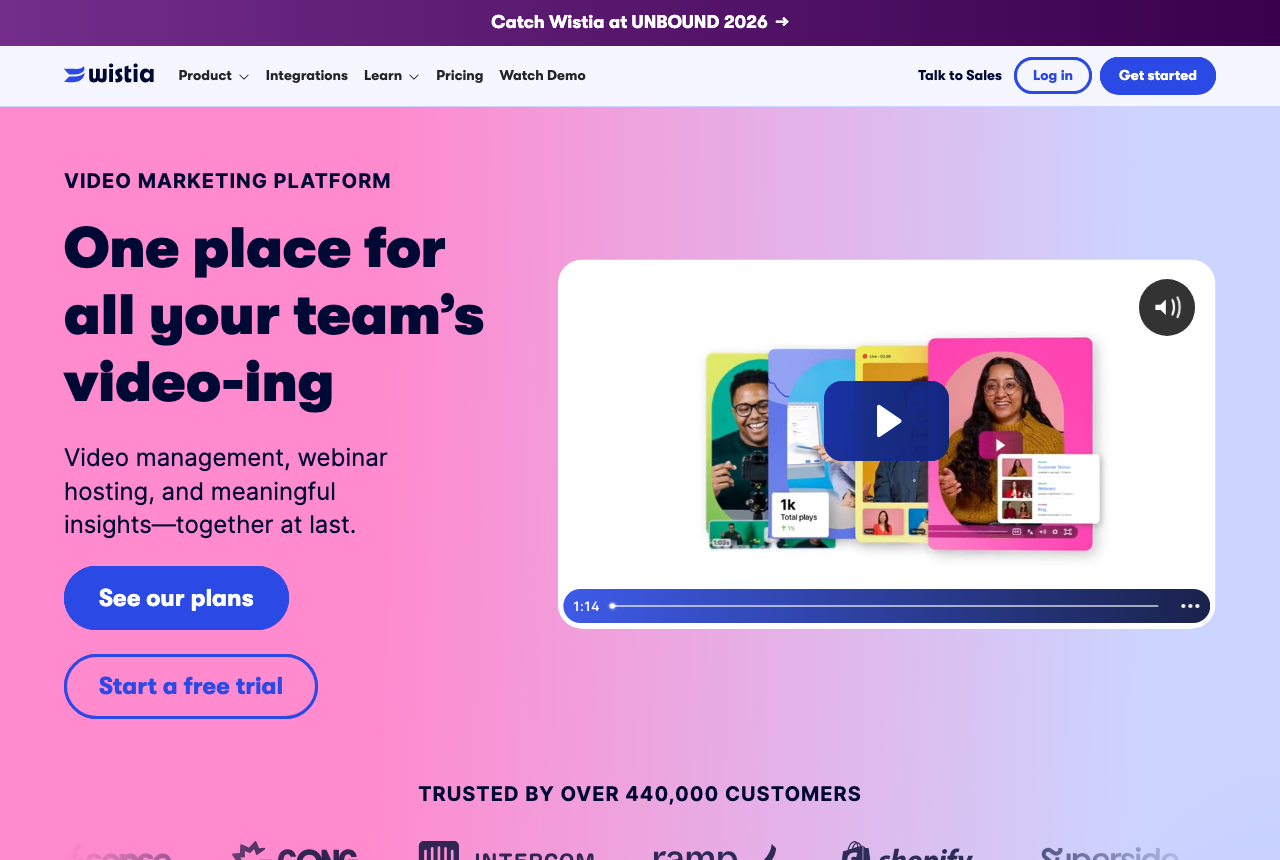
Wistia homepage showing its business video hosting and marketing platform
Wistia's homepage, showing its business video hosting and marketing platform.

If you are a company leaving Vimeo, Wistia is the tool you were probably reaching for anyway. It hosts video with the same clean, ad-free playback, then adds the marketing layer Vimeo keeps thin: branded embeds, lead-capture forms and CTAs inside the player, heatmaps, A/B testing, and real integrations with HubSpot and Marketo so a view can become a scored lead in your CRM.

In the client-hosting threads that followed Vimeo's price changes, Wistia is the name that keeps coming up for marketing teams, praised for polished embeds and analytics. The same threads carry the catch: it is called overkill and too expensive when the job is only to upload and embed a video.

The numbers back that up. The free plan hosts 25 GB but stamps Wistia branding on the player. The first serious tier, Business, is $79/mo with branding removed and the marketing features switched on, and the lead-generation tier jumps to $329 a month. Against Vimeo Starter at about $12 a seat, Wistia only makes sense when its analytics and lead tools actually generate revenue. One more limit worth knowing before you commit: video DRM sits at Wistia's enterprise level, so if locked-down, protected delivery is your reason for leaving Vimeo, this is not the cheaper fix.

What works

  • Branded, ad-free embeds with forms and CTAs
  • Heatmaps, A/B testing and engagement analytics
  • Real CRM integrations for lead scoring and follow-up
  • Free plan to start

What to watch

  • Built for B2B content, not paid-traffic VSL optimization
  • Business plan $79/mo, Lead Gen tier jumps to $329/mo
  • No sales-scored split testing or cart-level attribution
2. Vidalytics, best Vimeo alternative for direct-response VSLs

From $24/mo. Free Forever plan (limited). Read our full Vidalytics review.

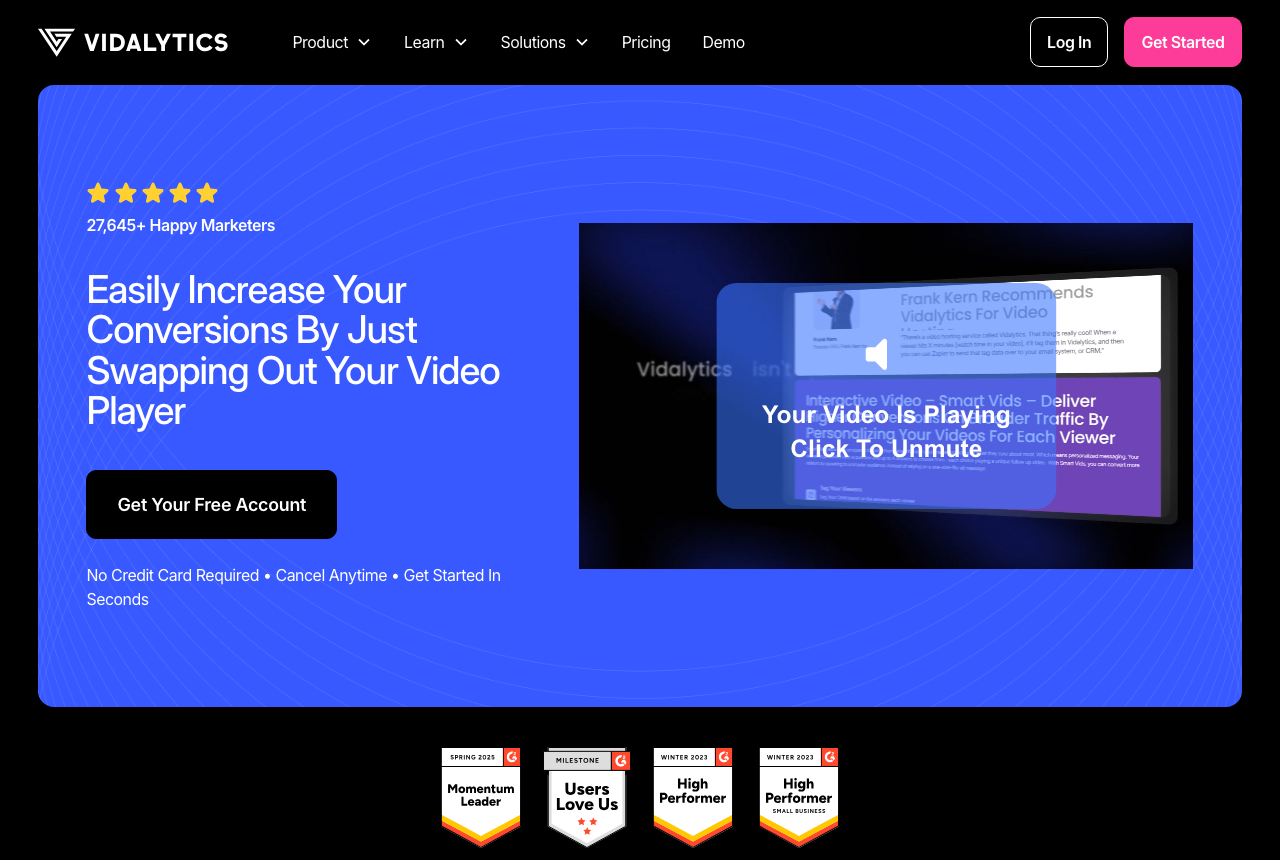
Vidalytics homepage showing its marketing-focused video player and analytics pitch
Vidalytics' homepage, presenting its marketing-focused video player and analytics.

Vidalytics is where you go when Vimeo's real failure is that it cannot prove anything. It is built for video sales letters and funnels, not for hosting a portfolio. On the front end you get smart autoplay, resume play, timed CTAs and play gates. On the back end you get the data Vimeo does not have: second-by-second engagement graphs, heatmaps, audience segmentation, conversion tracking, and native A/B experiments that pit two versions of a VSL against each other.

That is the difference that matters for paid traffic. Instead of an average watch-time number, you can see where viewers drop, which watch depths correlate with a sale, and which hook or CTA timing wins. It fires engagement events to Meta and Google so you can retarget on watch behavior. The honest limit, and the reason it is second here rather than the universal pick, is attribution depth: it reports events, but it does not stitch a specific cart purchase back to the exact viewer session and split-test variant the way a revenue-first tool does.

Two cautions before you scale. There is a Free Forever plan, but it is capped at 3 videos and 50 GB of bandwidth with restricted analytics, so a real test starts on a paid plan at $24/mo, and the serious analytics (heatmaps, segmentation, conversion tracking) start on the $79 Pro tier. And bandwidth is metered: paid plans include a monthly allowance and bill overages at $0.33 per GB. On paid traffic, bots and cheap clicks can push that bill up fast, so size the plan to your volume before you point real spend at it.

What works

  • Purpose-built VSL controls: smart autoplay, resume play, timed CTAs, play gates
  • Second-by-second engagement graph, heatmaps and buyer/non-buyer segmentation
  • Conversion and revenue tracking, plus native A/B tests scored on clicks or sales
  • Free Forever plan to start; paid from $24/mo ($19 billed annually)

What to watch

  • Bandwidth beyond your plan is billed at $0.33/GB, so a high-traffic VSL can outrun the sticker price
  • Smaller independent review base than mainstream hosts, so less third-party proof to check
  • More player and analytics settings than you need if you only want to host and embed a clip

3. VTurb, best Vimeo alternative for a lightweight VSL player

Paid plans after a 14-day trial. Read our full VTurb review.

VTurb homepage presenting its smart VSL video player
VTurb's homepage, presenting its smart VSL video player.

VTurb's SmartPlayer covers the same job as Vidalytics: a player built for sales videos, with timed action buttons that reveal the offer at the pitch moment, retention analytics that show drop-off points, A/B testing through a single embed, and conversion tracking that ties a view to a later sale. It leans harder into player styling and domain security, and it is widely used in Latin-American direct response.

The reason it sits at three is proof, not features. There is very little independent English-language discussion of VTurb; most of what exists is the vendor's own docs, which read in English but ship examples still tagged for a Brazilian market, and its published pricing is quoted in Brazilian reais. That is not disqualifying, but it means you are buying with less outside evidence than Vidalytics gives you. The other flag is trust: technical discussion has criticized VTurb-style progress bars as deceptive, and its traffic filter can serve a different "safe" video to bots and ad reviewers, which can drift into ad-platform territory you do not want to be in. Test it on a non-critical funnel, watch your drop-off and your ad compliance, and confirm current pricing in your currency before you move a serious offer.

What works

  • VSL-specific player with smart autoplay and progress controls
  • Split testing and domain security built in
  • Deep player customization

What to watch

  • Public English pricing is not clearly listed
  • Thin English-language review track record
  • Support and docs lean toward the Portuguese-speaking market

4. The cheapest field, and when to keep YouTube anyway

Not everyone leaving the defaults wants another platform. If you only need clean, ad-free playback and your reason is cost, the infrastructure hosts win outright. Bunny Stream lists storage from $0.01/GB and delivery from $0.005/GB, Cloudflare Stream bills by minutes stored and minutes delivered, and Mux prices by input, storage and delivery with a free monthly delivery allowance. All three undercut any Vimeo plan and carry no ads. The trade is that they are closer to plumbing than to a product: you get a player and an API, not marketing tools, lead capture or a friendly dashboard.

There is also a version of this decision where you keep YouTube. It is unlimited, it is free, and it is where discovery happens, so it is rarely a mistake to be on it. The mistake is using one YouTube embed for two jobs. The setup most businesses settle on is to keep uploading to YouTube for public reach, search and retargeting audiences, and to embed a clean paid-hosted version on landing pages, sales pages and paid-ad destinations, where the ads, recommendations and missing data cost you conversions. Any of the ranked picks above does that second job while YouTube keeps doing the first.

For private courses, paid content or DRM, the field shifts again toward names like SproutVideo, Kinescope and Dacast, which publish pricing and bundle privacy, white-label playback and, in some cases, built-in DRM that Vimeo treats as an enterprise add-on. That is its own comparison, and not the focus here.

How we evaluated these

We do not run these tools on live paid campaigns, and we do not pretend to. We read each vendor's own documentation and pricing pages for what a tool is, does and costs, and we read long-term user reports on Reddit, Hacker News and review sites for how it holds up once real money is behind it. Prices in this article were checked with the vendor on 14 September 2026; video pricing changes often, so treat the date as part of the fact.

For an "alternatives to Vimeo" list, we scored each tool on five things a Vimeo leaver actually cares about: what it costs to run at scale, not just the sticker price; whether the embed is clean and brandable; whether it can measure retention past a single average number; whether it can score a change on conversions rather than views; and how much independent evidence exists that it works. We rank ordinally and publish no star scores, because a number invites you to argue with the decimal instead of the decision. Every pick above names who it is wrong for, which is the part a paid list leaves out.

You can read the full method behind our rankings and how we make money.

Frequently asked questions

What is the best free alternative to Vimeo?
For reach, YouTube is free and unlimited, but it is a public platform: it shows recommendations and you do not own the audience or the data. For a free tier you control, Wistia hosts up to 25 GB but stamps its branding on the player. If you only need cheap embeds, infrastructure hosts like Bunny Stream (from $0.01/GB storage) and Cloudflare Stream (billed by minutes stored and delivered) cost less than any Vimeo plan.
Is Wistia or Vimeo better?
Wistia is better if the video has to generate leads: branded embeds, forms, CTAs, heatmaps and CRM integrations. Vimeo is cheaper and simpler for plain hosting, portfolios and client review. Wistia Business is $79 a month against Vimeo Starter at about $12 a seat, so Wistia only pays off when its marketing features earn back the gap.
What is the cheapest way to host videos without Vimeo?
Usage-based infrastructure hosts. Bunny Stream lists storage from $0.01/GB and delivery from $0.005/GB; Cloudflare Stream bills by minutes stored and minutes delivered; Mux prices by input, storage and delivery. These are the right pick when you want clean embedded playback and do not need marketing or conversion features, and you are comfortable with a more technical product.
Which Vimeo alternative is best for a VSL or paid traffic?
Vidalytics or VTurb. Both are built for video sales letters, with per-second retention, timed CTAs, play gates and split tests scored on conversions rather than views. Vimeo has none of that. Vidalytics has the deeper English-language track record; VTurb is strong in Latin-American direct response but thinner on independent English proof.
Do I need to worry about migrating off Vimeo?
Yes. Vimeo says source files on a lapsed paid account can be deleted after 60 days, so download your originals before you downgrade or cancel. Then inventory every embed URL on your site, courses and funnels, run a 20-video test on the new host, and keep Vimeo live for 30 to 60 days so any broken embed can be fixed without panic.
Is Vimeo shutting down after the Bending Spoons acquisition?
No. In September 2025 Vimeo agreed to be acquired by Bending Spoons in a $1.38 billion all-cash deal. The service keeps running, but the deal has fed reader uncertainty about future pricing and product direction, which is one reason more people are pricing out alternatives now.
Can I remove the ads and YouTube branding from an embedded video?
Not reliably. YouTube says embedded videos may show ads, and a Terms of Service update lets YouTube monetize content even on channels outside the Partner Program, so turning monetization off is not a guarantee. The modestbranding parameter that used to reduce branding is deprecated and no longer works, and rel=0 now only limits related videos to your own channel rather than hiding them. If an ad-free, unbranded player matters, that is a reason to move to a paid host, not a setting you can toggle.
Should I keep YouTube and add a paid host instead of replacing it?
For many businesses, yes, and it is the setup most people land on. Keep YouTube for public discovery, search and retargeting audiences, where free reach is the whole point. Then embed a clean paid-hosted version on landing pages, sales pages and paid-ad destinations, where ads, recommendations and lost data cost you conversions. Use each tool for the job it is good at rather than forcing one to do both.

Sources

Other sources

16 discussions and reviews read for this page. Quotes are excerpts; open a link to read the original in context.

  1. [] Vimeo pricing plans (vendor) Blog
  2. [] Vimeo: lapsing from a paid account to Basic (vendor help) Blog
  3. [] Wistia pricing (vendor) Blog
  4. [] Vidalytics for funnels (vendor) Blog
  5. [] Vidalytics pricing (vendor) Blog
  6. [] VTurb SmartPlayer docs (vendor) Blog
  7. [] Ads on embedded videos (YouTube Help) Blog
  8. [] YouTube embedded player parameters: rel and modestbranding (YouTube for Developers) Blog
  9. [] Updates to YouTube’s Terms of Service (YouTube Blog) Blog
  10. [] Vimeo to be acquired by Bending Spoons for $1.38B (vendor press) Blog
  11. [] Stop paying Vimeo after a decade Reddit
  12. [] Vimeo is forcing me onto a $5,400/year Enterprise plan Reddit
  13. [] Where are you hosting client videos now that Vimeo's pricing changed? Reddit
  14. [] The new youtube embed UI looks horrible and doesn’t work Reddit
  15. [] Vidalytics reviews on Trustpilot Trustpilot
  16. [] Discussion of VSL-style progress bars Hackernews

Related reading