Head to head
Wistia vs TrackPlay
One is the best business video platform here; the other proves which paid traffic bought. The pick turns on whether the video's job is content marketing or a direct-response sale.
You are down to two, and it is worth saying up front that Wistia and TrackPlay are not two versions of the same tool. Wistia is the strongest business video platform in this whole roundup: branded, ad-free embeds, forms and CTAs, heatmaps, A/B testing, webinars and real CRM links to HubSpot and Marketo. TrackPlay is a paid-traffic VSL player built to prove which traffic, which edit and which second of a sales letter actually made the money. So the honest question is not which is better in the abstract. It is what the video is for.
This site judges every video tool through one lens: does the player hold a cold viewer through the pitch, and can you prove which paid traffic actually bought. Wistia does a lot, but not that. It measures engagement, it captures leads, it scores A/B tests on watch behaviour. What it does not do is decide a split test on sales, split retention by who bought, or post the cart-verified purchase back onto the play and the ad that earned it. TrackPlay is built for nothing else.
Wistia is genuinely good at its own job, which is content marketing. If the video is a product explainer, a demo library, a webinar or a lead-gen asset that lives on your marketing site, Wistia is the more capable, more proven, better-supported answer, and TrackPlay is the wrong tool. If the video is a sales letter you are buying cold traffic to, Wistia will host it and tell you how far people watched, but it will not tell you why they did or did not buy, and TrackPlay is built around that exact question.
Below we put the two side by side on price, player, analytics and attribution, then say plainly who each is for. One caution rides on TrackPlay throughout, and it is about age rather than capability: it launched in 2026 with almost no independent track record, so treat it as a pilot, not a foundation, until its own numbers check out against yours.
Quick answer
Pick Wistia if the video's job is content marketing or lead gen, hosting demos, explainers, webinars and gated content on your marketing site, and you value branded embeds, forms, heatmaps and CRM integrations over proving a sale; pick TrackPlay if you buy traffic to a video sales letter and need to prove which traffic, which edit and which second of the pitch actually made the sale, with per-second retention split by buyer, split tests decided on the cart-verified sale, and server-side conversion tracking to Meta, TikTok and GA4, and you will pilot it on one funnel first because it is new.
- Wistia. The best business video platform of the group, built for content marketing and lead gen rather than VSL funnels. Branded, ad-free embeds, forms and CTAs, heatmaps, A/B testing on engagement, webinars and real CRM links with HubSpot and Marketo, plus a limited free plan to start. It has a large, checkable public review base, which is exactly the outside proof a new tool lacks. But it is the wrong shape for a single sales letter: the Business plan is $79 a month, the Lead Gen tier jumps to $329, and none of it scores a split test on the sale or ties a purchase back to the play the way a direct-response player does.
- TrackPlay. A paid-traffic VSL player and attribution platform built for one job: proving which traffic bought. It holds a cold viewer with sound-first autoplay, timed CTAs and watch gates, draws per-second retention split into buyers and non-buyers, and decides split tests on the cart-verified sale with a p-value and confidence interval, all under one embed. Its focus is attribution: the cart posts the purchase back onto the play that earned it, server-to-server from seven direct-response carts, and TrackPlay fires that conversion server-side to Meta, TikTok and GA4. Every feature ships on every plan, billing is by plays, and there is a no-card free plan plus a 14-day trial, from $29 a month. The catch is age, not capability: it launched in 2026 with almost no outside proof, so pilot it before a proven offer.
Wistia vs TrackPlay at a glance
Prices and plan features checked on the vendors' own pages on 27 September 2026.
| Feature | Wistia | TrackPlay |
|---|---|---|
| What it is | A B2B video marketing and hosting platform | A paid-traffic VSL player and attribution platform |
| Built for | Content marketing, lead gen and webinars | Proving which paid traffic bought |
| Track record | Established platform, deep public review base | New, thin outside proof yet |
| Starting paid price | Business $79/mo; Lead Gen $329/mo | $29/mo, every feature included |
| Free tier | Yes, a limited free plan | Yes, 1,000 plays/mo, watermarked |
| Smart autoplay | No | Yes, sound-first |
| Player controls | Branded ad-free embeds, CTAs and forms | Timed CTAs and watch gates |
| Split testing | A/B testing, scored on engagement | Native, decided on the cart-verified sale |
| Retention analytics | Heatmaps and engagement graphs | Per second, buyers vs non-buyers |
| Conversion pixels | Marketing integrations, not sales-scored | Server-side to Meta, TikTok and GA4, deduped |
| Cart postbacks | No | Yes, from seven direct-response carts |
| Revenue attribution | No cart-level attribution | Yes, revenue per play |
| Lead capture and CRM | Forms, CRM (HubSpot, Marketo) | Lead capture over video, hot-lead scoring |
| Webinars | Yes | No |
| Pricing model | Per plan and seats | Flat plans billed by plays, not bandwidth |
| Best for | B2B content marketing and lead gen | Paid-traffic VSLs that must prove the sale |
Strengths and trade-offs
The trade-off here is not feature against feature, because the two barely overlap on the thing that matters. It is which job you are buying for. Wistia gives you a proven, ad-free marketing platform with a large public track record and almost none of the sale-level direct-response stack. TrackPlay gives you the entire sale-level stack, scored on the cart-verified purchase, and almost no outside track record yet. Read each list against the job the video has to do.
Wistia: what works, what to watch
What works
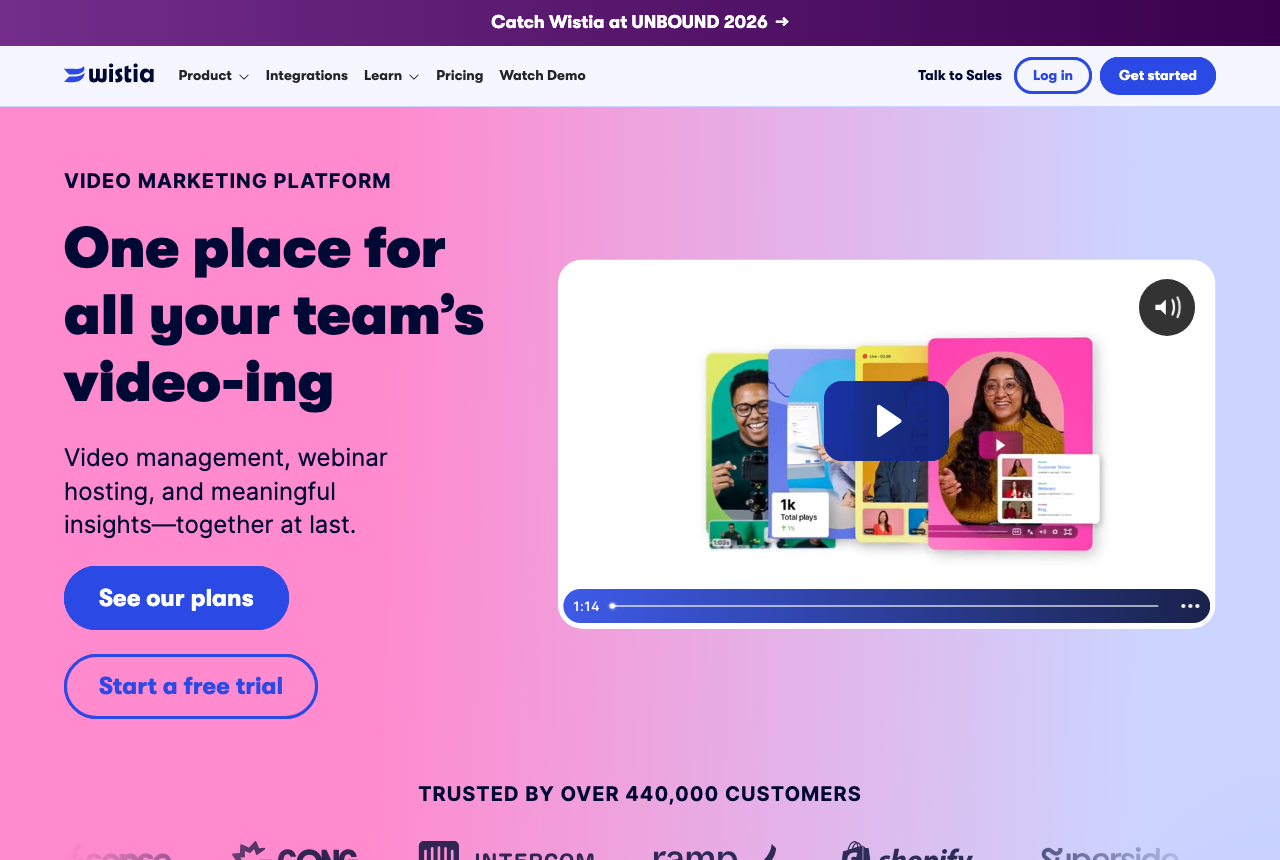
- Branded, ad-free embeds with forms and CTAs
- Heatmaps, A/B testing and engagement analytics
- Real CRM integrations for lead scoring and follow-up
- Free plan to start
What to watch
- Built for B2B content, not paid-traffic VSL optimization
- Business plan $79/mo, Lead Gen tier jumps to $329/mo
- No sales-scored split testing or cart-level attribution
TrackPlay: what works, what to watch
What works
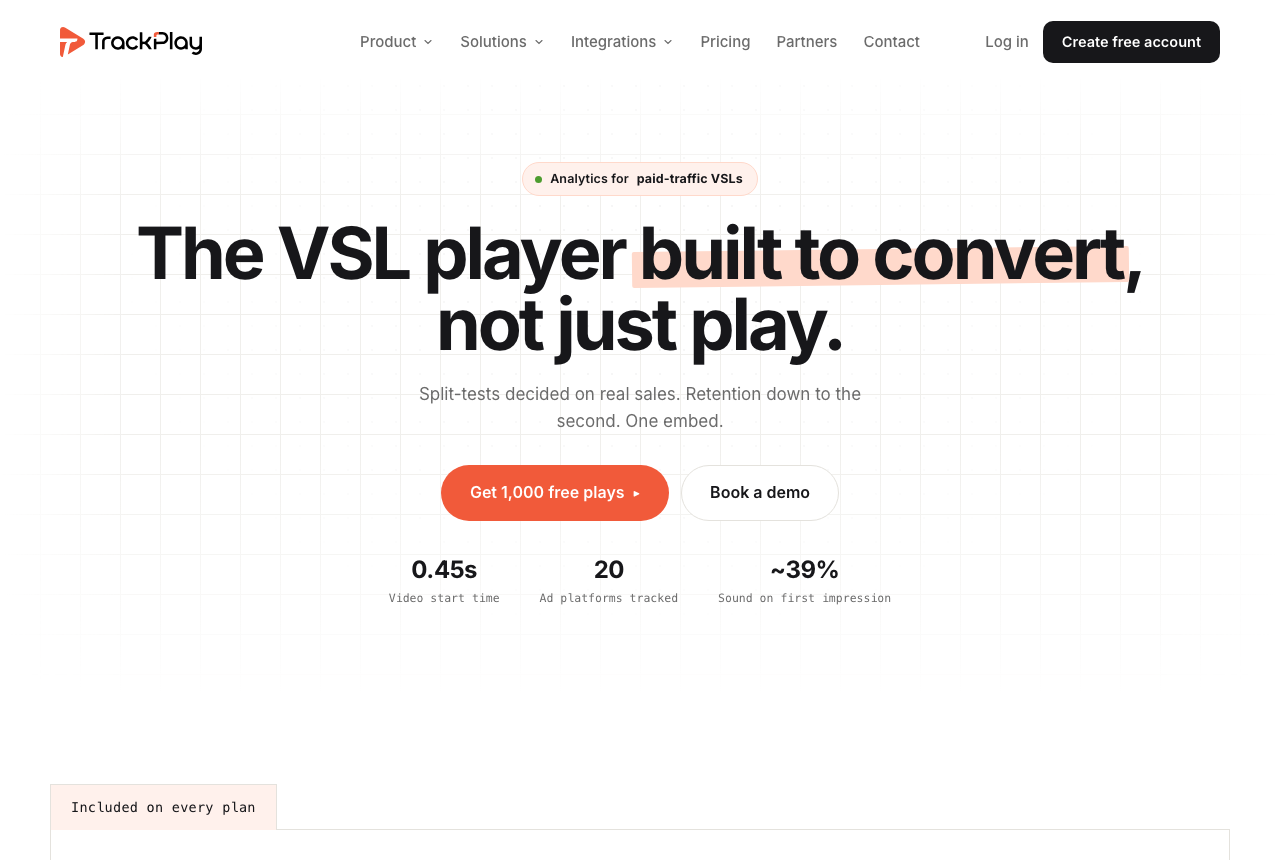
- Split-test winners are decided on the sale, with a p-value and confidence interval, and both variants run under one embed so your ad links and campaign learning never reset.
- Server-side pixels fire to Meta and Google Ads at the watch-time milestone you choose, and cart postbacks credit the sale to the play that earned it from ClickBank, BuyGoods, Digistore24, WarriorPlus, JVZoo and Kiwify.
- Retention is drawn second by second and split into buyers versus non-buyers, alongside revenue per play, so you can see the exact seconds costing you the sale.
- Every feature ships on every plan, billing is on plays rather than seats or tiers, and there is a real free plan of 1,000 plays a month with no card. Paid plans start at $29.
What to watch
- It launched in 2026 and has almost no independent track record. The testimonials are all on its own site, with no Reddit or review-site record to check yet, so you are relying on vendor claims until you pilot it.
- It is narrow on purpose: a paid-traffic VSL player, not a general video host or a B2B content library, so it has none of the channels, SEO pages or webinar tooling of a Wistia. If the video's job is content marketing rather than a direct-response sale, it is the wrong tool.
- Billing is by plays, and its own terms count a start, an unmute, a resume and a replay as separate plays, so one viewer can register several. At volume that changes the cost, though you can cap it and usage is live in the dashboard.
- The contract declines to promise a specific uptime percentage despite the 99.99% marketing figure, and the service is provided as is with no revenue warranty.
Pricing, tier by tier
Wistia's pricing is public and built for a marketing team. There is a limited free plan to start, the Business plan is $79 a month, and the Lead Gen tier jumps to $329 a month. Higher tiers add more bandwidth, more seats and the marketing and CRM features Wistia is known for. For a content library that will use the forms, webinars and CRM links every month, that is money well spent. For a single sales letter, it is a lot of spend on capabilities a VSL never touches, which is the honest reason a direct-response marketer rarely lands on Wistia.
TrackPlay prices on plays rather than storage, bandwidth or seats. There is a genuine free plan of 1,000 plays a month, watermarked, with no card and no time limit, plus a 14-day trial of the paid features. Paid plans are Basic at $29 a month, PRO at $79 and SCALE at $199, and every feature ships on every plan, including the free one. Plans differ only on how many plays are included and what an extra play costs. Read the play definition first: its own terms count a start, an unmute, a resume and a replay each as a play, so one viewer can register several, and at volume that changes the sum. You can cap it, and usage is live in the dashboard.
The two do not bill on the same thing, so a straight sticker comparison misleads. Wistia meters plans and seats and prices for a content team; TrackPlay meters plays and prices for a single funnel. TrackPlay's Basic at $29 is cheaper at the door than Wistia's $79 Business plan, and far cheaper than the $329 Lead Gen tier. But the deciding number is not the entry fee, because the two are not selling the same thing. Wistia's price buys a marketing platform. TrackPlay's buys the split testing, per-second buyer retention and server-side, cart-verified attribution Wistia does not offer at any tier.
One real cost note on each side. Wistia's is the jump between tiers: the features a growing marketing team wants often sit behind the Lead Gen plan, and $329 a month is a real line item you should confirm you will use. TrackPlay's is the play count: a high-traffic offer can register several plays per viewer, so budget the plan that fits real traffic and cap it. Neither is a reason to rule the tool out; both are numbers to price before you commit.
The verdict
For this site's core reader, someone buying cold traffic to a video sales letter, TrackPlay is the pick, and it is not close. Wistia will host that sales letter, brand it and tell you how far people watched, but it will not tell you why they did or did not buy. There is no smart autoplay to hold the cold viewer, no split test scored on the sale, no per-second retention split by buyer, and no way to attribute revenue to the play. Its A/B testing measures engagement, not purchases. TrackPlay is built for exactly that gap: it decides split tests on the cart-verified sale with a p-value and confidence interval, draws retention to the second split by who bought, and fires the conversion server-side to Meta, TikTok and GA4 with cart postbacks crediting the play that earned the sale. If your whole problem is proving which paid traffic made the money, that is the concrete fix, and it earns TrackPlay the win here.
Two honest cautions ride with that win. The first is age, not capability: TrackPlay launched in 2026 with almost no independent track record. The testimonials are on its own site, there is little third-party review or Reddit footprint to check, and its contract declines to promise a specific uptime figure. So pilot it. Start on the free plan or the 14-day trial, run one non-critical funnel, and reconcile its pixel, attribution and play counts against your own cart and ad accounts before you move a proven offer onto it. Wistia, by contrast, has a large public review base you can read before you buy, which is worth something when you are committing budget.
The second is scope, and it lands squarely here because Wistia is the platform TrackPlay is not. TrackPlay is narrow by design: it is built for paid-traffic VSL conversion, not general video hosting or content marketing, so it has none of the channels, SEO pages or webinar tooling of a Wistia, and it does not host a demo library or run a webinar. That narrowness is the reason it does the conversion job so well, but it also marks the exact reader Wistia wins. If the video's job is a product explainer, a gated content library, a webinar or lead gen on your marketing site, TrackPlay is the wrong tool and Wistia is the right one. Wistia does branded, ad-free, well-supported marketing video with a proven track record, which is what most non-sales video actually needs.
So the tie-breaker is the job, not the scoreboard. If the video has to sell to cold paid traffic and you need to prove which traffic bought, buy TrackPlay, and treat it as a pilot until its own numbers hold up. If the video's job is content marketing, lead gen or webinars rather than a direct-response sale, buy Wistia.
Our pick
TrackPlay
TrackPlay is the pick for this site's core reader: someone running paid traffic to a video sales letter, whose whole business is the video. It is the only one of these two that even attempts the job this site measures, and it does it thoroughly: split tests decided on the cart-verified sale, per-second retention split into buyers and non-buyers, revenue per play, and server-side conversion tracking with cart postbacks that credit the sale to the play that earned it. Every feature is on every plan and there is a real free tier to start on. The one caveat is age: it launched in 2026 with almost no outside proof, so pilot it on one funnel and reconcile its numbers against your own before you move a proven offer onto it. And if the video is not a direct-response sales letter, this is the wrong tool: Wistia hosts a content library, a webinar or a lead-gen asset better, and you can check its track record before you buy.
Frequently asked questions
Is Wistia or TrackPlay better?
Can Wistia track which paid traffic bought?
What can TrackPlay do that Wistia cannot?
Which is cheaper, Wistia or TrackPlay?
Is TrackPlay safe to rely on yet?
Can I use TrackPlay as a general video host or for webinars?
Sources
Other sources
6 discussions and reviews read for this page. Quotes are excerpts; open a link to read the original in context.
Related reading
- Our full Wistia review
- Our full TrackPlay review
- VTurb vs Wistia: a VSL player versus a B2B content platform
- Vidalytics vs TrackPlay: a proven VSL player versus a new one built to prove the sale
- Vimeo vs TrackPlay: clean hosting versus proving the sale
- Alternatives to Wistia, ranked by whether they move sales
- TrackPlay alternatives, ranked by the job
- The best VSL players and conversion video software
- All head-to-head comparisons