Head to head
Cloudflare Stream vs Uscreen
Cloudflare Stream is the cheapest reliable developer pipe for hosting and delivering a video; Uscreen is a done-for-you platform for running a subscription video membership with branded apps. They serve two different businesses. Which one, and on what grounds.
You are down to two, and these two could hardly be further apart. Cloudflare Stream is developer video infrastructure: you upload a video, it encodes and delivers it through one API, and you build the player and everything around it yourself. Uscreen is the opposite kind of product, a done-for-you platform that turns a video library into a recurring-revenue membership, with a Netflix-style catalog, branded mobile and TV apps, a community space and native live streaming, all set up for you. One is a pipe you pay a few dollars a month for and build on top of; the other is a whole subscription business in a box that starts at $49 a month and climbs from there.
This site judges video tools through a direct-response lens: does the player move viewers past the pitch, and can you prove which traffic bought. On that exact test both of these fall short, but for different reasons. Cloudflare Stream is neutral infrastructure with no conversion layer, so a paid-traffic sales letter can sit on it only if you build the funnel yourself. Uscreen is built for a different business model entirely, the recurring subscription, so it has monetization built in but none of it is scored on a single direct-response sale. The honest comparison is not which one is the better VSL player, because neither is. It is which business you are actually building.
Cloudflare Stream is the cheaper and simpler of the two by a wide margin. It runs upload, encoding, storage, RTMP and SRT live ingest and delivery on Cloudflare's global network, priced on two dimensions only, storage and delivery, with encoding and egress included so there is no separate bandwidth bill. It is our number-fifteen ranked tool, and its appeal is blunt: a few dollars a month to host a video on the network behind a large share of the web, then you own the funnel above it.
Uscreen is the more complete product, and a mature one. It has helped over 4,000 creators launch subscription businesses, and its standout is the branded apps: it builds you iOS, Android and TV apps with no code, which reviewers say makes a membership feel legitimate and lifts the share of viewing that happens in-app. Subscriptions, one-off sales, free trials, a community and analytics all live in one place. The trade is cost and commitment. Above the Starter plan you pay a per-subscriber fee on top of the monthly base, and annual contracts are rigid, with reviewers reporting no mid-term downgrade or cancellation. This page lines the two up on what a video marketer actually needs, says which reader each one is for, and names one more tool that belongs on the table for a narrow reader.
Quick answer
Pick Cloudflare Stream if you want the cheapest reliable way to host, encode and deliver a pre-recorded video on one API, with global delivery and no separate bandwidth bill, and you have a developer to build the player, gates and tracking on top; pick Uscreen if your business is a recurring-revenue subscription membership and you want branded mobile and TV apps, a catalog, a community and native live streaming set up for you in one platform, and you can accept a per-subscriber fee and a firm annual contract. Neither of them settles a split test on the sale.
One more tool belongs on this page for a specific reader. Cloudflare Stream measures how a video plays through its API and Uscreen measures how members watch, but neither proves which paid-traffic click bought. If your whole business is a paid-traffic sales letter and you want the split test settled on the cart-verified sale, TrackPlay is the specialist built for exactly that, and we line it up beside both below.
- Cloudflare Stream. The cheaper, simpler pipe, and the closer fit for a marketer who just needs a pre-recorded video hosted and delivered reliably to build a funnel on. One API handles upload, encoding, storage, live ingest and playback on Cloudflare's global network, priced on two dimensions only: $5 per 1,000 minutes stored a month and $1 per 1,000 minutes delivered, with encoding and egress included so there is no separate bandwidth bill. The catches: it is infrastructure with no conversion layer, no no-code dashboard and no built-in spending cap, and reviewers report H.264-only encoding capped at 1080p with no way to re-download the source.
- Uscreen. The complete subscription-membership platform of the two, and a mature product. It turns a video library into a recurring-revenue business, with a Netflix-style catalog, native live streaming, a community space and, its standout, branded iOS, Android and TV apps it builds for you with no code. Subscriptions, one-off sales, free trials, marketing and analytics live in one place, and onboarding comes with a dedicated success manager. The trade is cost and commitment: above Starter you pay $0.99 to $1.99 per subscriber on top of the monthly base, mobile apps only begin at $449 a month, and annual contracts are rigid with reviewers reporting no mid-term cancellation.
- TrackPlay. Best when you want the split test decided on the actual cart-verified sale and posted back to your ad platforms server-side, which is a job neither of these attempts. It scores tests on the verified sale with real statistics and posts that sale back to Meta, TikTok and GA4, from $29 a month with a no-card free tier. It is narrow by design: not a general host, a developer pipeline or a membership platform, and very new.
Cloudflare Stream vs Uscreen at a glance
Prices and plan features checked on the vendors' own pages on 1 October 2026. TrackPlay is the direct-response specialist we line these two up against, so it wins the conversion rows and sits out the general-hosting ones.
| Feature | Cloudflare Stream | Uscreen | TrackPlay |
|---|---|---|---|
| What it is | A developer media pipeline on one API | A done-for-you subscription membership platform | A paid-traffic VSL player and attribution platform |
| Built for | Hosting and delivering video as cheaply as possible | Running a recurring-revenue membership with apps | Tying every play to the cart-verified sale |
| Starting price | $5 per 1,000 stored minutes/mo, then usage | $49/mo Starter, billed monthly | $29/mo, billed by plays |
| Pricing model | $5/1,000 min stored + $1/1,000 min delivered, encoding and egress included | Monthly base plus a $0.99 to $1.99 per-subscriber fee above Starter | Billed by plays, not bandwidth or minutes |
| Free tier | No standing free allocation; no card to start | No; a 14-day trial, no card | Yes, no-card free plan (1,000 plays/mo, watermarked) |
| Setup | API-first; you build the workflow | No-code dashboard; an onboarding manager sets it up | One embed snippet into any funnel builder |
| Live streaming | RTMP and SRT ingest; HLS and DASH output | Yes, native live streaming | No, on-demand VSL focus |
| Mobile and TV apps | None; developer player and SDKs | Branded iOS, Android and TV apps built for you | No; on-page embed |
| Monetization | None built in; you build the cart | Subscriptions, one-off sales and free trials | Attribution, not a cart; posts the sale back |
| Playback analytics | Playback data through the API | Membership and viewing analytics | Per-second retention, split by buyers vs non-buyers |
| In-video hooks | None; developer player and SDKs | None; membership catalog player | Sound-first autoplay, timed CTAs, watch gates |
| A/B testing | No | No | Yes, decided on the cart-verified sale |
| Ad-platform tracking | None built in | None built in | Server-side to Meta, TikTok and GA4, with dedup |
| Revenue attribution | No | No | Yes, revenue per play plus cart postbacks |
| Community | None | Built-in community space | No |
| Main risk | No spending cap; support thin below Enterprise | Per-subscriber fees stack; rigid annual contracts | Very new, thin outside proof, invite-only |
| Best for | Developers hosting and delivering video cheaply | Creators building a subscription membership business | Paid-traffic VSLs measured on the cart-verified sale |
Strengths and trade-offs
Cloudflare Stream and Uscreen are built for two different businesses, and they split on price against completeness. Cloudflare Stream asks you to accept thin analytics, a 1080p ceiling, support that only gets serious at Enterprise and a funnel you build yourself, in exchange for the cheapest reliable pipe on the market. Uscreen hands you a whole subscription business, apps and all, but charges a per-subscriber fee that stacks as you grow and locks you into a rigid annual term. Here is what each does well and where each will bite.
Cloudflare Stream: what works, what to watch
What works
- Usage-based and genuinely cheap: $5 per 1,000 minutes stored a month and $1 per 1,000 minutes delivered, with encoding and egress free, so there is no separate bandwidth charge
- One API runs the whole pipeline: upload, encode, store, deliver, a built-in player or your own, plus RTMP and SRT live ingest with HLS and DASH output
- Runs on Cloudflare's global network, the infrastructure behind a large share of the web, so reach and reliability come as standard
- Predictable billing on two dimensions only, minutes stored and minutes delivered, with no card required to start and no opaque plan tiers
- Privacy-clean playback with no ads or trackers, plus signed URLs and token access for gated content
What to watch
- No direct-response conversion layer at all: no sales-scored A/B tests, no watch-depth pixels to Meta or Google, no revenue attribution and no marketing player, so a paid-traffic VSL has to build every one of those on top
- It is a developer product you drive through an API and your own code, so a marketer who wants a no-code dashboard to click through will find nothing here
- No built-in spending cap: a spike in delivery or unlimited end-user streams can run the bill up, and long-term Cloudflare customers report blunt overage and billing handling, so you have to watch usage yourself
- Reviewers report encoding is H.264 only and delivery caps at 1080p, with no 4K and no re-download of the original file, which matters if you need higher quality or the source back
- Support is slow and hard to reach on Free and Pro plans, with real help sitting behind an Enterprise contract
Uscreen: what works, what to watch
What works
- Purpose-built for subscription memberships: a Netflix-style catalog, native live streaming and a community space in one platform, so members watch, chat and pay without you stitching three tools together
- Branded mobile and TV apps are the standout feature. Uscreen builds iOS, Android and TV apps for you with no code, and reviewers say the app makes a membership feel legitimate and lifts the share of viewing that happens in-app
- Real monetization built in: subscriptions, one-off sales and free trials, plus marketing automations and analytics, so you charge members directly instead of bolting on a separate cart
- Hands-on onboarding and free migration. A dedicated success manager walks you through setup, and reviewers repeatedly credit the team with making the launch of a site and app easy
- A 14-day free trial with no card, and a Starter plan at $49/mo, so you can test the membership model before committing real money
What to watch
- It is a membership platform, not a direct-response VSL player: there is no sound-first smart autoplay, no split test scored on the sale and no revenue attribution, so a paid-traffic sales letter still cannot prove which traffic actually bought from inside Uscreen
- The per-subscriber fee is the loudest complaint. Above Starter you pay $0.99 to $1.99 per subscriber on top of the monthly base, so a growing membership pays far more than the headline price, and reviewers describe the total take as high once fees stack up
- Annual contracts are rigid: Trustpilot reviewers report no mid-term downgrade or cancellation and being billed through the full term, so treat the annual commitment as firm and start on the monthly Starter plan to test
- Support and payouts can go quiet at the worst time. Reviewers report delayed payouts after cancelling and difficulty reaching a person to resolve a billing problem, so keep your own records and cancel in writing
- The entry price is not the price to run apps. Starter caps at 100 subscribers and mobile apps only begin on App Essentials at $449/mo, and the dashboard and marketing tools draw usability complaints, so budget and pilot for the plan you will actually need
TrackPlay: the paid-traffic VSL pick
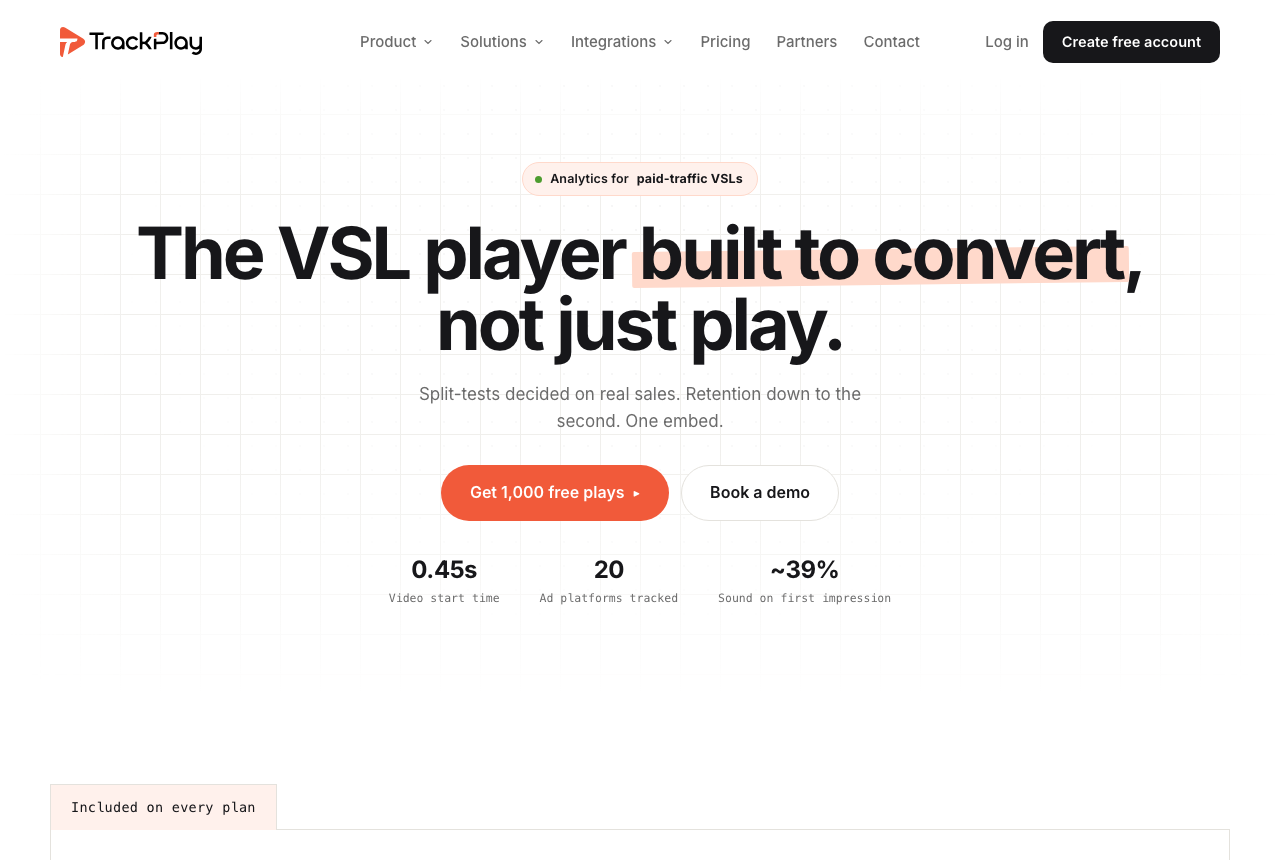
Cloudflare Stream gives you the cheapest reliable pipe and Uscreen gives you a done-for-you subscription business, and both stop short of the same thing: neither settles a test on the sale, and neither posts that sale back to the ad platforms server-side. Cloudflare Stream reports playback data through its API and Uscreen reports how members watch and pay inside your membership, but both count viewing, not which paid-traffic click bought. If your whole business is a paid-traffic sales letter and you want the test decided on the money, a third tool belongs on the table. TrackPlay is a VSL player and analytics platform built for paid-traffic funnels. On the front end it holds attention with sound-first autoplay, timed CTAs and watch gates. On the back end it draws per-second retention split into buyers and non-buyers, with hook rate, hold rate and revenue per play, so you can see the exact seconds to cut or protect.
Where it goes further than either of these is what it settles the test on and how it reports the sale. Neither Cloudflare Stream nor Uscreen runs a split test scored on a purchase; TrackPlay decides its split test on the cart-verified sale, with a real z-test, p-value and confidence interval, and runs every variant under one embed so your ad links and campaign learning never reset. The cart posts the verified sale back onto the play that earned it from seven direct-response processors, including ClickBank, ClickFunnels and Digistore24, server to server, and TrackPlay fires that conversion server-side to Meta, TikTok and GA4 so the ad platform learns from the actual purchase rather than a page-load pixel. It bills by plays rather than stored minutes or subscribers, every feature ships on every paid plan, and there is a no-card free plan of 1,000 plays a month plus a 14-day trial, with paid plans from $29 a month.
What works
- Split tests are decided on the cart-verified sale, with a real z-test, p-value and confidence interval, and every variant runs under one embed so ad links and campaign learning never reset
- Server-side conversion tracking to Meta, TikTok and GA4 fires on the watch-time milestone you choose and dedupes browser and server events, so the ad platform optimizes on the actual sale rather than a page-load pixel
- Cart postbacks tie each sale to the play that earned it from seven direct-response carts, including ClickBank, ClickFunnels and Digistore24, server to server
- Per-second retention split into buyers and non-buyers, with hook rate, hold rate and revenue per play
- Every feature ships on every paid plan and billing is by plays, with a no-card free plan of 1,000 plays a month and a 14-day trial; paid plans start at $29 a month
What to watch
- Narrow by design: built for paid-traffic VSL conversion, it is not a general video host, a developer pipeline or a subscription membership platform, so it has none of Cloudflare Stream's cheap usage-priced delivery or Uscreen's catalog, branded apps and community, and is a poor fit if the video's job is a content library or a recurring membership rather than a direct-response sale
- Very new, with thin outside proof: the testimonials are on its own site, there is little third-party review or Reddit footprint yet, and signup is currently invite-only, so you cannot lean on independent validation before you commit paid traffic. That is what you would expect of a platform this recent
Where TrackPlay is not the answer
It is narrow by design. TrackPlay is built for paid-traffic VSL conversion, not general hosting or a subscription business, so it is not a general video host or a B2B content library, and it has none of the channels, SEO pages or webinar tooling of a Wistia. If the video's job is a content-marketing asset, a library or a recurring membership rather than a direct-response sale, it is the wrong tool, and Cloudflare Stream or Uscreen is the better home for it. It is also not a membership platform the way Uscreen is: there is no catalog, no branded mobile or TV apps and no community, and it is not a raw programmable pipe the way Cloudflare Stream is either. And it is very new, with thin outside proof: the testimonials are on its own site, there is little third-party review footprint yet, and signup is currently invite-only, which is what you would expect of a platform this recent. Pilot it on one funnel and reconcile the numbers against your own cart before you trust it with a proven offer.
Visit TrackPlay for the current plans and the free tier.
Pricing, tier by tier
Cloudflare Stream has no plan ladder. Storage is prepaid at $5 per 1,000 minutes of video stored each month, and delivery is post-paid at $1 per 1,000 minutes watched. Upload, encoding and egress are included, so there is no second bandwidth line. There is no standing free allocation for Stream itself, so the practical floor is about $5 a month once you store video, then the delivery meter follows actual watch time. For a single pre-recorded sales letter that is a few dollars a month.
Uscreen prices the opposite way, as a subscription business rather than a usage meter. Starter is $49 a month billed monthly and caps at 100 subscribers with no per-subscriber fee. Above Starter you pay a monthly base plus $0.99 to $1.99 per subscriber, and the branded mobile and TV apps that are the reason most people choose Uscreen only begin on the App Essentials plan at $449 a month. There is no free plan, only a 14-day trial with no card. So the headline price is not the price to run the thing: a growing membership on apps pays far more than $49, and reviewers describe the total take as high once the per-subscriber fees stack up.
The two do not really compete on a per-video basis, because they are not selling the same thing. Cloudflare charges you for a lean pipe and nothing else; Uscreen charges you for a whole business with apps, a catalog, a community and a payment system built in. For a developer who only needs to host and serve a pre-recorded video, Cloudflare is dramatically cheaper. For a creator who would otherwise stitch together a hosting tool, a membership plugin, a community and app builders, Uscreen's price buys the assembly and the support that comes with it.
Each carries a billing risk worth pricing in. Cloudflare Stream has no built-in spending cap, so a spike in delivery or unlimited end-user streams keeps accruing minutes; set usage alerts and rate limits in your own stack. Uscreen's risk is the contract: Trustpilot reviewers report no mid-term downgrade or cancellation and being billed through the full annual term, plus delayed payouts after cancelling, so start on the monthly Starter plan to test the model and cancel in writing. Neither is a reason to rule the tool out; both are numbers to watch.
TrackPlay uses a third meter because it sells a different job again. It bills by plays rather than stored minutes or subscribers, includes every feature on every paid plan, and starts at $29 a month. Its no-card free plan includes 1,000 watermarked plays a month, plus a 14-day trial of the paid features.
The verdict
Between these two, Cloudflare Stream wins for this site's core reader, the marketer who just needs a pre-recorded video hosted and delivered reliably without buying a whole subscription business they will not run. It is the cheapest reliable pipe here: one API for upload, encoding, storage, live ingest and playback, priced on two dimensions with encoding and egress included, running on the network behind a large share of the web. Two honest limits stay attached to the pick. It is developer infrastructure with no conversion layer, no no-code dashboard and no built-in spending cap, so a non-developer has nothing to click and a traffic spike keeps billing; and reviewers report encoding is H.264 only, capped at 1080p, with no 4K and no way to re-download the source, which matters if you need higher quality or the original file back.
Uscreen wins the other reader, and it is a real and different one. If your business is a recurring-revenue subscription membership rather than a one-time sale, and you want a Netflix-style catalog, a community and, above all, branded mobile and TV apps set up for you with no code, Uscreen is the stronger platform by a distance. It has launched thousands of creator memberships, its onboarding comes with a dedicated success manager, and reviewers repeatedly credit the apps with making a membership feel legitimate. The trade is the money: a per-subscriber fee that stacks as you grow, apps that start at $449 a month, and a rigid annual contract, so pilot on the monthly Starter plan first.
The tie-breaker is which business you are building. If you want the cheapest reliable pipe to host and deliver a pre-recorded video and you have a developer to build the funnel, buy Cloudflare Stream. If you are running a subscription membership and want the catalog, the community and the branded apps done for you, buy Uscreen. And there is a third call for one specific reader: if your whole business is a paid-traffic sales letter and you want the split test settled on the actual cart-verified sale, not on playback data or membership analytics, look at TrackPlay before you commit. Neither of these runs a split test scored on a purchase; TrackPlay decides its test on the cart-verified sale with real statistics and posts that sale back to Meta, TikTok and GA4 server-side. It is the newer, narrower specialist and its outside proof is still thin, so pilot it on one funnel first.
Our pick
Cloudflare Stream
Cloudflare Stream is our pick here. It is the cheapest reliable way to host, encode and deliver a pre-recorded video: one API, global delivery, and pricing on two dimensions with encoding and egress included, so there is no separate bandwidth bill. Know its two real limits: it is developer infrastructure with no conversion layer, no no-code dashboard and no built-in spending cap, and encoding is H.264 capped at 1080p. Choose Uscreen instead if your business is a subscription membership and you want branded mobile and TV apps, a catalog and a community set up for you.
Frequently asked questions
Is Cloudflare Stream or Uscreen better?
Which is cheaper, Cloudflare Stream or Uscreen?
Can either one run a video sales letter for paid traffic?
Does Uscreen include mobile and TV apps?
What are the limits of Cloudflare Stream's video quality?
What if I want the split test scored on the cart-verified sale?
Sources
Other sources
9 discussions and reviews read for this page. Quotes are excerpts; open a link to read the original in context.
Related reading
- Our full Cloudflare Stream review, a usage-priced developer video pipeline
- Our full Uscreen review, a subscription video membership platform
- Cloudflare Stream alternatives, ranked by the job
- Uscreen alternatives, ranked by whether they move sales
- Cloudflare Stream vs Dacast: a developer pipeline against a live and OTT broadcast platform
- Cloudflare Stream vs Mux: the cheapest developer pipe against the richer developer platform
- Bunny Stream vs Uscreen: cheap usage-based hosting to build on against a membership platform
- The best VSL players and conversion video software
- All head-to-head comparisons