Head to head
Wistia vs Dacast
One is a marketing video platform that turns recorded video into leads with forms, heatmaps, CRM sync and webinars. The other is a live-streaming and OTT platform for broadcasters, with RTMP and SRT ingest, unlimited viewers and a paywall. The pick turns on whether your video is a marketing asset you host or a live broadcast you charge for.
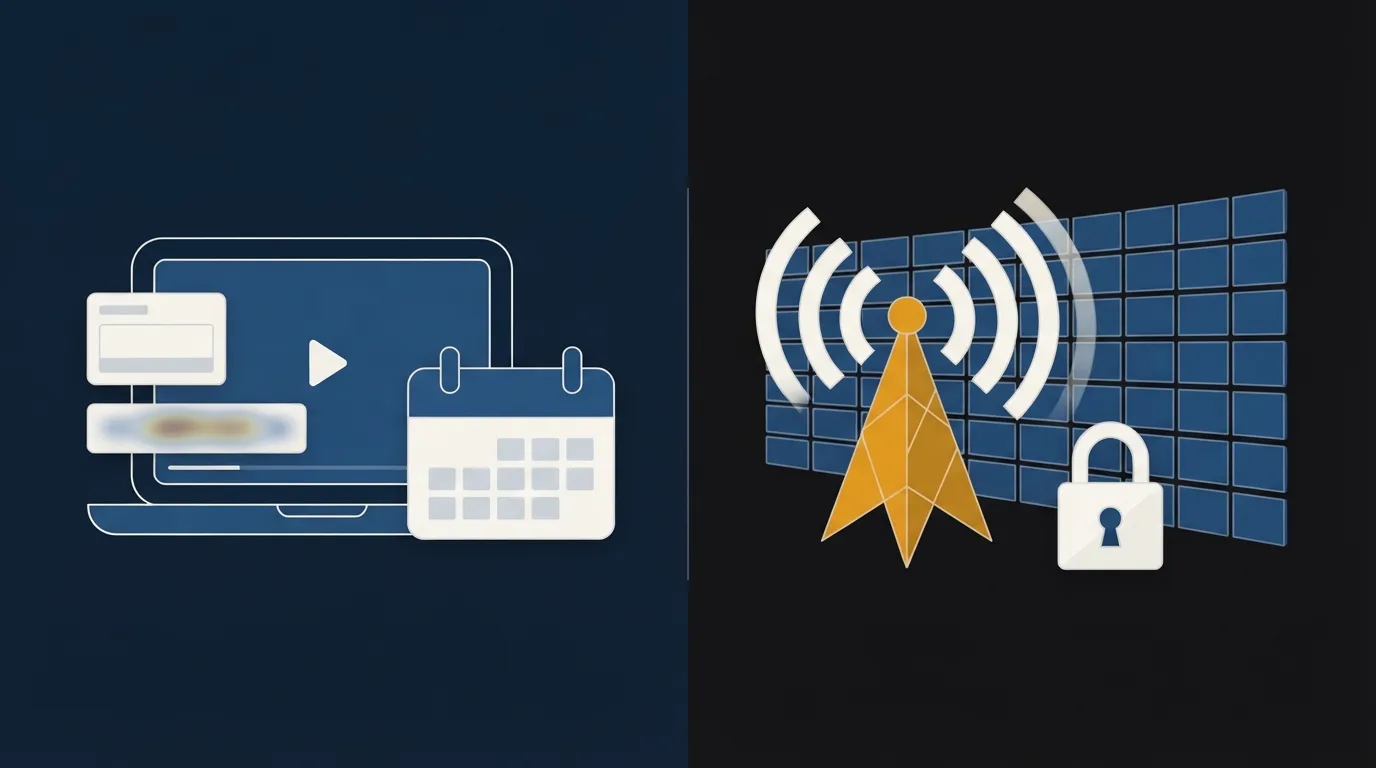
You are down to two, and they were built for different buyers. Wistia is a video and webinar platform for business marketing: it hosts recorded video on a branded, ad-free player, captures leads with forms and CTAs, shows where viewers drop off with heatmaps, and on its upper tier syncs that engagement into HubSpot, Marketo and Pardot. Dacast is broadcast infrastructure. You send it a live feed, it streams that feed to an audience of any size, records it for replay, and charges for access through its own paywall. Both will host and play a recorded video, and that is about where the overlap ends.
This site weighs video tools on one question: does the player move viewers toward a sale, and can you prove what worked. Neither of these is a purpose-built VSL player. For a reader hosting pre-recorded marketing or sales video, Wistia is the closer fit by a distance, because its forms, CTAs, A/B tests and CRM links all act on the viewer while they watch. Dacast's strengths sit in a live channel that a recorded sales letter never opens.
Dacast wins its own ground clearly. Its $39 Starter plan streams live to unlimited concurrent viewers, and its comparison page says it sets no time limit per stream. Wistia's live product is its webinar line, which starts at $429 a month and caps the base plan at 500 attendees and 1.5 hours per stream. Dacast also sells a paywall for pay-per-view and subscriptions plus ad slots before, during and after the video, and its comparison page says Wistia offers paid access on no plan, Enterprise included.
Each side has a catch. Wistia's is cost against the job: one marketer on Reddit called the Wistia plan that includes live streaming too expensive for private course video, and its A/B testing scores engagement instead of revenue. Dacast's is billing. Bandwidth is metered with overage at $0.30 per GB, monthly plans need three months paid upfront, and a Trustpilot reviewer was refused a refund because annual subscriptions auto-renew by default. Neither ties a sale to the play that earned it, which is why a third name appears below.
Quick answer
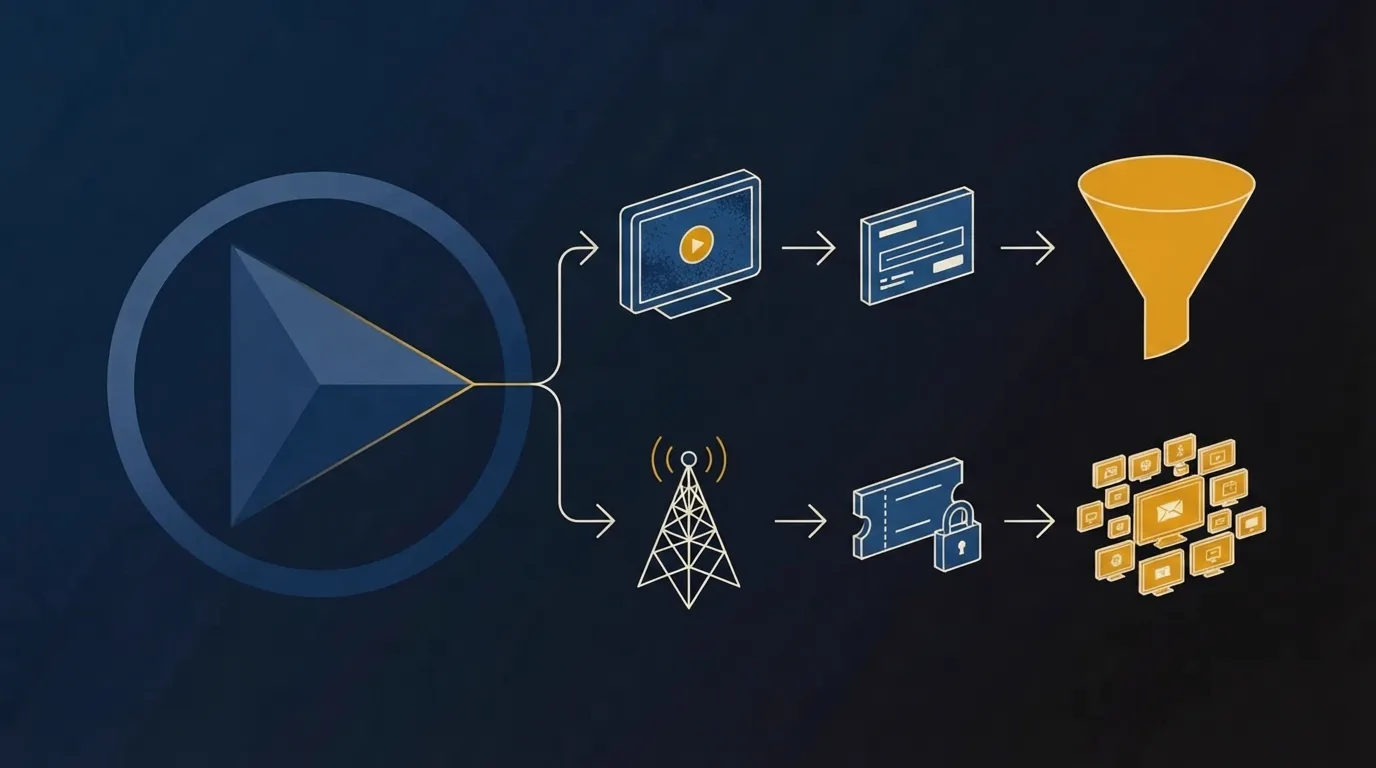
Pick Wistia if you want branded on-demand business video with forms, heatmaps, CRM-connected analytics and marketing webinars, and your goal is content marketing or lead gen rather than selling access to a live broadcast; pick Dacast if you need professional live streaming with RTMP or SRT ingest, unlimited concurrent viewers, a built-in paywall for pay-per-view or subscriptions, and bandwidth-metered broadcast plans from $39 a month.
One more option belongs on this page for a specific reader. Wistia ships marketing analytics and Dacast ships broadcast monetization, and neither decides a split test on the cart-verified sale or posts that sale back to your ad platforms. If your video is a paid-traffic sales letter and the test has to be settled on real purchases, TrackPlay is the newer specialist built for that job, and it sits beside both in the table below.
- Wistia. The business video platform of the pair. Business at $79 a month gives you an ad-free branded player with CTAs and forms, heatmaps and A/B testing. The $329 Business + Signals plan syncs viewer engagement into HubSpot, Marketo and Pardot, and webinars start at $429 a month. A free plan with 25 GB of storage gets you started. For this reader the limits are that its A/B tests measure engagement, it sells no pay-per-view access, and the base webinar plan stops at 500 attendees and 1.5 hours.
- Dacast. A live-streaming and VOD platform built for broadcasters. It takes RTMP, SRT and WebRTC ingest, streams to an audience of any size, and on the $63 Event plan adds a paywall for pay-per-view and subscriptions plus pre-, mid- and post-roll ads. Starter costs $39 a month paid yearly, with a 14-day trial that needs no card. It has no marketing layer for a sales funnel, it bills by the terabyte with overage, and annual plans renew automatically.
- TrackPlay. Best when the split test has to be decided on purchases and each sale posted to your ad platforms server-side. Paid plans from $29 a month, billed by plays, and a free tier that needs no card. Narrow by design, and very new.
Wistia vs Dacast at a glance
Prices and plan features checked on the vendors' own pages on 12 October 2026. TrackPlay is the direct-response specialist we line these two up against, so it wins the conversion rows and sits out the general-hosting ones.
| Feature | Wistia | Dacast | TrackPlay |
|---|---|---|---|
| What it is | A video and webinar platform for business marketing | A live-streaming, VOD and OTT platform for broadcasters | A paid-traffic VSL player and attribution platform |
| Built for | Content marketing, lead gen and webinars | Live events and monetized channels | Tying every play to the cart-verified sale |
| Starting price | Free plan; Business $79/mo billed annually | $39/mo Starter, billed annually | $29/mo, billed by plays |
| Pricing model | Plan tiers by storage, bandwidth and seats (+$25/user) | Annual bandwidth buckets; overage $0.30/GB bandwidth, $0.15/GB storage | Billed by plays, not bandwidth |
| Free tier | Yes: 25 GB storage, 200 GB bandwidth, Wistia branding | No; 14-day trial, no card | Yes, no-card free plan (1,000 plays/mo, watermarked) |
| Live streaming | Webinars from $429/mo: 500 attendees, 1.5 h; RTMP on Webinars Plus | RTMP, SRT and WebRTC ingest, unlimited concurrent viewers | No, on-demand VSL focus |
| Built-in monetization | No paywall or pay-per-view | Paywall, pay-per-view, subscriptions and ad slots from Event ($63/mo) | No paywall; ties each play to your own cart's sale |
| In-video marketing hooks | CTAs and forms on an ad-free branded player | None for direct response | Sound-first autoplay, timed CTAs, watch gates |
| A/B testing | Yes, scored on engagement | No | Yes, decided on the cart-verified sale |
| CRM and ad tracking | HubSpot, Marketo, Pardot on Business + Signals ($329/mo) | None built in | Server-side to Meta, TikTok and GA4, with dedup |
| Revenue attribution | Pipeline attribution in the CRM on Signals; no cart-level sale | No | Yes, revenue per play plus cart postbacks |
| Analytics | Heatmaps and engagement graphs | Real-time and advanced viewer analytics | Per-second retention, split by buyers vs non-buyers |
| Independent reviews | Well established; price complaints for live | Mature; auto-renew and latency complaints on record | Very new, thin outside proof, invite-only |
| Best for | Marketing teams turning video into CRM leads | Live broadcasts and paid access to video | Paid-traffic VSLs measured on purchases |
Strengths and trade-offs
Wistia is strongest when a marketing team wants every view to become a lead in its CRM. Dacast is strongest when the event is live and the audience pays to watch. Here is what each does well and where each costs you.
Wistia: what works, what to watch
What works
- Branded, ad-free embeds with forms and CTAs
- Heatmaps, A/B testing and engagement analytics
- Real CRM integrations for lead scoring and follow-up
- Free plan to start
What to watch
- Built for B2B content, not paid-traffic VSL optimization
- Business plan $79/mo, Lead Gen tier jumps to $329/mo
- No sales-scored split testing or cart-level attribution
Dacast: what works, what to watch
What works
- Genuinely built for live broadcasting: RTMP and HLS ingest, full 1080p HD, unlimited concurrent viewers, simulcast, VOD-to-live and auto-recorded streams, on a multi-CDN network that most reviewers find reliable
- Real, built-in monetization most video hosts skip: a paywall for pay-per-view and subscriptions, plus pre-, mid- and post-roll advertising, so a broadcaster can charge for content directly rather than bolting on a separate cart
- A complete OTT and security stack: branded apps across devices, a video CMS, DRM and AES encryption for VOD on the Scale plan, token security, and domain and country restriction for gating content
- Established and supported: sixteen-plus years in the market, a Video API and Player API for developers, real-time and advanced analytics, and 24/7 support that reviewers most often praise for fast response
- No startup fees, and unused bandwidth rolls over for twelve months, so an occasional or seasonal broadcaster is not paying for capacity they did not use that month
What to watch
- It is a broadcast platform, not a direct-response VSL player: there is no sound-first smart autoplay, no split test scored on the sale and no revenue attribution, so a paid-traffic sales letter still cannot prove which traffic actually bought from inside Dacast
- Billing is the loudest complaint: annual plans auto-renew by default and reviewers report being refused refunds after a surprise charge, so treat auto-renewal as on and cancel in writing before the renewal date
- Pricing is bandwidth-metered by the terabyte, and live or viral video burns an allowance fast; overage runs $0.30 per GB for bandwidth and $0.15 per GB for storage once you pass the plan, so model your real usage before you commit
- Monthly billing carries a three-month minimum charged upfront, and some higher-value features (the paywall on Starter, multi-CDN, China streaming) are paid add-ons rather than plan inclusions, so the sticker is not the whole bill
- Support is fast to respond but reviewers say it can be shallow on harder problems, and there are regional reports of high latency and unreliable encoding, so pilot from your own region before a critical broadcast
TrackPlay: the paid-traffic VSL pick
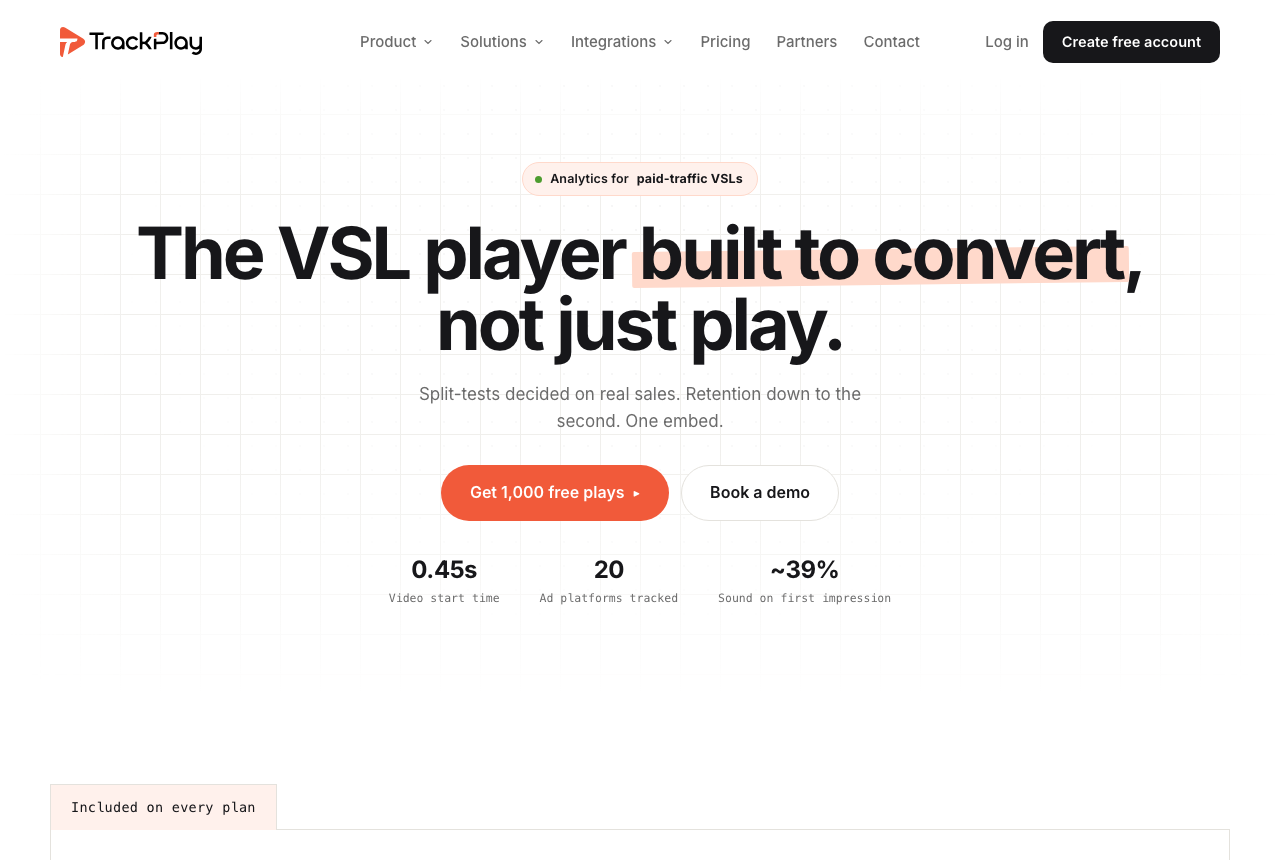
Wistia measures how people watch and Dacast measures how many tune in, and neither connects a play to a purchase. Wistia's A/B tests pick a winner on engagement and its pipeline attribution lives inside the CRM, while Dacast scores no test at all. If your video is a paid-traffic sales letter, that gap is the one that costs money. TrackPlay is a VSL player and analytics platform for paid-traffic funnels. It holds attention with sound-first autoplay, timed CTAs and watch gates, and draws retention per second split into buyers and non-buyers, with hook rate, hold rate and revenue per play.
Its edge over both is attribution. The cart posts each verified sale back onto the play that earned it from seven direct-response carts, including ClickBank, ClickFunnels and Digistore24, server to server, and TrackPlay fires that conversion to Meta, TikTok and GA4 so the ad platform optimizes on purchases. Split tests are decided on those sales with a z-test, p-value and confidence interval, and every variant runs under one embed, so ad links and campaign learning never reset. Billing is by plays, every feature ships on every paid plan, paid plans start at $29 a month, and there is a no-card free plan of 1,000 plays a month plus a 14-day trial.
What works
- Split tests are decided on the cart-verified sale with a z-test, p-value and confidence interval, and every variant runs under one embed so ad links and campaign learning never reset
- Server-side conversion tracking to Meta, TikTok and GA4 fires on the watch-time milestone you choose and dedupes browser and server events
- Cart postbacks tie each sale to the play that earned it from seven direct-response carts, including ClickBank, ClickFunnels and Digistore24
- Per-second retention split into buyers and non-buyers, with hook rate, hold rate and revenue per play
- Every feature on every paid plan, billed by plays, with a no-card free plan of 1,000 plays a month and a 14-day trial; paid plans from $29 a month
What to watch
- Narrow by design: built for paid-traffic VSL conversion, it is not a general video host or a B2B content library, so it has none of the channels, SEO pages or webinar tooling of a Wistia or the live ingest and paywall of a Dacast, and is a poor fit if the video's job is content marketing or a live event
- Very new, with thin outside proof: testimonials are on its own site, there is little third-party review or Reddit footprint yet, and signup is currently invite-only, which is what you would expect of a platform this recent
Where TrackPlay is not the answer
It is narrow by design. TrackPlay is built for paid-traffic VSL conversion, so it is not a general video host, a B2B content library or a broadcast platform. It has none of the channels, SEO pages or webinar tooling of a Wistia and none of the live ingest or paywall of a Dacast, so if the video's job is content marketing or a live paid event, Wistia or Dacast is the better home. Its player, retention analytics and attribution still apply to any recorded sales video you run on paid traffic. It is also very new, with thin outside proof: testimonials live on its own site, there is little third-party review footprint, and signup is invite-only for now, which is what you would expect of a platform this recent. Pilot it on one funnel and reconcile its numbers against your cart before trusting it with a proven offer.
Visit TrackPlay for the current plans and the free tier.
Pricing, tier by tier
Wistia sells plan tiers billed annually, and each step adds storage, bandwidth and marketing features. Wistia Free gives one user 25 GB of storage and 200 GB of bandwidth, with Wistia branding on the player. Business is $79 a month and brings 250 GB of storage, 1 TB of bandwidth, CTAs and forms, heatmaps and A/B testing for three users, with extra seats at $25 each. Business + Signals at $329 a month adds the Automation Suite: HubSpot, Marketo and Pardot sync, lead scoring and pipeline attribution.
Live is priced on its own line. Webinars costs $429 a month on the annual plan for up to 500 attendees and 1.5 hours per stream. Webinars Plus at $829 a month lifts that to 1,000 attendees and 3 hours and adds RTMP ingest, so streaming from your own encoder sits on the upper plan.
Dacast prices on bandwidth, also on annual terms. Starter is $39 a month with 2.4 TB of bandwidth a year, 500 GB of storage, live streaming and no cap on concurrent viewers. Event at $63 a month loads 6 TB upfront and adds the paywall and pre-, mid- and post-roll ads. Scale at $165 a month carries 24 TB a year, 2 TB of storage, DRM for on-demand video and phone support. Past the allowance, overage bills at $0.30 per GB of bandwidth and $0.15 per GB of storage, and paying month to month means three months upfront.
Side by side, the cheaper tool depends on whether you stream live. Dacast Starter at $39 a month broadcasts with no viewer cap, while Wistia's cheapest live plan is $429 a month and stops at 500 attendees. For recorded marketing video with lead capture, Wistia Business at $79 a month is the relevant plan, and Dacast's broadcast features add nothing to that job. A popular live event burns terabytes quickly, so model Dacast's overage against your real audience and put the renewal date in your calendar.
TrackPlay meters a third way. It bills by plays rather than seats or bandwidth, so a high-traffic sales letter is charged on views watched, and every feature ships on every plan. Paid plans start at $29 a month, its free tier covers 1,000 plays a month with a watermark and asks for no card, and a 14-day trial unlocks the paid features.
The verdict
Between these two, Wistia wins for this site's core reader, the marketer hosting pre-recorded marketing or sales video. It gives that video a branded ad-free player, CTAs and forms that capture the viewer, heatmaps that show where attention breaks, and on Signals a direct line into HubSpot, Marketo or Pardot. Dacast is a strong platform, but a recorded sales letter would pay for live ingest, unlimited-audience delivery and a paywall it never uses. Two limits stay with the Wistia pick. It is priced for B2B teams, with the CRM layer at $329 a month, and its A/B tests are scored on engagement, so a direct-response marketer still cannot see which variant sold more.
Dacast wins the live reader outright. For a live event, a sports or worship broadcast, or a channel viewers pay to watch, it brings RTMP, SRT and WebRTC ingest, no viewer cap on any plan, and a paywall plus ad slots from $63 a month, at a fraction of Wistia's webinar pricing. The trade is billing discipline: overage at $0.30 per GB, a three-month minimum on monthly plans, annual plans that renew by default, and an older Reddit report of roughly 50 seconds of latency on a white-label Dacast player. Model the bandwidth, and cancel in writing before the renewal if you plan to leave.
The tie-breaker is the job the video does. If it is a recorded asset that should turn viewers into leads, buy Wistia. If it is a live broadcast or paid access to video, buy Dacast. If it is a paid-traffic sales letter whose split test has to be settled on purchases, look at TrackPlay first, knowing it is the newer and narrower specialist with little outside proof yet.
Our pick
Wistia
The strongest business video platform of the group, but it is built for content marketing and lead gen, not classic VSL funnels. You get branded embeds, CTAs and forms, heatmaps, A/B testing, webinars and real CRM integrations with HubSpot and Marketo. It is overkill and overpriced for a single sales letter: the Business plan is $79 a month and the lead-gen tier jumps to $329, and none of it scores a split test on sales the way a DR player does.
Frequently asked questions
Can Wistia sell pay-per-view access?
Which is cheaper for live streaming?
Does Dacast sync with HubSpot or Marketo the way Wistia does?
Is either one good for a paid-traffic VSL?
Does Dacast have a free trial?
What should I watch for on Dacast billing?
Sources
Other sources
10 discussions and reviews read for this page. Quotes are excerpts; open a link to read the original in context.
- [] Wistia home (vendor)
- [] Wistia pricing (vendor)
- [] Wistia webinar pricing (vendor)
- [] Dacast home (vendor)
- [] Dacast live streaming pricing (vendor)
- [] TrackPlay (vendor)
- [] Dacast's Wistia alternative page (Dacast's own comparison)
- [] Platform suggestions for private course videos (r/marketing)
- [] White-label live stream solution (r/VIDEOENGINEERING)
- [] Dacast on Trustpilot
Related reading
- Our full Wistia review, the B2B video platform judged against the sale
- Wistia pricing breakdown, from the free plan to Signals
- Our full Dacast review, a broadcaster's live-streaming and OTT platform
- Dacast pricing and the bandwidth math behind it
- Wistia vs Vimeo: marketing platform or clean professional hosting
- Vimeo vs Dacast: clean hosting or a live broadcast platform
- Vidalytics vs Wistia: a VSL player or a B2B video platform
- Wistia vs TrackPlay: content marketing or a player that counts sales
- TrackPlay vs Dacast: a sales-letter player or a broadcast platform
- Wistia alternatives, ranked by whether they move sales
- Dacast alternatives, ranked by whether they move sales
- The best VSL players and conversion video software
- How we evaluate video tools